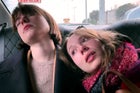
Fjord: This year’s provocative Palme d’Or winner deserves to be a major Oscar contender.

Romanian director Cristian Mungiu specializes in naturalistic dramas whose discreet aesthetic choices – long shots, few close-ups, no extradiegetic music – leave it up to the viewer to navigate the dense ethical thickets that his films set out to explore. Mungiu’s films often depict people in heartbreaking circumstances, while maintaining a respectful distance from the drama. Although he is fascinated by ideological extremes, his own perspective as a filmmaker is intentionally difficult to pin down.
Mungiu’s latest film, Fjordwon the Palme d’Or at Cannes this year. This is the second time Mungiu has won the festival’s top prize, following the brilliant abortion-themed drama 4 months, 3 weeks and 2 days in 2007. Like this film (which would easily appear in my Top 10 of 21st century to date), Fjord tackles a hot-button issue while doing everything possible not to guide the audience’s hand to a specific button. Fjord may not have the poignant power of the director’s best work, but it’s a demanding study of a contemporary social problem that’s rigorous without being clinical.
This time, the subject, loosely inspired by real events, is the clash of cultural values that can emerge as a result of immigration. The Gheorghiu family recently moved from Bucharest, Romania to a remote village in northern Norway. Mihai (Sebastian Stan) is Romanian, while his wife Lisbet (Renate Reinsve) is of Norwegian origin. They return to his hometown so that his mother can care for the couple’s five children, who range in age from adolescence to toddlerhood.
The Gheorghius are Christian fundamentalists whose lives are organized around their faith. Although we never find out exactly which religious sect they belong to, it is established early on that Mihai and Lisbet are strict but loving parents whose children are not allowed to use the internet, play video games, or dance. As the film opens, their eldest child, teenager Elia (Vanessa Ceban), apologizes to her father for an offense she committed, the nature of which the audience is never shown. “You have to learn to admit you’re wrong,” he tells her sternly as she gives him a tearful hug. This will prove to be a difficult task for every character in this film, child or adult, especially since, as the viewer will soon discover, the question of who exactly is in the wrong becomes increasingly difficult to resolve.
The Gheorghiuses enroll their children in the local public school, a seemingly welcoming and progressive institution whose principal is their friendly neighbor Mats (Markus Scarth Tønseth). Mats’ rebellious teenage daughter, Noora (Henrikke Lund-Olsen), goes after the pious, possibly romantic Elia and persuades her and her younger brother Emmanuel (Jonathan Ciprian Breazu) to sneak out of their house for furtive late-night rides on her family’s motorboat.
The family seems to be settling in well in their new secular but close-knit community, until the school’s gym teacher notices bruises on Elia’s back during wrestling class. It’s never clear that these are the results of parental abuse – earlier we saw a scuffle between Elia and Noora’s jealous ex-best friend, and the gym class itself seems harsh enough to have potentially caused the marks. But Norway’s child abuse laws are strict enough that within days, a representative from the national child protection office (Ellen Dorrit Petersen) ordered the placement of not only Elia, but all of Gheorghiu’s children, including the still-breastfed baby, into three different foster families while the parents’ child-rearing practices are investigated.
This configuration is established less than an hour later FjordThe running time is two and a half hours; with a deliberate but never dragging pace, Mungiu’s patient camera (the cinematographer is Tudor Vladimir Panduru) observes the repercussions of these events, both within the Gheorghiu family and the community at large. Eventually, this reach will expand to include the global religious right, as an outraged Mihai begins to attract a large social media following after protesting what he perceives as faith-based persecution. During a civil hearing to assess their parental fitness, Mihai and Lisbet are cross-examined not only about their attitudes toward spanking as a form of parental discipline – a practice Mihai defends as part of his traditional culture – but also about their refusal to give cell phones to their children and their insistence on daily prayer. Even as you begin to believe it’s true that the couple’s conservative beliefs could harm their children’s development, you find yourself siding with them against the officious child welfare bureaucrats who seem convinced that a single interview with two confused teenagers — both of whom say they love their parents and want to return home — is enough evidence to make all five Gheorghiu children wards of the state and possibly put their parents in prison.
Sebastian Stan is perhaps most familiar to the average American moviegoer as Bucky Barnes, Captain America’s sidekick turned Winter Soldier (a role he will reprise in the upcoming film). Avengers: Apocalypse), but he has since made a name for himself as a serious and ambitious actor, delivering a performance of great comic brilliance as Tommy Lee in the miniseries Pam and Tommy and bringing an unexpected pathos to the thankless role of a young Donald Trump in 2024. The apprenticea role that earned him his first Oscar nomination. Stan spent the first eight years of his life in Romania and later grew up in an extended family of Romanian-speaking immigrants; without knowing the language, I can only say that he alternates with complete credibility between this language, which Mihai speaks to his family, and the Romanian-accented English which he uses to communicate with his Norwegian neighbors. Stan’s decidedly unglamorous performance as Mihai, a soft-spoken but steel-willed man with enormous reserves of pride and occasional flashes of frightening anger, is what gives the film its fascinatingly unstable center of gravity, and it’s not hard to see why he might be on his way to the No. 2 nomination.
As for Renate Reinsve, even though she doesn’t physically disappear into her role as completely as Stan does in his, she is still recognizable as the gorgeous, slender star of The worst person in the world And Sentimental value— Lisbet is a very different character from the one we are used to seeing Reinsve play, not a sharp individualist but a pious and devoted wife and mother. Her big scene, a meeting with child welfare authorities during which she gradually realizes that her entire world is about to be torn apart, is a master class in the art of responding and could very well earn her a second Oscar.
Mungiu’s screenplay economically establishes that although the Gheorghius’ marriage operates according to more or less traditional gender roles, the couple’s bond to each other and to their children is genuine and deep. In the film’s most moving scene, the camera watches Mihai from behind as he looks out the window at his wife in their driveway, strapping their baby into his car seat as he is about to be taken away by a child protective services worker. Neither the face of the father nor that of the mother are visible during this long shot; it’s only through their body language (his rigid stance, his slumped shoulders) that we see how heartbreaking the moment is for both of them.
Fjord is less concerned with reconciling the tension between secular and faith-based value systems than with impressing upon the public that even the most progressive modern democracies are built around what may be an unbridgeable chasm. Like the beautiful but menacing snowdrifts that cover the mountains around the village – avalanches are frequent enough that the school has a fire drill-style protocol for pushing children inside when the snow starts to slide – the social order that Mungiu shows us seems constantly on the verge of collapse. In the final shot of the film, the sacred and the profane seem to converge in an image of almost supernatural beauty. You’ll come away from the film wondering what the filmmaker was asking you to believe about that final image and suspecting that his real goal was simply to keep you around. ask.
Gn entert