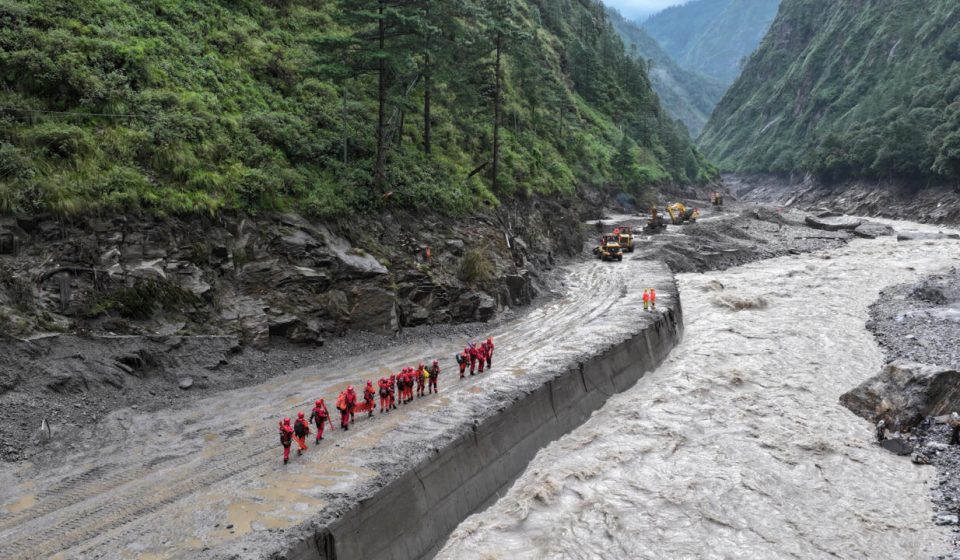
The search for survivors continues in Tibet. Rescuers searched on Friday August 28 for people buried under mud after the collapse of a section of glacier on Wednesday in a region of the Himalayas, on the border between Nepal and China.
According to official reports, thousands of mobilized rescuers have already extirpated 586 bodies – 579 on the Nepalese side, 7 on the Chinese side – not to mention 7 corpses recovered in India from rivers originating in Nepal.
Just under 2,500 people, or 1,924 in Nepal, including 517 foreigners, and 554 in China, including 260 foreigners, are still missing.
Also readDeadly floods in Nepal and Tibet: rescuers face a mountain of challenges
Nepal’s disaster agency reported that 933 workers at a hydroelectric plant were among those with whom contact was lost.
“I have not heard from him since I spoke to him that day (Wednesday) at 7 a.m.,” Sita Adhikari, whose husband is among them, told the press. “We also don’t know what the status of attempts to save them are.”
“I was at the power plant when I heard a shattering noise,” Ananay Sharma, a 29-year-old Indian engineer, told AFP. “When I came out, everything was gone except the river.”

Relatives consult the lists of missing people after flash floods in Nepal, outside a hospital in Kathmandu, August 28, 2026. © Prakash Mathema, AFP
Nepalis flocked to hospitals in the capital, Kathmandu, desperately searching for their loved ones. Posters with the photos and names of the missing were plastered on the walls, AFP journalists noted.
“It’s the third day and we don’t know anything. I hope he (my brother) is safe. (…) We lost everything and he is everything to us,” Samjhana Thing, 27, told AFP.
“Wealth doesn’t matter to me. I just want to find my son. If any of you can save him, please do it for me,” Kula Priya cried.
The collapse of a section of glacier
The United States Geological Survey (USGS) explained that this cataclysm was caused by the collapse of a glacier, triggering a vast flow of icy debris. This deluge of ice and mud also resulted in the formation of huge lakes. One of these bodies of water poses a direct threat to rescuers.
In this regard, the Nepalese police urged all rescuers to “immediately go to a safe place”, after receiving information according to which “a dam has broken again on the Tibetan side”.
Also readNepal-Tibet: what threat does the reservoir formed by the flood represent?
In Tibet, on the Chinese side of the border, relief operations had to be suspended on Friday in the hardest-hit Gyirong area due to the risk of further flooding, before the threat finally dissipated.
State broadcaster CCTV reported that a lake formed by huge piles of debris had started to overflow towards where rescuers were heading, but later clarified that the water level had fallen.
However, a first group of 21 Chinese firefighters, accompanied by a dog, were finally able to reach the area around the Gyirong border post, in the heart of the devastated area, on Friday afternoon, state media reported.
Also readNepal-Tibet: torrents of mud, submerged buildings… images of deadly floods
Place of hiking and pilgrimage
Located in the Himalayan massif, the region of Nepal which suffered this tragedy normally attracts hikers and mountaineers from all over the world. It is also a place of pilgrimage for Hindus and Tibetan Buddhists.
An Indian woman who was participating in a pilgrimage around the sacred Mount Kailash, in Tibet, told AFP that two of the three buses carrying her group of 57 faithful were swept away by the mudslide on Wednesday.
“Suddenly, we were caught in a kind of fog, of smoke, which enveloped everything,” testified Sivaranjani Muthunathan, 46, showing a video of the torrent which swept through the convoy, made with his phone.
This disaster is the deadliest in Nepal since the 2015 earthquake in which around 9,000 people died. In 1993, historic floods caused more than 1,300 deaths there.
Difficulties in accessing the disaster areas make it difficult to assess the damage.
“According to current estimates, some 93,000 people may have been affected,” noted the representative of the International Federation of Red Cross and Red Crescent Societies (IFRC) in Nepal, David Fisher. “The trauma will be enormous.”
In Nepal, flood alerts after deadly lake rupture
An extension in your browser appears to be blocking the loading of the video player. To be able to watch this content, you must disable or uninstall it.

Cover image: © France 24
Floods and landslides are common during the monsoon – between June and September – in Nepal, Tibet and throughout South Asia. According to scientists, climate change is increasing their intensity and frequency.
With AFP