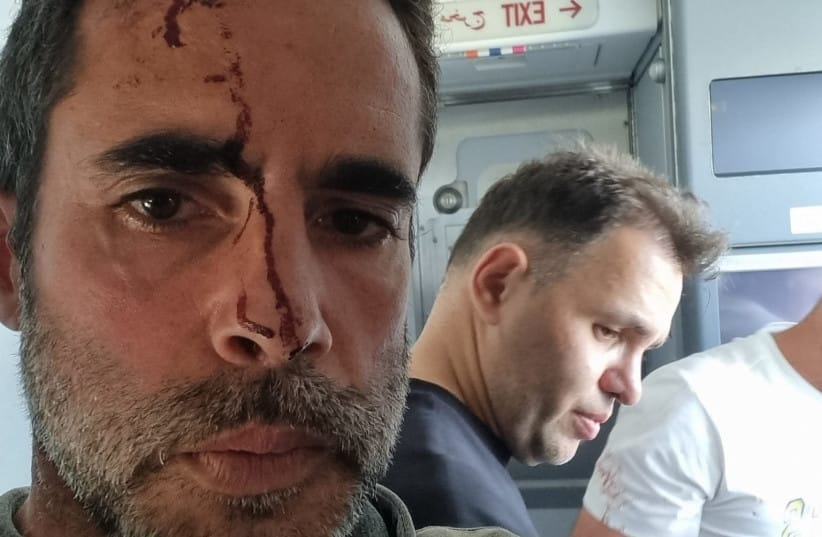

Eleven days after helping to subdue the co-pilot accused of trying to crash a flydubai flight to Israel, passenger Asaf Rajuan wants two flight attendants who were on board to be investigated. He also requested that the two other pilots who were traveling and who landed the plane in Saudi Arabia be questioned.
Talk to The Jerusalem Post On Sunday, Rajuan said he suspected the officers helped the attacker. He described confrontations with passengers, objections to the filming and exchanges between the two men that made him fear the danger would persist after the co-pilot was restrained.
The September 30 flight from Dubai to Tel Aviv was diverted to Tabuk, Saudi Arabia, after the co-pilot attacked the captain with an emergency ax from the plane.
His allegations remain unfounded. The United Arab Emirates’ account Friday credited a flight attendant with helping subdue the attacker. The co-pilot admitted to having acted alone, while specifying that investigators were still looking for accomplices and other links.
Rajuan wants Israel to be involved in establishing what happened. During our conversation, he kept coming back to the behavior of the crew and the difficulty of knowing who to trust while the plane was still in flight.

He was returning from Phuket, Thailand, with his wife and their two daughters, aged approximately 12 and 14. He was sitting in 7D when a woman ran down the aisle screaming that someone had a knife. He looked towards his family and saw them thrown into the air.
He thought he would see his daughters die.
He ran forward. The captain’s resistance had already weakened the attacker, Rajuan said, making it easier for passengers to overpower him. He suffered a small head injury and emerged covered in blood, much of which he said was not his.
Suspicions about the attendants
Rajuan made his most specific accusation in an interview with N12’s Ulpan Shishi, broadcast on Friday. He alleged that an officer began to loosen the attacker’s restraints after the passengers subdued him. Several passengers noticed the man and challenged him, he said.
He also described an attendant approaching the injured captain with a tablet while the captain was receiving medical treatment. Rajuan said the passengers intervened because they didn’t understand why someone was trying to give him a pill in that condition.
“I don’t have any proof,” he said when asked if the officers cooperated with the attacker.
In the Post interview, Rajuan described grabbing, pulling on clothing and repeated confrontations with attendants. One of them asked if he was a police officer. He remembers their physical strength and their determination to prevent the passengers from filming. He was worried that someone might produce another weapon.
There was even uncertainty about the direction of the plane. Passengers checked GPS locations and came up with competing answers: Iraq, Jordan, Saudi Arabia. Rajuan wondered if they were still being hijacked.
“I became paranoid,” he says.
He admitted that he had started to suspect everyone. Still, he wanted investigators to look at the specific encounters he and other passengers remembered, including the officers’ interactions with those guarding the attacker. He described an atmosphere of mutual fear and pressure that persisted after the immediate struggle ended.
The drivers who took over
Rajuan also wanted to know what happened to the two additional pilots. He said he searched for their public accounts and couldn’t find them. On the N12, he remembers seeing the pilot who saved the plane for the last time as he disembarked.
Their presence on board flight FZ1073 has an explanation that we reported on September 30.
There were four pilots: the attacked captain, his co-pilot and a second flydubai cockpit crew traveling in the passenger cabin. The additional captain and co-pilot were available to operate the return flight from Israel.
A person familiar with the matter told the Post that possible regional diversions could add hours to the flight and leave the operating crew beyond their authorized work hours. The additional pilots had been assigned as a manning precaution, without prior warning of an attack.
When I interviewed Tal, an Israeli businessman aboard the flight, at the Carlton Hotel in Tel Aviv on October 1, he described having to keep these men moving forward while other passengers fought off the attacker.
“I had to shake them so they would move forward and take control of the plane,” he said.
Tal remembers an interval when the cockpit was empty. A pilot finally took control; the other, he said, took longer to recover from the shock. We have not independently established the duration of this interval or the precise sequence inside the cockpit.
The UAE account describes the relieving captain noticing unusual movements of the cockpit door, entering with an access code and helping passengers and a flight attendant subdue the attacker. He and his co-pilot then regained control and landed in Tabuk.
It didn’t address Tal’s account of their initial hesitation or the empty cockpit.
Rescue pilots spoke to investigators: Prosecutors said they took statements from both men. The press release does not name them.
Our interviews recreated the emergency from the passenger cabin: people fighting at the front, an injured captain being treated, two other pilots pushed towards the controls. Rajuan wants the men who ultimately flew the plane to give their own account, including what they saw about the behavior of the attendants.
“I hope Israel will investigate properly,” he said. “Because it’s something that needs answers.”
Gn world