What is this?

©安田佳澄/小学館/「フールナイト」製作委員会
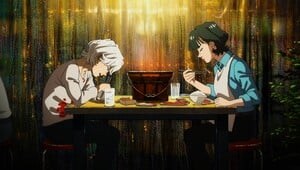
In a world perpetually covered in clouds, humanity continues to survive only thanks to special plants that draw their energy from the human soul rather than the sun. These plants grow inside a living human for two years before taking root and fully transforming the subject. The government offers a generous cash stipend to all who volunteer, attracting both the terminally ill and the poor.
Crazy night is based on the manga of the same name by Kasumi Yasuda. The animated series is streaming on Netflix.
How did the first episode go?

©安田佳澄/小学館/「フールナイト」製作委員会
Richard Eisenbeis
Episode 1 ranking:
Honestly, I feel bad about my reaction to this first episode. I have no problem with stories of giant transforming robots, cyborg old men, heroes summoned in myths and legends, or magic of any kind. Yet for some reason I just can’t accept the idea that because the clouds have permanently blocked the sun, the only way to survive is to turn people into genetically modified plants that can grow in the dark and purify the air of carbon dioxide.
I mean, we can already grow plants with artificial light. Given that the process from man to plantation takes two years – and occurs entirely on a voluntary basis – the cloud cover was clearly a gradual thing that took time to achieve. So it’s not like increasing UV light production isn’t a possibility. But all technology aside, why are humans needed for this process? Are you saying animals wouldn’t work as well? What about chimpanzees? They are 98% genetically similar to humans. Surely chimpanzee breeding would be much more efficient than waiting for people who are about to die and want 2 more years to party?
But of course, the how and why are not important. The setting is just a way to explore ideas like having a terminal illness, living with an unmedicated person with extreme mental illness, and finding meaning in a world where simple survival is hard enough. For the most part, the first episode does a decent job of this.
Toshiro is one of those people who had big dreams, little talent, and a terrible family life – he never really had a chance. Meanwhile, Yomiko was lucky to find a job that was stable and easy, but one that required her to kill her emotions and treat people’s misfortune as nothing special. Being reunited after 15 years shakes them both to their core, and their renewed friendship seems to make them both happier than they were alone.
Overall, I like pretty much everything about this series except the setting. There are good characters and a fantastic setting. Maybe if I try hard enough, I’ll be able to suspend my disbelief in the future – ignoring how much this premise bothers me. We’ll just have to see.

©安田佳澄/小学館/「フールナイト」製作委員会
Episode 2 ranking:
It is with this second episode that we get a clear idea of how Fool’s Night is structured as a series. Basically, it’s a typical “one person can speak with the dead” drama: every episode, Toshiro meets a new person whose family member or friend has turned into a plant and he will help them solve their unresolved problems.
This time around, Toshiro is tasked with helping Sumi Matsuno, a famous pianist whose father, Shogo, spent his transfloration allowance on Sumi’s musical education and then disappeared. But even though this act of self-sacrifice gave Sumi the privileged life she has today, it doesn’t change the fact that he was a child molester, a man who beat her every time she refused to continue practicing the piano.
The question here is complex. Did Shogo love his daughter? Yes. Did he beat her? Yes. Did he force her to lead a life she didn’t want? Yes. Did he think doing all this was in his best interest? And yes. What we are supposed to understand through this story is that no one is 100% good or 100% bad. You can love your child, lay down your life for your child, and still be a shitty parent.
It’s more than anything else that ruins Sumi. She has memories of love and memories of trauma. She sees that, logically, he was right. Without her abusive training, she would live a much poorer life in this distopian world. But that doesn’t make the pain go away.
My only real complaint about this episode is that it takes the easy way out. Shogo’s belief that what he was doing was right was so strong that he died. The idea that a few tears from his daughter could now change his mind is almost insulting. If Shogo were a man capable of realizing his own flaws, neither he nor Sumi would be in this situation in the first place.
That said, Sumi’s idea of shrinking it down and making it a piano – even metaphorically – is a solid ending. She transforms both trauma and love into art. She uses the impact of his existence to change his game from the robotic teaching he imposed on her into something full of passion – something he wouldn’t like to listen to but normal people would.
I don’t know if this counts as a happy ending, but it’s as close as many people can hope to get.
Gn entert