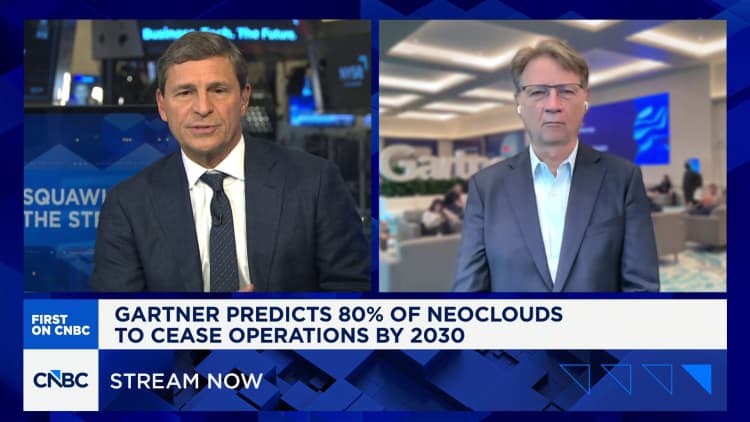


Wall Street research and advisory firm Gartner is maintaining its forecast that $3.5 trillion in AI investments could be in trouble due to profitability issues among leading AI models.
Gartner’s forecasts, released last week, helped send shockwaves through the AI sector. The company’s chief forecaster, John Lovelock, told CNBC on Monday that returns are not yet sufficient for the scale of investments.
Consolidations and takeovers of AI companies, known as neoclouds, could follow, in part because of a shift in timing, he added.
“Right now we have more computing capacity than demand, and a lot of the tokens and processing power are being given away in freemium solutions,” he told CNBC. “Everyone in the AI race is fighting for a last-man position. Nearly every market Gartner tracks in our AI race is at risk of collapsing and becoming a duopoly.”
This duopoly for leading frontier business models consists of Anthropic and OpenAI. The asset base of computing power built by neoclouds to serve this duopoly requires a degree of cash flow for these companies that is not yet commensurate with the investment, Lovelock said.
Neoclouds would not cease operations en masse, Lovelock reiterated, but could be subject to consolidation, such as buyouts and mergers.
Following its business case, Gartner predicted last week that 80% of neoclouds, which are providers of computing power dedicated to AI, could cease operating as independent companies.
Neoclouds were hit hard last week, helping to drag down the rest of the stock market with them.
CoreWeave fell 25%; Nebius fell 25%; And IREN fell 16%. THE S&P500 ended down 2% and the Nasdaq Composite fell 4% for the week ending October 16, while the Dow Jones Industrial Average ended up 0.7% as investors moved away from technology stocks.
CoreWeave was up about 2% as of midday Monday, while Nebius was up 3.3% and IREN was ahead 5.6%.

CoreWeave 5 days.
Wolfe analysts said in a note Sunday that the Gartner report likely contributed to market stress.
“By late (Wednesday), the market was already looking nervous when a Gartner report was released warning that more than $3.5 billion in AI infrastructure spending could be exposed to depreciation by 2030, with neocloud providers particularly vulnerable,” Roth’s Stephanie Wolfe wrote to clients.
Lovelock also said Monday that AI is a technology as opposed to a market, likening it to table salt that will be sprinkled into existing business operations rather than creating an inherently new field in which companies will sell differentiated and competing products.
In their Wednesday report, Gartner researchers found that overall, “AI revenues will be insufficient to support profitable returns on all planned AI capital expenditures” between 2027 and 2030.
The finding comes as revenue growth at border algorithm company Anthropic slowed, from 140% growth in the second quarter to 45% in the third.
The $16.8 billion quarterly revenue level for Anthropic, which many tech analysts consider one of the pillars of the AI business, is quite low compared to the more than $5 trillion that hyperscalers are expected to invest by 2030, the pace of which is accelerating.
OpenAI’s annual revenue expectations missed by $20 billion the previous week, Roth de Wolfe noted.
Gartner was not alone in warning that investors’ calculations regarding AI development could be flawed. Chris Wood, Jefferies’ global head of equity strategy, has been warning of capital destruction in AI since at least September. Famed investor Paul Tudor Jones told CNBC last week that macroeconomic considerations will lead to a tough year for the stock market in 2027.
“(If) we sum up all the buyouts, the M&A, all the positive things that have fueled this market so much… let’s say since 2009, if I sum all that up and subtract the IPOs, the secondaries, the unlocks, et cetera, then you definitely get the most negative flow picture since 2009,” he said.
Gn bussni