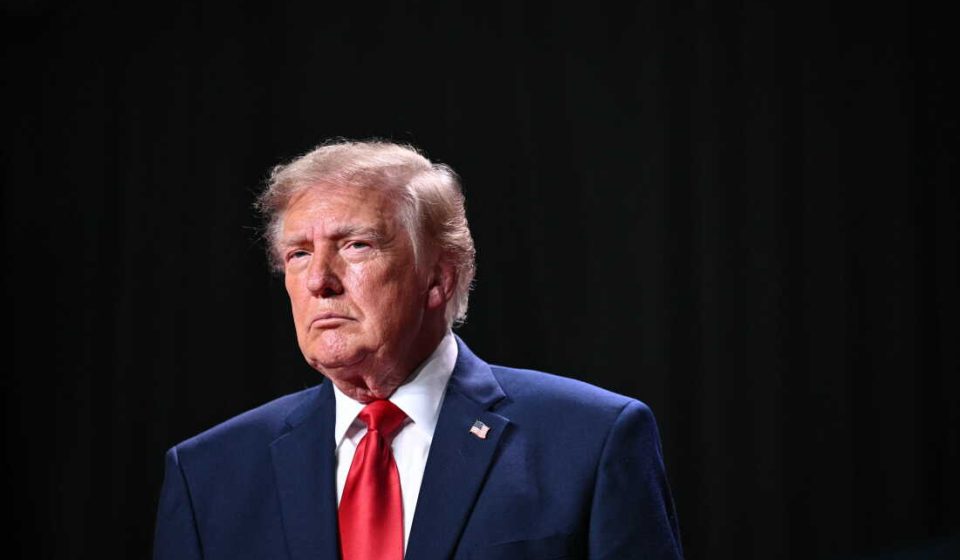


President Trump speaks at a campaign rally in San Antonio on October 7. Trump made big inroads with young voters in 2024, but some of that support appears to be waning.
Mandel Ngan/AFP via Getty Images
hide caption
Mandel Ngan/AFP via Getty Images
Gen Z Americans were a key part of President Trump’s winning coalition in 2024. Nearly two years later — and with early voting underway in several states for the midterm elections — some of that young support has faded.
That sentiment came through in a focus group last week with eight Gen Z Trump voters, who expressed varying degrees of dissatisfaction and disappointment with the state of politics, with some going so far as to say they regret supporting Trump in 2024.
The conversation was conducted virtually by Navigator Research, a left-leaning polling group. Participants were aged 20 to 29 and spanned five states: Florida, Mississippi, Ohio, Texas and South Carolina – places Trump won by double digits in the last election. Two of those states, Texas and Ohio, are home to competitive races that could be critical to control of the Senate.
For participants who now regret voting for Trump, much of their frustration centers on what they see as a series of broken promises. When asked to give a letter grade to the president’s job performance, a majority of participants, 6 out of 8, gave him a grade of D or F, while two chose C.

“I just feel like nothing went right. I just feel like everything got worse,” said John, a 29-year-old black man from Florida. (Participants agreed to be part of the focus group provided they were identified only by their first name.)
John, who identifies as Republican and has voted for Trump since 2016, gave the president an F and said he now plans to support Democratic candidates this fall, largely because of the pressure he’s felt from rising costs.
“I am ready to give the other side a chance,” he added. “I don’t think they’re going to make a total change. But things are just horrible right now for me. So I feel like even if they make one or two small changes, it will probably benefit me.”
Although the focus group was not a nationally representative survey, the frustrations shared by participants echoed the Navigator poll released in August, which found that nearly a third of Generation Z — those under 30 — regret voting for Trump, more than older generations.
Trump’s growing unpopularity with young voters is no accident. It has also lost ground to other key groups that have moved to the right in 2024, including independents and Latino voters — and in a year when the Republican Party is facing political headwinds, it’s unclear whether that expanded coalition from two years ago will be able to run with the same strength today.
Turn to the Democrats – or not
While some voters, like John in Florida, feel compelled to vote blue this cycle in response to Trump, 4 of the 8 who participated in the focus group said they still plan to support Republicans this year. Three said they would vote for Democrats; one participant said she was still deciding.
Matthew, a 25-year-old black man living in Texas, said he doesn’t regret his support for the president and gave him a C grade.
“I feel like he did a really good job closing the border,” he said. “I also appreciate his efforts to try to end some of the conflicts that started under the last administration, besides the fact that the Iran conflict didn’t really work out the best, from my point of view.”

He plans to vote in the midterm elections and has argued that Trump would be able to achieve more of his agenda if Republicans can win larger majorities in the House and Senate, even though national polls indicate the Republican Party is more likely to lose seats.
But enthusiasm is another matter.
Courtney, a 20-year-old white woman living in South Carolina, said she doesn’t regret her vote for Trump in 2024 and broadly aligns with Republicans, but she admitted she has become more distrustful of the two major political parties, particularly when it comes to foreign policy.
“I really feel like we would be in this situation anyway. …Education, the economy, everything else would be much better if we didn’t pump money into other countries that aren’t ours,” she said, referring to U.S. aid to Israel and the decision to go to war with Iran.
“I don’t think it matters which side you vote for — that’s why I voted red, because I agree more with these policies — but at the end of the day, what we do in the Middle East is not going to depend on which (ruling) party at all,” she said during the focus group.
This sense of political disaffection could underscore a growing challenge for Republicans and Democrats as both try to reconnect with this generation.

“While we see people regretting their vote for Trump, sour toward the Republican Party and Republican politics, that doesn’t necessarily mean they’re moving directly toward Democrats,” said Melissa Toufanian, chief executive officer of Navigator.
Toufanian points to Navigator’s own polling, which found that while the Republican Party has lost confidence on economic issues, “it’s not one for one with Democrats gaining that confidence.”
“A lot of people gravitate toward that middle, that category where ‘I don’t trust either party,’” she said. “We’re seeing people becoming more and more pessimistic about our political parties and our political system, and they’re not really convinced that either party can actually meet their expectations.”
Gn headline