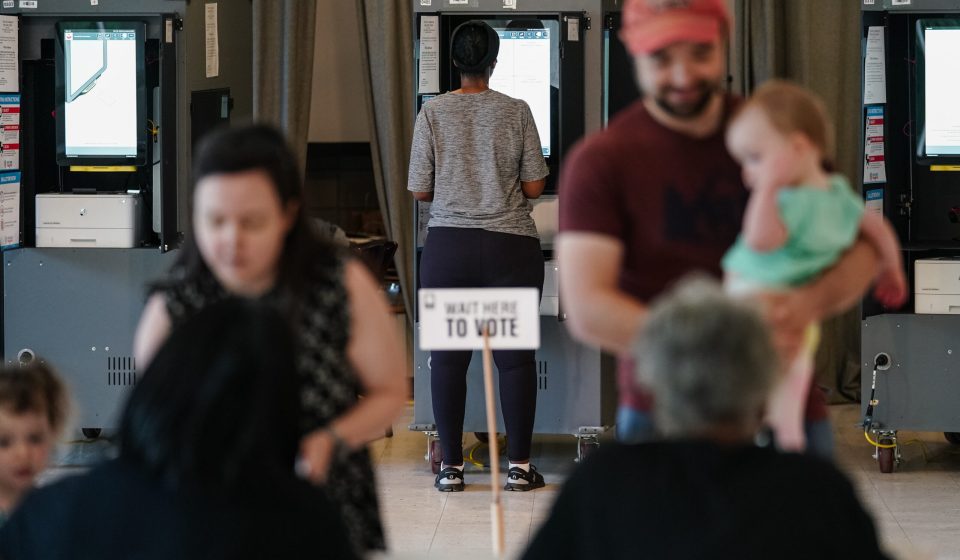
Georgia’s GOP-controlled election board asks DOJ to declare state’s voting machines illegal

Georgia’s Republican-controlled Board of Elections on Thursday called on the Department of Justice (DOJ) to declare the state’s election system illegal ahead of the upcoming midterm elections.
In a letter Thursday, State Election Board (SEB) Executive Director James Mills (R) asked the DOJ to “prohibit” the state’s use of voting machines previously certified by the federal government.
Mills also asked the DOJ to “set a binding six-month deadline” to force the state to phase out the machines he asked it to deem illegal.
This request constitutes an extraordinary attack on Georgia’s election system by unelected officials appointed to craft and enforce the state’s election rules. It was also sent despite several SEB members — including the president — denouncing federal involvement in state election procedures.
The DOJ does not have the legal authority to declare voting machines illegal or to unilaterally seize voting equipment, because the U.S. Constitution gives state and local authorities the power to administer elections.
However, the letter comes after President Donald Trump repeatedly attempted to exert greater control over state election procedures, including what machines can be used to vote. In particular, election deniers have repeatedly attacked Georgia voting machines since Trump’s defeat in the state in the 2020 presidential election.
Mills’ letter concerns Georgia’s electronic ballot marking devices, which voters use to make their selections. These selections are then encoded into QR codes which are then scanned by tabulators during the vote counting process.
Specifically in his letter, Mills asked Assistant Attorney General Harmeet Dhillon, head of the DOJ’s Civil Rights Division, to declare illegal “the use of voter tabulations based on an unreadable and unverifiable QR code and any other electronic tabulation method that does not allow the voter to verify which vote is actually counted” under the Help America Vote Act (HAVA).
Voting machine experts have recommended that states abandon ballot marking devices that encode votes as barcodes or QR codes. However, the bipartisan U.S. Election Assistance Commission (EAC), created by HAVA to test and certify voting equipment used in U.S. elections, has certified the Georgia voting machines.
In fact, Georgia law prohibits election officials from using voting equipment not certified by the EAC.
Dominion Voting Systems, a voting machine company that was at the center of baseless election theories, manufactured most of Georgia’s voting systems. The company has since been purchased by Liberty Vote.
At a meeting earlier this week, three SEB members passed a resolution ordering Mills to seek help from the Trump administration in a crusade to force a last-minute software update to the state’s voting system.
Carolyn Roddy, the Republican Party appointee to the SEB, introduced the resolution and was joined in passing it by Vice Chair Janelle King, who represents the state House Republican on the board, and Salleigh Grubbs, the appointee of Georgia Lt. Gov. Burt Jones.
Grubbs supported it even though she called herself a “strict constitutionalist” and said she opposed federal involvement in state election matters.
John Fervier, chairman of the board and an appointee of Gov. Brian Kemp (R), strongly opposed the resolution, saying it invites the federal government to become directly involved in state affairs.
“I have a fundamental problem with federal involvement in Georgia elections,” Fervier said. “I just fundamentally disagree with that.”
Mills also copied U.S. Attorney General Todd Blanche and Homeland Security Secretary Markwayne Mullin on the letter.
In a separate letter to Blanche earlier this year, Mullin asked the DOJ to declare bar or QR coding machines illegal under HAVA.
Mills called on the Trump administration to interfere with the state’s election system even as Georgia is in the process of completely overhauling how it conducts elections.
Earlier this year, a Georgia special committee embarked on a multi-year effort that is expected to lead to the phasing out of QR-coded ballot marking devices for most voters. However, under federal law, ballot marking devices must still be made available to the public, particularly to voters with disabilities who may not be able to complete a hand-marked ballot without assistance.
This story has been updated with additional information throughout.
Gn usa