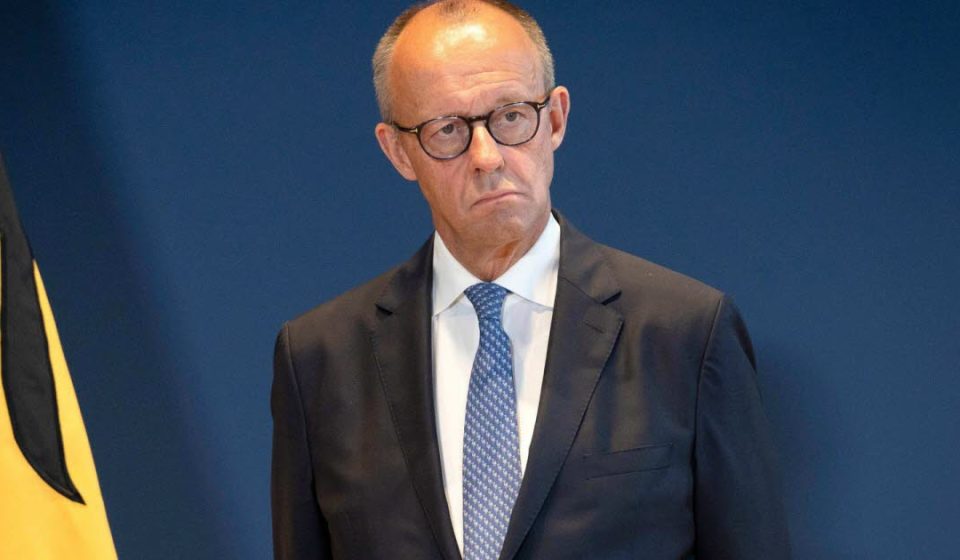

Nothing is going well for German Chancellor Friedrich Merz, who alienated his party after last Friday’s ministerial reshuffle. The head of government is multiplying political errors which could cost him dearly, especially if his party suffers a heavy defeat in the regional elections next September.
Critics within his party, the Christian Democratic Union (CDU), are becoming more and more open, which contrasts with the usual restraint of the party’s leaders. For some, the question is no longer whether the chancellor will be replaced at the head of the government coalition, but when and by whom. The dismissal of the popular Transport Minister Patrick Schnieder caused trauma within the CDU. The method used by Friedrich Merz did not help matters: the minister learned that he was being ousted from the government through a telephone call while he was on vacation. The successor who had been chosen by the chancellor resigned from the position before being replaced by Steffen Bilger, another member of the CDU.
The use of GPA creates discomfort
The reshuffle which ignited the situation was triggered by the resignation in mid-July of Jens Spahn, the former head of the CDU parliamentary group in the Bundestag. Friedrich Merz’s long-time rival was in an untenable position after confirming he had become a parent with his husband through a surrogate mother in the United States. Surrogacy (GPA) is prohibited in Germany, as in France. The CDU recently came out in favor of maintaining this ban. The affair caused a stir within the conservative party because Friedrich Merz had congratulated Jens Spahn on the birth of his child before backpedaling and demanding that he resign.
His successor was overwhelmingly elected head of the CDU parliamentary group this Wednesday. Thorsten Frei, who until now was head of the chancellery, obtained 170 votes out of 185 deputies present. Despite this score, the atmosphere remains tense within the CDU. Friedrich Merz is facing the most serious political crisis since he came to power in May 2025. The “black-red” coalition, which brings together the CDU-CSU and the social democrats of the SPD, is facing an inexorable rise of the AfD. The leading opposition party, the far-right party is leading in the polls at the federal level.
The German chancellor is on reprieve until the regional elections, which will take place next September in three Länder in eastern Germany, in Saxony-Anhalt on September 6, then in Berlin and in Mecklenburg-Western Pomerania on September 20. Friedrich Merz and his government are very unpopular, in particular because of the poor economic situation in Germany which is emerging from two years of recession. In 2025, Europe’s leading economic power will lose an average of 10,000 industrial jobs per month. The automobile giant Volkswagen plans to eliminate 100,000 by 2030. In the midst of the doldrums, the country has halved its growth forecasts, bringing them down to 0.5% in 2026.