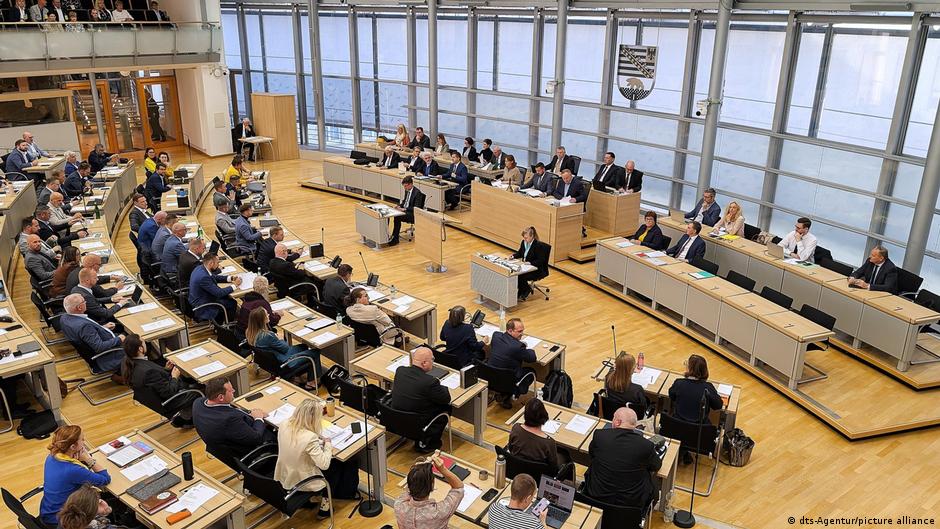

The parliament of the state of Saxony-Anhalt, in the east of the country, is demanding an immediate end to all German financial and military aid to Ukraine. The motion was passed in an extraordinary parliamentary session with votes from the far-right populist Alternative for Germany (AfD) party and the Alliance for Social Justice and Economic Reason (BSW), which combines left-wing economic positions with right-wing populist positions on immigration.
Both parties are urging current Saxony-Anhalt state premier Sven Schulze of the center-right Christian Democratic Union (CDU) to advocate to the Bundesrat, Germany’s upper house representing the states, for peace negotiations with Russia.
However, since the Länder do not have specific foreign policy powers, the proposal will not have a direct impact on Germany’s Ukraine policy.
Speaking on behalf of the BSW in the state parliament, lawmaker Claudia Wittig called on the prime minister to act: “It is your responsibility to finally use all available avenues to work for peace.”
The proposal attracted strong criticism from all other parties. “Anyone who demands a ceasefire only from the attacked side is not calling for peace, but for capitulation,” said CDU MP Stefan Ruland.
AfD and BSW move closer to Russia
The extraordinary session took place against the backdrop of ongoing negotiations on the formation of a new state government of Saxony-Anhalt. The AfD emerged as the clear winner in the September 2026 elections, obtaining just under 44% of the vote. However, he fell short of an absolute majority in the state parliament and will need the support of other parties if he wants to govern.
The BSW, which narrowly won representation in the state parliament, is the only party willing to enter into formal negotiations with the AfD over the formation of a government. With the AfD classified by East German state security authorities as a “confirmed far-right” party, all other parties have ruled out cooperation.
Observers see the joint motion by the AfD and BSW as a sign of closer and potentially lasting cooperation between two parties rooted in very different ideological traditions.
“What they have in common is their rejection of the political establishment, their pro-Putin stance and their criticism of Germany’s support for Ukraine,” political scientist Armin Pfahl-Traughber of the Federal University of Applied Administrative Sciences said in an interview with DW.
The BSW was founded in 2024 as a break with the Left Socialist Party. Its founder, Sahra Wagenknecht, after whom the alliance was originally named, had long been a controversial figure on the German left and advocated sweeping changes in German economic policy. She was the most prominent representative of the Left Party of the so-called “Communist Platform”, which maintained close ties with Russia.
Over time, however, his socially conservative positions and criticism of German immigration policy came under increasing scrutiny within the party. These growing tensions eventually led to his departure from the Left Party and the founding of the BSW.
The AfD has also repeatedly expressed sympathy for Putin’s system. Shortly after the start of Russia’s war against Ukraine, Björn Höcke, the influential AfD chairman in Thuringia, described Russia as a “champion of a world of free and sovereign states.”
Historical parallels
The growing rapprochement between the two parties made headlines following a meeting in early October. At the invitation of a far-right publishing house, representatives of the AfD and BSW met in Saxony-Anhalt for what was described as a confidence dinner. Also present were controversial figures from the far right and the dogmatic left. According to their own testimonies, participants from both sides explored the possibility of closer cooperation in a cordial atmosphere and in the spirit of mutual trust.
Jürgen Elsässer, host of the event and editor-in-chief of the right-wing magazine Compact, has for years defended the idea of a so-called “cross-front” alliance (Querfront) between the far left and the far right in opposition to the German political establishment. He has long sought to build bridges between the two camps.
Pfahl-Traughber does not see the cooperation between the AfD and the BSW as a “transversal” alliance: “I’m not even sure that the BSW can still be classified as part of the political left.” If the party’s founder, Wagenknecht, has her roots on the left, she and her allies position themselves on the economic left but on the cultural right, argued the political scientist.
Are both AfD and BSW reactionary?
Prominent German historian and author Ilko-Sascha Kowalczuk also does not consider the BSW to be a left-wing party. In an interview with DW, he said: “BSW has never been left-wing; it has always been reactionary.”
Kowalczuk sees the AfD and the BSW as threats to democracy: “The BSW and the AfD are two sides of the same coin. Both are mouthpieces of the Kremlin, both pursue similar national political goals, and both seek a comparable undemocratic transformation of the state into an authoritarian system.”
Although the recent resolution passed by the Saxony-Anhalt state parliament is unlikely to have an immediate impact on German policy towards Ukraine, Kowalczuk warns of its wider implications: “For now, the AfD and BSW remain isolated, but with positions like these they appeal to large sections of society, especially in East Germany. The erosion of solidarity with Ukraine will continue and soon expand to wider segments of the SPD and CDU.”
This article was originally published in German.
Gn world