
The rise of the Alternative for Germany (AfD) is causing widespread concern, including in unexpected quarters: other far-right European parties.
While the German party is gaining record support at home, some of its closest ideological allies elsewhere in Europe are keeping it at arm’s length.
This tension manifested itself again after the recent regional elections in Germany. In the state of Saxony-Anhalt, earlier this month, the AfD made historic progress by winning 43.8% of the vote, falling just three seats short of an absolute majority. Last weekend’s elections in Mecklenburg-Vorpommern and Berlin also showed an exodus of mainstream parties to the margins, notably the AfD.
Several far-right party leaders from the bloc offered their congratulations, including Geert Wilder of the Netherlands Party for Freedom, Viktor Orbàn of Hungary’s Fidesz and Santiago Abascal of the Spanish newspaper Vox, who hailed the AfD’s advance as “a great hope for Germany and Europe.”
But some of Europe’s largest far-right parties – notably in France, Italy and Britain – have remained silent.
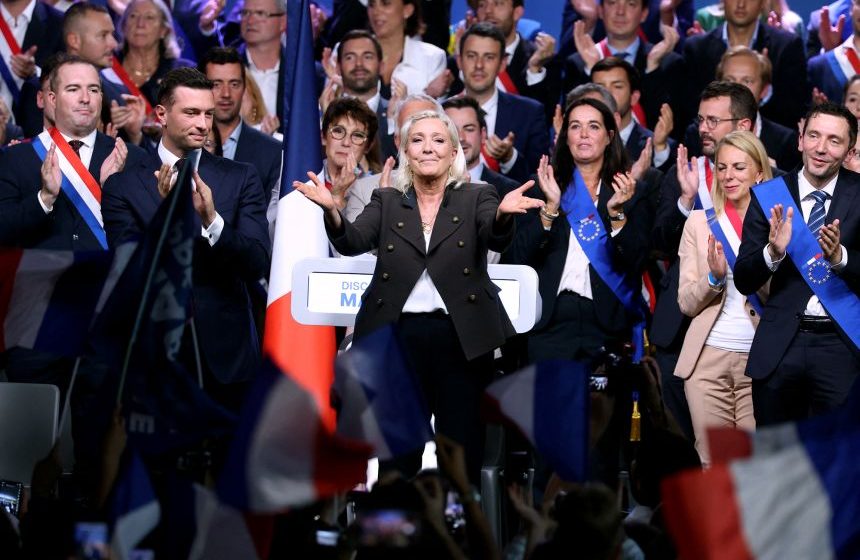
The National Rally (RN), once one of the AfD’s closest partners, had declared even before the Saxony-Anhalt vote that the resumption of cooperation with the AfD was “not planned”.
For party leader Marine Le Pen, there is a domestic but also an ideological calculation at play.
Under his leadership, the National Rally has embraced what he calls “detoxification,” moving the party away from the overt xenophobia of its roots under his father, Jean-Marie Le Pen, and toward the political mainstream.
She also worked to distance the party’s image from the stain of the Nazi past of two of its founders. His anti-immigration rhetoric is gentler, his doors open to mixed-race citizens whom his father’s generation might not have welcomed as the “good type” of French. Since the Hamas attacks on Israel on October 7, she has made condemnation of anti-Semitism a powerful tool in her rebranding.
The RN, in its former form of the National Front, had long been a collaborator of the AfD in the European Parliament. But comments from a senior AfD official denouncing the criminal role of Hitler’s SS paramilitary group during World War II as well as the emergence of a secret plan by the German party to mass expel people of foreign origin crossed the RN’s red lines. An alliance with the AfD was not compatible with the new image of the RN. In May 2024, the French party breaks ranks and ties with the German far right.

The split was evident after the AfD’s recent successes, with the RN’s senior leadership particularly silent. With the 2027 presidential election on the horizon – Marine Le Pen’s best chance of winning the Elysée – this is likely a strategy to avoid any negative blowback.
“We have real problems, both in substance and substance. We do not consider them our allies in Germany,” RN MP Franck Allisio told the LCI television channel on September 6, the day of the vote in Saxony-Anhalt.
Compared to the RN, the AfD has made no effort to purge itself of its extremist factions, even though it now appeals to a wide range of voters, said Grégoire Roos, director of Europe, Russia and Eurasia programs at the Chatham House think tank. The AfD has rejected accusations of right-wing extremism, with the party’s co-leaders previously calling the classification of “extremist” by Germany’s domestic intelligence services an attempt to “distort democratic competition”.
“Unlike the National Rally which worked extremely hard to eliminate any morally disruptive elements… the AfD did not carry out such a cleansing,” Roos told CNN.
Figures within the AfD are also comfortable talking about the Nazi era as if anything about that period of history should not be “thrown in the trash,” another aspect that makes the party unpalatable to most of its European peers, Roos said.

Eric Zemmour’s more radical far-right French party, Reconquête, however, welcomed the AfD’s victory in Saxony-Anhalt. Reconquest MEP Sarah Knafo described the results as “historic” in an election night post. “The people of Europe have shown a lot of patience. Today, they want to take their destiny back into their own hands. An entire continent is rising up,” she declared.
In this light, the AfD is not entirely alone. He contributed to the creation of the Europe group of sovereign nations in the European Parliament after his exclusion from Identity and Democracy. The smallest and most isolated group includes nationalist parties such as Reconquest, as well as Renewal in Bulgaria, Our Fatherland Movement in Hungary, New Hope in Poland and the Republic Movement in Slovakia.

Italy’s far-right Brothers have also not embraced the AfD, with party leader Giorgia Meloni, the Italian prime minister, instead pursuing a strategy to strengthen its influence within the European political mainstream.
His party sits in the European Conservatives and Reformists group, which is more integrated into the institutional mainstream of the European Parliament than the AfD’s Europe of Sovereign Nations group. The two parties have deep disagreements on foreign policy: Meloni’s party supports NATO and Ukraine, while the AfD advocates not sending weapons to Ukraine and wants to lift sanctions against Russia. Meloni called these differences “irreconcilable.”
Nigel Farage, spearhead of Britain’s far-right Reform UK party, described the AfD as a “mixed bag”.
Asked in April during a podcast with Mathias Döpfner, CEO of Axel Springer, about the main differences between his party and the AfD, Farage replied: “I think the pro-Putin stuff, I find it hard to understand.” The AfD’s ties with some dictators were “very, very difficult”, he added.
The AfD’s foreign policy positions have made it an awkward partner for many.
The party contains competing strands over Germany’s relations with Russia and the United States, while its support for closer relations with Moscow sets it apart from other European right-wing parties. He has also adopted strong anti-aid rhetoric toward Ukraine, distinguishing it from some, but not all, European populist parties.
The party is “very radical when it comes to Ukraine and Russia,” says Roos. “Listening to the AfD, one would almost have the impression that Russia did not invade Ukraine, that Russia does not commit crimes every day in Ukraine and kill civilians. » Russia has repeatedly denied accusations of targeting civilians in Ukraine.
Additionally, parties such as the French RN have made efforts to disassociate themselves from foreign powers such as Russia and China, unlike the AfD. Last year, the AfD’s ties to Beijing were highlighted when a former senior party aide was convicted in Germany of spying for China.
The AfD has also sought support from Washington. President Donald Trump congratulated his party on social media for its landslide victory in Saxony-Anhalt, ending his message with a German variation of his Make America Great Again acronym, “MGGA!”
Elon Musk, who has defended the AfD for years, also expressed his joy.

The AfD has maintained a “strong association with Trump and the MAGA movement, which in France, as in many European countries, has become increasingly unpopular,” Roos said.
Hypothetically, if the AfD were to make significant regional gains in Germany, it would likely push for a strong nationalist agenda as well as strengthening relations with Moscow and lifting Russian oil and gas sanctions at the European level, Roos said. He stressed, however, that German foreign policy falls under the Chancellor’s office, which could limit abrupt changes, even if regional support for the AfD’s positions increases.
He added that Germany’s democracy remains strong thanks to its independent judiciary and constitutional court, designed to check political power.
The growing strength of the AfD presents Europe’s far right with a dilemma. If the party continues to gain popularity in Germany, ignoring it could become more complicated. But adopting it could have a political cost for far-right parties who want to demonstrate that they can move from the political margins to government.
Gn headline