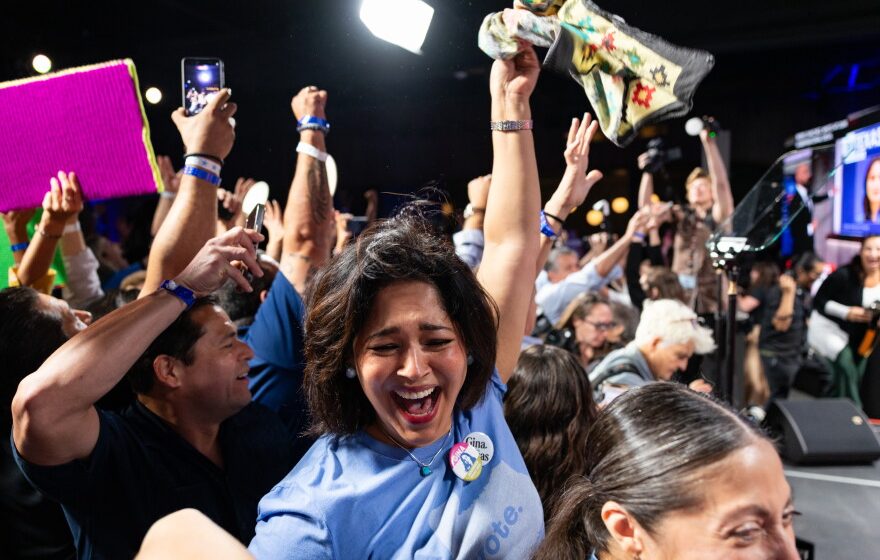

Gina Hinojosa defeated Gov. Greg Abbott in the Texas gubernatorial race, a stunning result that ends three decades of Republican control in Texas and makes her the first Latina to lead the state.
“This is what Texas said loud and clear today: Your government is yours,” Hinojosa said in his victory speech. “As governor, I will never forget him.”
At 10:17 p.m., the Associated Press called the race in favor of Hinojosa. She led with about 57% of the vote to Abbott’s 41%.
“It has been the joy of my life to have the opportunity to serve as governor of the great state of Texas,” Abbott said during his concession speech. “There are still votes to be counted, but mathematically, we are not going to be able to win this election.”
The victory deprived Abbott of a fourth term and elevated a state representative from Austin who built her campaign around public education, household costs and criticism of the state’s Republican leaders.
David Crockett, a political science professor at Trinity University, said before the election that a Hinojosa victory “would feel like an earthquake” because of Republican dominance in statewide elections for decades.
But he cautioned that a single election would not necessarily mean lasting partisan change. Democrats will have to demonstrate that they can govern effectively and defend their gains in the next elections.
“Can you get re-elected or is this a one-off?” said Crockett, describing the challenge a Democratic governor could face.
The challenge of governing
Hinojosa’s victory gives Democrats control of the governor’s office for the first time since Ann Richards left office in 1995. But how much of her agenda she can carry out will depend on the makeup of the Texas Legislature.
As governor, Hinojosa will have the power to sign or veto legislation and appoint leaders of state agencies. But major changes to public school funding, property taxes and the state’s voucher program would require legislative approval.
Crockett said before the election that a Democratic governor could use his veto to block legislation and appointments to influence how state policies are implemented. However, to pass its own program, it would be necessary to find common ground with legislators.
“To pass meaningful legislation, they will have to find something they can agree on and that will not be easy,” he said.
He highlighted public school funding as a possible area of compromise, although Hinojosa’s opposition to vouchers could create friction with Republican lawmakers who support the program.
A campaign focused on education and affordability
Abbott, first elected in 2014, will leave office in January after a 12-year term marked by conservative policies on immigration, abortion, education and border security.
Education was a central dividing line between the candidates.
Hinojosa, a former Austin school board president, opposes private school vouchers and state buyouts of local school districts. She pledged to replace Education Commissioner Mike Morath with an educator, increase funding for public schools and overhaul the state’s testing and accountability system.
Abbott defended the private school voucher program created in 2025, arguing that it gives parents more choices in their children’s education. The program allows families to use public funds to finance private education expenses, with $1 billion allocated for the 2026-2027 budget period.
Abbott also signed an $8.5 billion funding package for public schools in 2025, including $4.2 billion for increased teachers and staff, as well as funds for special education, early learning and school safety.
Both candidates also focused on reducing household costs, including property taxes.
Abbott proposed eliminating school district property taxes for homeowners through a constitutional amendment and tightening limits on property assessment increases. Eliminating these taxes would require replacing a major source of public school funding.
Hinojosa proposed cutting business grants to help finance property tax relief, as well as one-time $1,500 payments to Texas households from the state’s Rainy Day Fund.
A victory with national implications

Michael Minasi
/
KUT News
Hinojosa’s victory comes as Democrats have made gains in other major elections in Texas, including the U.S. Senate, where James Talarico defeated Republican Attorney General Ken Paxton.
Crockett and Nancy Sims, a political science professor at the University of Houston, said before the election that the national political environment could influence the gubernatorial race, even if President Donald Trump was absent from the ballot.
“If Democrats win Texas in 2026, it will be because of their anger at the federal government and at Donald Trump,” Sims told Texas Newsroom last week.
Sims said Democrats who win would have to address voters’ concerns about the economy and public education. Crockett added that sustaining these victories would require demonstrating that Democrats could govern effectively.
Hinojosa will take office in January as Texas’ first Democratic governor in more than three decades. Her next challenge will be turning a historic election victory into a governing agenda — and determining how much of the change she promised voters can pass through the Texas Capitol.
Gn headline