
Of all the criticisms leveled at Christopher Nolan’s “The Odyssey” (other than the one I have: that the entire film is a fucking mess), the most resonant, for me, was the complaint that Nolan erred in leaving the Greek gods out of the story. He certainly demonstrated that you could do a version of Homer without the gods; he did not necessarily show that this could be done without losing a crucial dimension. Besides, if you can’t see gods in an “Odyssey” movie, where will you see them?
The answer is: in a Japanese monster movie — more thrilling, by leagues, than “The Odyssey” — where the monsters possess a menacing majesty that is not of this world, even as they are laying waste to it.
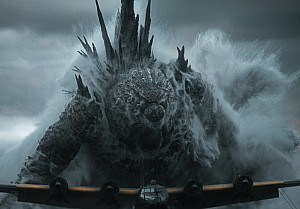
In “Godzilla Minus Zero,” premiering tonight at the New York Film Festival (opening Nov. 6), there are two oversized mystical beasts: Godzilla, the original kaiju (the character is now 72, proving that 72 is the new awesome), and King Ghidorah, the hydra dragon who made his first appearance in the 1964 kaiju classic “Ghidorah, the Three-Headed Monster.” Each is a fearsome creature, though in both cases it’s more than a matter of epic stomp or gargantuan wing power. When Godzilla raises his head to the sky, gathers his strength, and then unleashes a blast of radioactivity that can destroy a city, it’s a display of transcendence. force. And Ghidorah’s heads – which look, up close, like costumed figures from a golden dragon dance – emit orange lightning that stretches for half a mile. They are not simple monsters. They are serious movie gods.
“Godzilla Minus Zero” is set in 1949 and opens with a surprising sequence in which Ghidorah, with only one head (this will change), appears in the town of Matsumoto and destroys it. We get a grand view of the demolition, as well as close-ups of Ghidorah from the perspective of Professor Murakami (Min Tanaka), a Hiroshima survivor who conducts research on biological creatures. Godzilla will soon reappear as well, although he was thought to have been destroyed at the end of “Godzilla Minus One”. (It’s hard to destroy a god.) To save Japan, Kenji Noda (Hidetake Yoshioka), the wiry, pencil-necked, Einstein-haired director of the Office of Large-Scale Disaster Response, leads his team in hatching a plan that has a sandbox confrontational ingenuity: They will lure the two creatures into a single location and provoke them into fighting. Whoever remains standing will be injured and weakened, and human forces will then be able to finish off this monster.
When you go to see a big visual effects movie, like something from Marvel, the 12-minute closing credits will feature several armies of visual effects teams (each digital company with its own general). I have no doubt that a formidable army worked on “Godzilla Minus Zero.” But it’s also a film that features the very unusual “VFX, written and directed by Takashi Yamazaki” credits. This is a sign of the extent to which the visual effects of the film emanate directly from the imagination of the filmmaker. He writes, directs and orchestrates gargantuan and spectacular action paintings of beasts in motion. He’s a larger-than-life pop horror artist.
We’ve seen countless monster duels in kaiju films (old and new, good and bad, Japanese and American), but Yamazaki, who revived the genre and took it to a new height in the revelatory 2023 retro kaiju classic “Godzilla Minus One,” works with a quality that none of the filmmakers of recent decades have summoned: a fairy-tale innocence, an immersion in annihilating heavy metal. poetry of Godzilla – the way the destruction of a city can become a spectacle out of a dream (i.e. a national nightmare). In “Godzilla Minus Zero,” when Godzilla and King Ghidorah go at it, it’s more than a WWE match between primitive rivals. It’s a clash of the titans that will reduce everyone in the audience to a wide-eyed, gaping child.
“Godzilla Minus One” was rightly celebrated for its human story, which felt like a Kurosawa film from the 1950s. In “Godzilla Minus Zero,” Yamazaki continues this path by continuing the story of Kōichi Shikishima (Ryunosuke Kamiki), the former World War II kamikaze pilot; Noriko (Minamo Hamabe), who is now his wife; and Akiko (Sae Nagatani), their adopted daughter, who has grown into a verbally precocious seven-year-old. The fate of this family is at the heart of the emotional palette of the film. To fight the creatures, Kōichi will return to fighter pilot mode, but Noriko’s services will also be requested. She is one of the survivors of Godzilla’s attack in 1947 and now has pieces of Godzilla’s DNA embedded in her body (which is why she wears an eyepatch).
For a long time, kaiju movies were a semi-joke — a fusion of the colossal and the cheesy, and the fact that you couldn’t separate the two was part of what gave the genre its unique shlock magic. But Yamazaki transcends all that. Its staging draws on our collective nostalgic memory of the greatness of the kaiju, and it also dignifies the genre by building it on a drama staged with passion and vigor. When have we ever talked about representations in a Godzilla movie? But in “Godzilla Minus Zero,” we respond to the great anxiety of Yoshioka’s Noda, and the magnetic intelligence of Masami Nagasawa as Makoto Aoyama, a meteorologist whose intuition about storms has a hint of the prophetic. Min Tanaka, who plays the professor, is an actor born on March 10, 1945, the day of the Tokyo firebombing (the deadliest air raid in human history), and his courteous but quivering presence powerfully channels the film’s historical consciousness. Yamazaki stages some daring sequences that resemble, in their own way, his response to “Oppenheimer.” One is a fantasy of Godzilla approaching Manhattan the same way he approached Tokyo, a frightening sight for any American.
At first, when Japanese officials think they’re only dealing with Ghidorah, the film’s battles have a tactical majesty. Ghidorah heads to the mountains and hibernates, curling up like a giant snake, which makes them think they can bomb him into oblivion, using planes and weapons borrowed from the United States. But all it does is wake up the sleeping giant. The sequence in which half a dozen planes fight Ghidorah in the air is a grandiose and breathtaking film. And that’s just an appetizer, because the return of Godzilla heralds a battle of staggering immensity.
In the final section, one or two plot strands become a little tangled. The professor has a hidden agenda, and the way he wanted to achieve it remains too abstract to be completely clear. Yet as key characters come under fire, we realize how much we care about these creature fighters. They’re rooted in a time and place that feels very real, which allows the monsters to display their primal power in a way that means something. It was a stroke of inspiration on Yamazaki’s part to reset the kaiju genre to the late 1940s, the atomic era where it is spiritually rooted (the original “Gojira” was released in 1954). The creators of the new James Bond series would do well to follow suit. (This is how Bond could become vital again.) “Godzilla Minus Zero” is destined to reach a wide international audience, and it’s already clear that this won’t be the last of Yamazaki’s kaiju epics. That’s because the film proves that when you do things right, what seemed old can become timeless.
Gn entert