Gold Nears One-Year Lows, Silver Rebounds as Stocks Fall, Fed Hike Bets Persist – Kitco PM Report

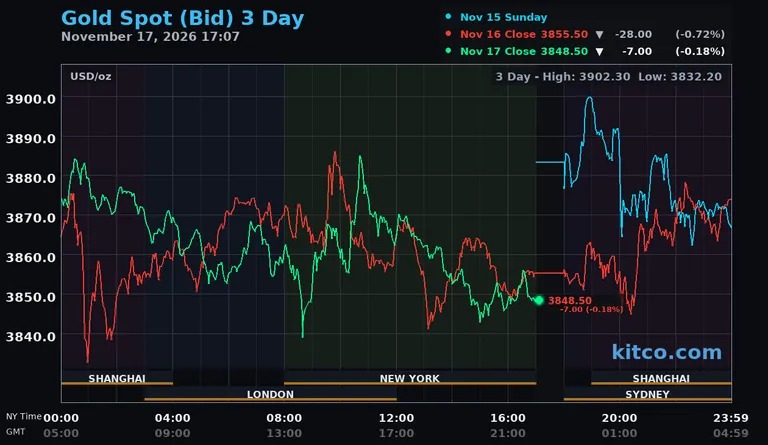
(Kitco NewsWire) – Spot gold prices were little changed Tuesday in late U.S. trading, while silver rebounded from Monday’s sharp losses as weaker U.S. economic data, falling Treasury yields and renewed geopolitical tensions competed with expectations of further Federal Reserve tightening. Gold struggled to maintain gains despite a weaker dollar and another widespread stock market selloff, while silver sparked a bargain hunt after its recent decline. Spot gold traded near $3,853.10 an ounce, down $2.40, or 0.06 percent, while spot silver traded near $47.330, up $0.472, or 1.01 percent, on the session. Gold traded between $3,836.00 and $3,891.60 during the day, while silver’s range extended from around $46.710 to $48.130.
U.S. economic reports released Tuesday provided further evidence of uneven growth, as high borrowing costs and persistent inflation continue to pressure consumers and industrial activity. October retail sales rose 0.2%, matching expectations but slowing considerably from September’s 0.8% advance. Non-auto sales rose 0.6%, above expectations for a 0.4% increase, suggesting underlying spending remained relatively resilient. Industrial production fell 0.4% in October, significantly below expectations for a 0.1% increase, following September’s 0.7% gain. Manufacturing production increased by 0.3%, while mining production fell by 0.8% and utility production by 4.3%. Capacity utilization fell to 76.4%. These mixed numbers have heightened concerns about slowing economic momentum without providing sufficient evidence that inflationary pressures have eased enough to change the Fed’s tightening path.
Market positioning remained heavily tilted toward another interest rate hike from the Federal Reserve at the Dec. 8-9 policy meeting. The last published futures valuations indicated a roughly 94% probability of a 25 basis point increase, with the remaining 6% favoring a larger 50 basis point increase. Those expectations followed stronger employment and inflation figures in October, although Tuesday’s weaker industrial production report and renewed stock selling encouraged demand for Treasury securities. The benchmark 10-year Treasury yield fell to 5.10% in late trading, while the two-year yield fell as low as 4.79%. The dollar has also retreated from recent highs, providing some support for precious metals. Investors now turn their attention to October housing starts and building permits numbers on Wednesday at 8:30 a.m. EST, followed by minutes from the Oct. 27-28 Fed meeting at 2:00 p.m. EST. Nvidia’s upcoming results and additional comments from the Fed could also influence risk sentiment, Treasury yields and expectations for December policy.
The situation in the Strait of Hormuz and between the United States and Iran deteriorated Tuesday as new military incidents and tanker attacks intensified concerns about the security of commercial shipping using the strategic waterway. Iranian drones attacked a US military radar installation in Bahrain, while US forces carried out retaliatory strikes against a missile launch site on the Iranian island of Qeshm. The crew of a ship struck twice in the Strait of Hormuz was also missing, heightening concerns over maritime security. Shipping activity had already slowed significantly following attacks on tankers operated by the Abu Dhabi National Oil Company, with ship tracking figures showing only five cargo ships transited the strait on Saturday, down from 31 the previous weekend, and none recorded on Sunday. Diplomatic efforts between the United States and Iran have remained stalled, leaving the risk of further escalation high. The resumption of hostilities supported crude oil prices and maintained a geopolitical risk premium on gold, although expectations of restrictive monetary policy in the United States and a broader sell-off in financial markets continued to limit bullion’s reaction.
Crude oil futures recovered slightly on Tuesday, as renewed risks to Persian Gulf shipping and expectations of falling U.S. inventories supported prices after Monday’s sharp decline. Brent futures rose $0.70, or 0.76%, to $93.14 a barrel, while Nymex WTI advanced $0.29, or 0.34%, to $86.01. The rebound remained limited by expectations of a recovery in Middle East exports and an emerging global oil surplus. Brent fell by around 20% in November, while WTI fell by around 16%, reflecting the substantial reduction in prior geopolitical supply premiums. For gold, renewed pressure on energy prices presents contradictory implications: a military escalation may increase defensive demand, while sustained oil-led inflation could reinforce expectations of higher interest rates and constrain the rise of precious metals.
North American stock markets finished sharply lower on Tuesday, extending Monday’s tech-led sell-off, as concerns over artificial intelligence valuations, export restrictions and corporate profits weighed on investor confidence. The Dow Jones Industrial Average fell about 849 points, or 1.6%, to close at 50,759.42, while the S&P 500 lost 1.0% to end at 7,340.53. The Nasdaq Composite fell 0.7% to 24,328.38 and the Russell 2000 fell 1.5% to 2,701.87. Semiconductor and technology stocks remained volatile ahead of Nvidia’s earnings, while financial stocks also contributed to the broader pullback. The continued decline encouraged demand for government bonds, although gold’s limited response suggested defensive buying was offset by position reductions and continued expectations of monetary tightening.
Canada’s S&P/TSX Composite Index also traded lower Tuesday, extending Monday’s 1.06% decline as technology stocks and broader weakness in risk assets weighed on the Toronto market. The index was down about 0.74% near 35,456 during afternoon trading, compared to Monday’s confirmed close of 35,722.13. Weakness in some growth-oriented companies reflected the broader deterioration of sentiment in North America, while precious metals producers faced a mixed underlying commodities market, with gold remaining weak and silver recovering. Energy stocks received some support from the rebound in crude oil. A confirmed Tuesday closing value for the Canadian benchmark was not available in the verified market figures used for this report.
European stock markets ended sharply lower on Tuesday, extending the global decline as technology stocks and financial companies came under renewed selling pressure. The pan-European Stoxx 600 index fell 1.75% to close at 650.72, while Germany’s DAX fell 2.08% to 26,045.37. France’s CAC 40 lost 1.62% to 8,216.78 and Britain’s FTSE 100 fell 1.76% to 10,689.87. Semiconductor equipment companies remained under pressure following tightened U.S. restrictions on exports of advanced artificial intelligence chips to China, while weakness in European banks contributed to the broader decline. Energy and telecom stocks showed relative resilience, reflecting rising crude oil prices and defensive sector rotation.
Major external markets see Nymex WTI crude oil futures rising after settling at $86.01 a barrel, while Brent crude finished at $93.14. The benchmark 10-year U.S. Treasury yield fell toward 5.10%, while the two-year yield fell nearly 4.79%. The U.S. dollar has weakened from recent highs, providing some relief for gold and silver despite continued expectations of further tightening from the Federal Reserve. Falling Treasury yields and renewed geopolitical tensions provided defensive support, although continued stock market weakness and concerns about tightening financial conditions dampened bullion demand. (The Kitco Global Index shows how much of gold’s current performance is driven by the dollar versus the gold market itself.)
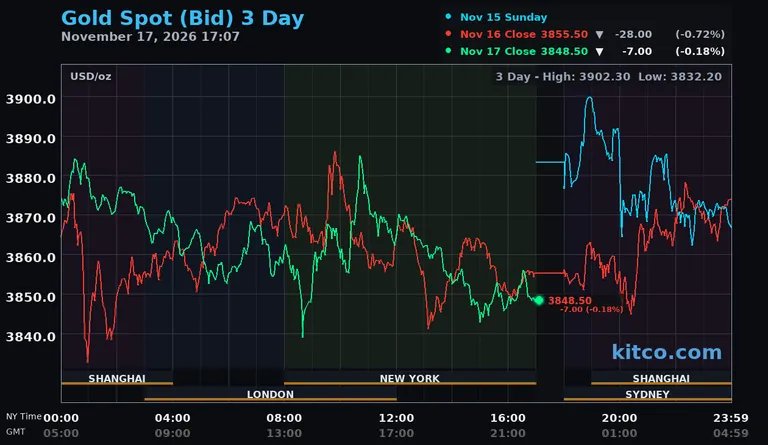
Technically, the next upside objective for spot gold prices is to push prices back above the $3,888.00 to $3,898.61 resistance zone, with a sustained move targeting $3,922.00 and then the $3,934.00 zone identified in the previous session’s analysis. The bears’ next near-term downside price objective is a break below $3,832.00, with deeper downside targets at $3,829.70 and then $3,805.00. The first resistance is seen at $3,888.00 and then at $3,898.61. The first support lies at $3,832.00 and then at $3,829.70.
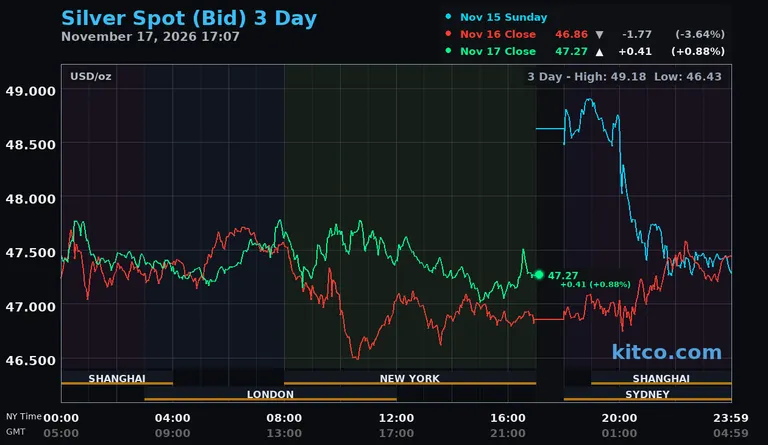
Spot silver’s next upside objective is to bring prices back above the $48,540 to $48,660 resistance zone, with a sustained rally targeting $49,840 and then $51,000. The next downside price objective for the bears is a break below $46.920, with deeper downside targets at $46.136 and then $45.580. The first resistance is seen at $48.540, then at $48.660. The next support lies at $46.920, then $46.136.
View live precious metals prices for gold, silver, platinum and palladium — in USD, CAD and 12 other currencies.
Disclaimer: The opinions expressed in this article are those of the author and may not reflect those of Kitco Metals Inc. The author has made every effort to ensure the accuracy of the information provided; however, neither Kitco Metals Inc. nor the author can guarantee such accuracy. This article is for informational purposes only. This is not a solicitation to trade any commodities, securities or other financial instruments. Kitco Metals Inc. and the author of this article accept no liability for loss and/or damage arising from the use of this publication.
Gn bussni