Goldman says AI layoffs are starting to look ‘sustainable,’ just like those over the past 40 years in history

Goldman Sachs has tracked Americans who lost their jobs to technology for four decades. The first workers laid off from jobs exposed to AI are starting to look a lot like them, the investment bank wrote in a note published Thursday.
Goldman economist Pierfrancesco Mei found that workers laid off from jobs exposed to AI since 2025 took about a month longer to find a new job than other workers laid off. They were also about 10 percentage points more likely to still be unemployed a year after losing their job. These effects are “comparable in magnitude” to what Goldman found in previous waves of technological change, he wrote, calling the damage caused by those waves “long-lasting.”
As in these waves, it is older workers who are having the most difficulties so far. AI-displaced workers aged 35 and older took about five weeks longer than other displaced workers to return to full-time work. For those under 35, it was about three weeks.
Government figures for all laid-off workers, not just those in jobs exposed to AI, show the same age gap. The Labor Department survey used by Goldman counted 7.4 million displaced workers between 2023 and 2025, compared to 6.3 million in the previous survey, which covered 2021 to 2023, the Bureau of Labor Statistics reported in August. Among those who had held their job for at least three years, 72.9% of workers aged 25 to 54 were working again in January 2026, compared to 57.3% of those aged 55 to 64 and 38.6% of those aged 65 and over.
Employers cited AI in 120,136 job cuts announced through September, about 21% of all cuts and the top reason cited, according to Challenger, Gray & Christmas’ September report.
What four decades of layoffs have done to the tech sector
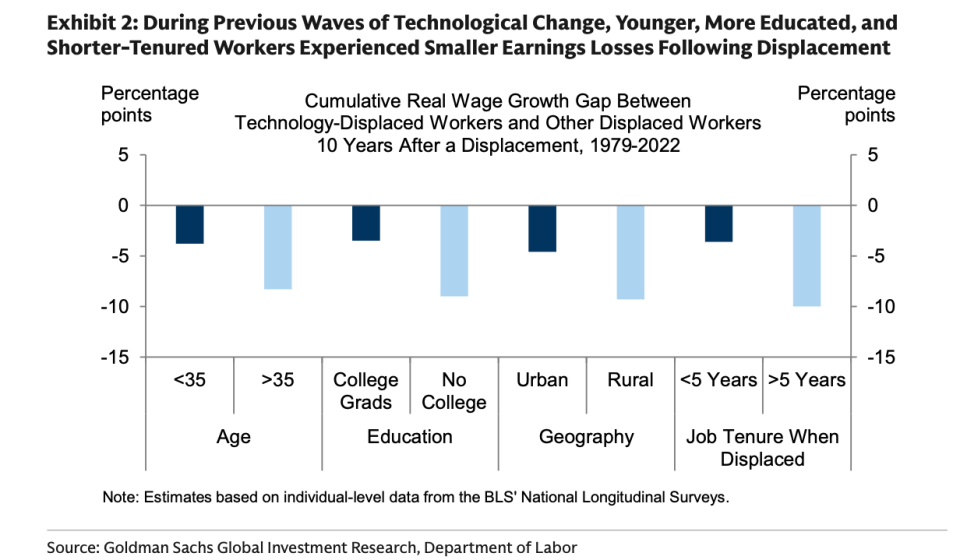
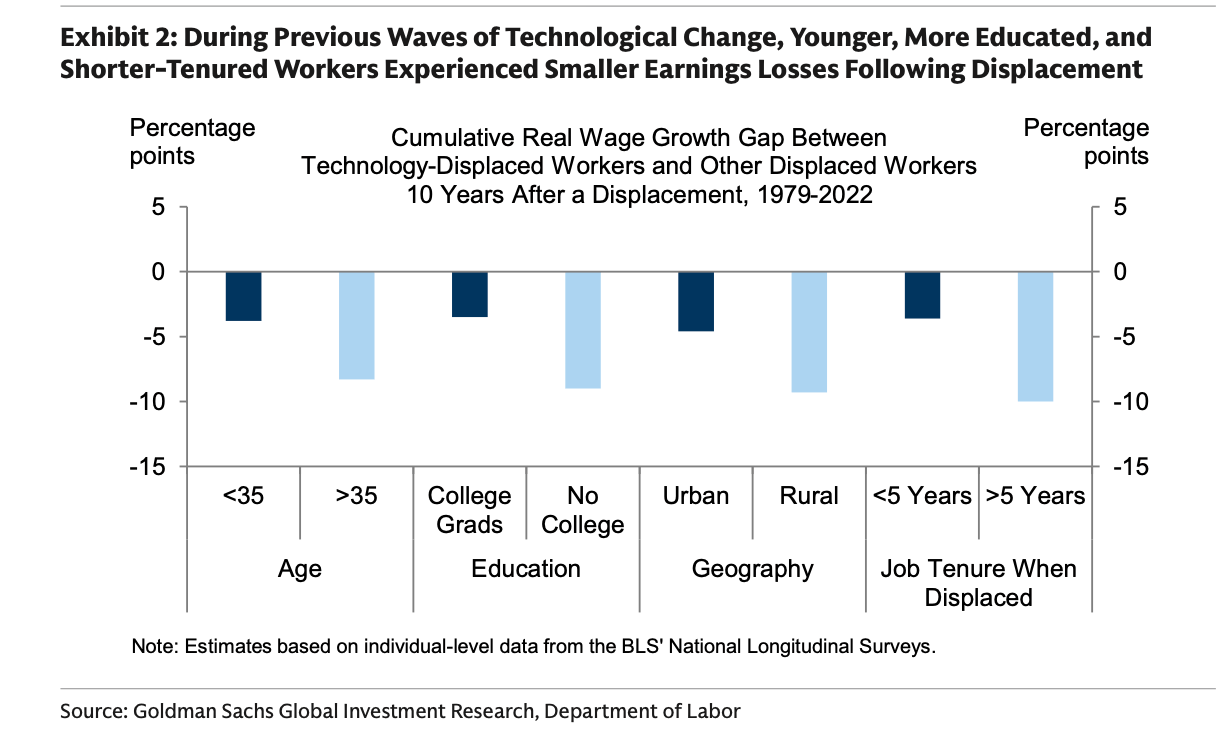
Goldman’s previous research used individual-level data dating back to 1979. It found that in the years after losing a job to technology, workers’ real earnings grew more slowly than those of other laid-off workers. Their probability of a new spell of unemployment remained consistently higher.
The wage impact is already showing up in the broader data. Among longtime workers who lost their full-time job between 2023 and 2025 and returned to full-time employment, about 49% earned the same or more as before, compared to about 62% in the previous survey, according to the BLS.
The damage was not evenly distributed. Younger, college-educated, and urban workers experienced cumulative real earnings losses about half as large as other technology-displaced workers in the 10 years after losing their jobs. Workers who lost less time on the job also performed better, “probably because their skills were less occupation-specific and therefore more transferable,” Mei wrote.
The age group reappears
The new data shows a similar trend by age. In addition to returning to full-time work more quickly, young workers displaced by AI held fewer temporary jobs along the way. They were also less likely to work a second job alongside their new full-time job.
Mei wrote that younger workers “may be able to adapt more flexibly to AI disruptions.” He called it “an encouraging sign given concerns that job losses due to AI could disproportionately affect young graduates.” Goldman also found that students are increasingly choosing majors that lead to jobs with less exposure to AI and higher growth.
Goldman cautioned that it was “still too early to assess the impact across all these dimensions,” such as education and geography.
Other research suggests that young workers are being hit elsewhere: at the front door. Stanford’s Digital Economy Lab, using payroll data from ADP, found in August that employment of workers ages 22 to 25 in occupations most exposed to AI is about 19% lower than it would be if it had kept pace with workers of the same age in jobs with less exposure.
“Experienced workers do not show a comparable gap,” wrote Erik Brynjolfsson, Bharat Chandar and Ruyu Chen. The adjustment “seems to take place mainly through a reduction in the hiring of young workers rather than through an increase in departures,” they write.
Goldman’s data only covers people who had a job to lose.
How Goldman counted
Data comes from the Displaced Worker Supplement of the Current Population Survey. This is a survey conducted every two years that asks people who lost their job involuntarily in the previous three years what happened next. Goldman analyzed more than 15,000 displaced workers who lost their jobs between 2016 and 2025. That includes recently released data on job losses between 2023 and 2025, a group said Goldman “likely captures the first wave of AI-displaced workers.”
No survey question asks whether AI cost anyone their job. So Goldman constructed a score from the profession’s exposure to AI, industry adoption rate of AI, and potential job elimination, and treated the top 30% as likely displaced by AI. Goldman found no significant gap between the two groups in job losses until 2023, when AI adoption began to increase.
Not everyone sees AI changing the entire job market yet. The Stanford researchers wrote that they “do not see widespread, economy-wide job loss associated with AI.” The Yale Budget Lab, which tracks the issue with data from the Current Population Survey, found that measures of exposure, automation, and increased AI “show no signs of being related to changes in employment or unemployment,” as the Yale Budget Lab points out. Fortune» reported Sasha Rogelberg in February.
The old model, again
In previous waves, workers who lost their jobs to technology were more likely to be rehired in more routine, less complex jobs, likely because the change that eliminated their jobs had also reduced the value of their skills. This is the kind of work the next wave of technology might require.
Goldman is once again seeing the first signs of this. Workers displaced by AI are more likely to leave their old profession and industry altogether. But when they are rehired, more of them, “especially older ones,” move into positions with similar or even greater exposure to AI.
Generative AI was used for research assistance and/or transcription of this article. The journalist independently reported and verified the factual claims in this article, and a human editor reviewed it before publication.
Gn bussni