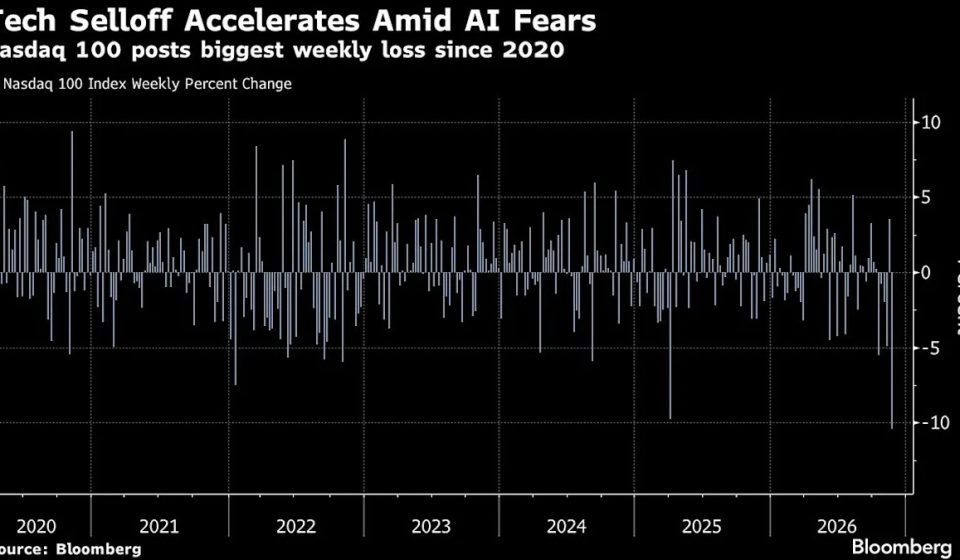
(Bloomberg) — Goldman Sachs Group Inc.’s trading desk says last week’s selloff created an attractive opportunity to buy U.S. stocks. The bank nevertheless warns that overall investor positioning remains elevated, indicating that the broader capitulation needed for a meaningful rally may be lacking.
Most read on Bloomberg
The bank’s Panic Volatility Index rose to 9.8 out of 10 on Friday, approaching historic extremes. Hedge funds have been aggressively reducing their exposure, with the bank’s brokerage data reporting a third straight week of global stock selling. Short sales outpaced long-term purchases by 1.5 to 1, while single-stock short sales in the United States reached their highest level since June 2022 at the weekly level. Fundamental long-short funds pushed a measure of their risk appetite, known as net leverage, to 42.3%, the lowest level in a year.
The unwinding of hedge fund stocks has become “quite extensive” and markets are approaching a “tactical entry point,” the bank’s trading desk wrote in a note to clients on Sunday. But some major hurdles remain: overall stock market positioning remains strong, the Federal Reserve is expected to continue raising interest rates, and future benefits from massive investments in artificial intelligence remain uncertain.
“Generally speaking, panic like the one we experienced recently was a good opportunity to start adding risk,” the bank’s traders wrote in the note. “But there are two important differences with the current configuration that we are reluctant about.”
The first major risk to a significant rally in U.S. stocks is the Fed, according to Goldman. Traders at the bank pointed to parallels with the fourth quarter of 2018, when the Fed’s tightening cycle and weakening risk appetite pushed U.S. stocks to the brink of a bear market. After a sharp decline in October 2018, the S&P 500 Index fell another 6.8% before bottoming out. In the five historical instances where Goldman’s Panic Index rose above 9 during a rate-hike cycle, the S&P 500 gained just 0.4% on average over the following three months.
The second important variable is broader investor positioning, which has not followed hedge funds in reducing equity exposure. Goldman’s U.S. Stock Sentiment Indicator, which tracks nine measures of positioning among groups such as mutual funds and retail investors, remains in the 75th percentile of historical observations. Investors have poured nearly $170 billion into U.S. mutual funds and exchange-traded funds since the start of the fourth quarter, while asset managers’ exposure to stock futures is in the 82nd percentile of figures from a decade ago.
Gn bussni