
As rural communities across the United States wage increasingly intense battles to keep AI computing data centers out of their backyards, some tech giants are mulling methods that could circumvent such local resentment — by sending the facilities into space.
There is no guarantee that the technology will work, nor is it clear whether sending data centers into Earth orbit will make economic sense. But Google is testing the waters.
The company is preparing to launch its first test satellite for Project Suncatcher, its orbital data center initiative. The spacecraft prototype is scheduled to lift off aboard a SpaceX Falcon 9 rocket for a rideshare mission called Transporter-18 at 2:18 p.m. ET (11:18 a.m. PT) Thursday from Vandenberg Space Station in California.
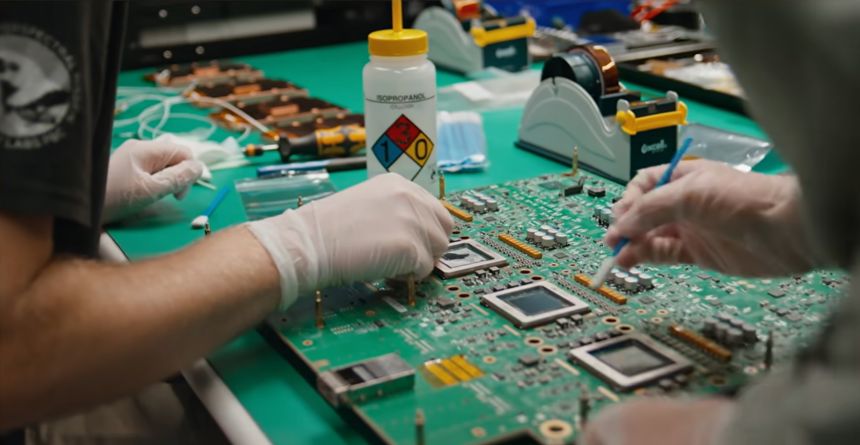
This is not the first time that AI chips have been tested in space. But Google’s experimental satellite is designed to specifically understand how the company’s tensor processing units, or TPUs, perform after experiencing the jarring forces associated with launching into orbit atop a rocket and being battered by the radiation-riddled environment of space.
“This first launch is about seeing what works, identifying failure points, and applying those findings to future missions,” Travis Beals, senior director of intelligence paradigms at Google, said in a press release.
Google plans to continue its research in 2027 by sending two additional satellites.
Radiation, heat and space traffic
Google is just one of many companies that have proposed sending data centers into space, as the race for ever more sophisticated machine learning has created an insatiable demand for computing power.
A similar idea partly fueled SpaceX’s record IPO earlier this year.
However, there remains much to see. The Earth’s orbit environment presents many technological dilemmas that need to be resolved, as Google noted in a new video series about Project Suncatcher.
Space congestion – and the risk of collisions between satellites – is already a concern, and data centers could exacerbate this threat.
For computing, the radiative environment can also create data errors, called bit flips. And hardware has a limited lifespan when it’s constantly bombarded. by high energy particles.
Attempts to simulate the space environment on the ground – conducted at the Crocker Nuclear Laboratory at the University of California, Davis – showed that Google’s TPU chips performed “remarkably well,” the company said, “but some things can only be tested in space.”
Radiation is only part of the battle. Space data centers will also face the question of how to dissipate heat.

On Earth, this process is simple – but also strains local resources – because data centers use the simple physics of convection. Cooling towers can disperse heat by evaporating water.
This solution is not viable in the vacuum of space, where there are no air molecules to facilitate the process.
So data processing satellites built to host AI will likely need huge radiators to carry heat away from their internal processing chips.
Google said it would test a combination of radiators and heat pipes to address this issue, intending to “refine our designs as we learn more.”
But importantly, the company’s satellite prototype likely won’t do much to prove the technology needed to solve the cooling dilemma.
A Google spokesperson told CNN that the test vehicle – which primarily seeks to verify the proper functioning of TPU chips in orbit – “will have to power down every 20 minutes, because we don’t want it to overheat.”
These shutdowns will be necessary even though the TPU chips will not consume as much power as would be necessary for operational satellites. Google’s test satellite will only provide about 1 kilowatt of power to the TPUs, according to the New York Times. (Google declined to comment to CNN on the test satellite’s power production levels.)
That’s far less than existing communications satellites produce — and even smaller compared to what fully operational AI data center satellites will need to conjure up, noted Caleb Henry, research director at Quilty Space, a consulting firm based in St. Petersburg, Florida.
Currently, operational telecommunications satellites operate on about 10 to 20 kilowatts, Henry noted. However, the power required for AI computing spacecraft can reach 100 kilowatts.
A new paper from Google’s research team, published Thursday in the peer-reviewed journal Joule, confirms that data center satellites may need to produce as much power as a typical data rack on Earth, or about “50 to 100 kW.”
It’s not clear how much power the two test satellites Google plans to deploy next year will generate or what heat management equipment they will have on board – but the company spokesperson confirmed they will be able to operate continuously without needing to shut down to avoid overheating. (Critically, both prototypes can test another key capability: transmitting data between them using laser communication. Such technology is nascent and has so far only been demonstrated on a large scale by SpaceX’s Starlink satellites.)
Nevertheless, the technological problems associated with space data centers can be solved.
But myriad other questions loom — each of which could determine whether tech companies like Google will still view orbital data centers as cost-effective compared to terrestrial facilities.

Placing AI computer chips in space, for example, makes it harder to upgrade hardware when better technology becomes available: AI chips “advance every 1 to 2 years, while satellites last 5 to 7 years, making hardware obsolescence a persistent challenge,” market analysis firm JLL Research explained in a June report.
The only way for orbital data centers to become more attractive than terrestrial data centers, the report concludes, is for the price of launching new satellites into space to drop significantly.
But launch costs are not going down. They are probably rising – and expected to continue to rise.
This is where SpaceX has an advantage: The company builds its own rockets and leads the industry in satellite production and orbital launch volume.
And the scale of orbital data centers could be enormous: SpaceX has announced plans to deploy a constellation of up to 1 million AI computing satellites. Google has not indicated how large it might seek to develop a Project Suncatcher constellation, but a 2025 paper suggested the company proposed operating the technology in “clusters” of 81 satellites. It’s not yet clear how many clusters Google would need to deploy for a fully operational system, the spokesperson said.
However, trends and forecasts could change, and Google says it is playing the game for the long term.
“Just as early research into autonomous driving and quantum computing required years of experimentation before arriving at practical systems, the exploration of computing in space begins with measured, deliberate steps,” Google said in a press release.
The company’s partner on the project, San Francisco-based Planet Labs, a veteran satellite operator, has indicated a similar commitment. Planet Labs referred CNN’s questions to Google.
“I think it’s a very viable project in the long term,” said Will Marshall, co-founder and CEO of Planet Labs, when asked about the Google partnership during an earnings call. “This will require significant investment in R&D – and these companies will be willing to spend money on it.”
Sign up for CNN’s Wonder Theory science newsletter. Explore the universe with information on fascinating discoveries, scientific advances and much more.
Gn bussni