
Using Google’s products and services has always been inherently insecure: It gives the world’s largest advertising company a lot of juicy personal data. Google has long said it won’t use sensitive data from products like Gmail, Drive and Photos for ad personalization, but a change to the company’s privacy policy appears to dismantle that firewall.
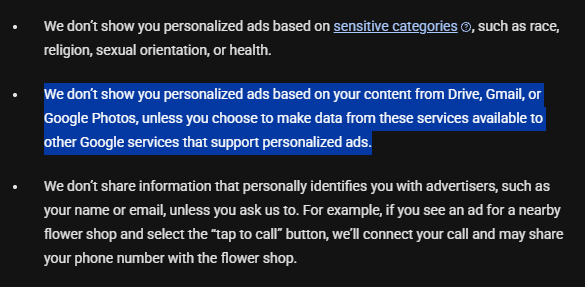
On October 16, Google released an update to its privacy policy, spotted by Android Authority. The ad personalization section previously included a clear limit on data from certain apps. “We don’t show you personalized ads based on your content from Drive, Gmail, or Photos,” the document states. Now Google has updated it with the following language.
Updated language on when your sensitive data can inform ads.
Credit: Google
Updated language on when your sensitive data can inform ads.
Credit: Google
This ambiguity opens the door to data from apps like Gmail and Photos being used in ads when shared with other Google services, and it turns out that Google has a mechanism for doing this, with Personal Intelligence. The company released Personal Intelligence in early 2026, allowing users to feed data from multiple apps to Google AI products. The idea is that added context from your existing data will lead to better AI answers, but it also turns out to be a privacy minefield.
Personal Intelligence connects your data to the Gemini app but also to features such as AI mode search. Although the Gemini app currently does not offer any advertising, you may see sponsored content in AI search tools. Google’s changes to the privacy policy appear to recognize that data shared with AI search through Personal Intelligence could therefore contribute to ad personalization.
According to Google, this clarification does not mean that the advertisements are “directly based” on your personal data. Here is the company’s full statement:
“Connecting your apps is completely optional. Ads will continue to be relevant to things like your query, response context, and interests. Ads will not be based directly on your Gmail inbox or photo library, and as always, sensitive information will not be used to personalize ads.”
Google’s statement is essentially a backdoor way of confirming that Workspace and Photos data can inform ads. If you interact with AI Mode while Personal Intelligence is enabled, your data summaries and insights may inform the answers you get. Since this same data is used for ad targeting, it is accurate to say that your personal data is an element of ad targeting in AI search. The privacy policy now makes this clear.
Gn tech