
Sony has revealed QSSR – Quick Spectral Super Resolution – bringing machine learning-based upscaling to the standard PlayStation 5. This is a refined refactoring of the PSSR scaling available on PS5 Pro, initially available for Marvel’s Wolverine and Ghost of Yōtei. We had the chance to test the technology for about six hours a few weeks ago and also spoke with Sony about how it works.
We’ve only seen the two games so far (video coming soon) very soon), but the potential here is remarkable: low resolution and poor scaling have impacted many titles this generation, but QSSR could make a big difference. In Marvel’s Wolverine in particular, the quality improvement can be exceptional.
In terms of image quality analysis, suffice it to say that temporal stability is significantly improved, the level of detail increases, sub-pixel integrity is significantly higher, while artifacts from elements such as moving foliage are significantly reduced. That said, with Ghost of Yotei, a game with already decent image quality saw less dramatic improvements.
The most immediate question you might ask is: why would Sony release QSSR when high-quality upscaling is one of the PS5 Pro’s unique selling points? The bottom line is this: the PS5 Pro has a lot more performance by offering higher output enhanced resolution and higher base resolutions as well. There remains a big gap between the same game running QSSR on standard PS5 and PSSR on Pro.
Daniel Craig, Principal Engineer for Graphics R&D at SIE, said: “It’s great to improve the PS5 at this point in the generation, allowing developers to create even better-looking games. The reality is that the PS5 Pro has 300 TOPS of hardware dedicated to this purpose and is free to choose a much more generous place on this cost/quality curve.
The refactoring of the PSSR for the standard PlayStation 5 is a remarkable achievement. The PS5 Pro has dedicated ML silicon and the PSSR, which has commonalities with AMD’s FSR 4, uses INT8 instructions. The base PS5 does not support this.
“It’s true that the PS5 Pro was designed specifically for this task, so QSSR relies primarily on the math of FP16,” says Craig. “A simplified neural network architecture brought us closer, but from there we leveraged a variety of less obvious hardware features to maximize efficiency (as console developers tend to do)… packaged math instructions are widely used. The real challenge is keeping the pipeline full and reducing or amortizing math costs.”
And while QSSR has many of the features – and the obvious benefits – of ML upscalers, it’s not a simple port. Compromises were necessary but Sony is happy with the end result:
“Game development is always about compromise, but we haven’t had to compromise as aggressively as you might think,” says Daniel Craig. “We’re closely monitoring the cost/quality curve of the model’s architecture, and the ‘hard choice’ was simply deciding where to land for the base hardware. We believe we’ve chosen a spot that developers can afford while still providing an upgrade over the standard TAA.”
The key word here is “afford”. None of the upscalers are free: they all have a computational cost and this cost should be as low as possible. Looking at the PSSR of the PS5 Pro, the upscaling time is around 2ms to 4K. To determine the cost of QSSR, I ran three tests in total: running a cutscene of Marvel’s Wolverine with QSSR on and off in performance mode, uncapped with VRR. QSSR is slower than Insomniac’s upscaler, to the tune of about 1.5ms to 1.8ms, increasing from a baseline of 864p to 1440p. This equates to a difference of 8-10 fps. However, in 60Hz performance mode, dynamic resolution scaling targets 60fps instead, where the gap narrows considerably: the internal resolution is lower to accommodate QSSR, but the output frame rate will be similar and the image quality is much higher.
I then ran the test again in uncapped fidelity mode, which targets 2160p output – a much tougher job for QSSR. The frame rate is lower for this more difficult content, but again there is a difference of 8-10fps. However, the “hit” in terms of QSSR frame time seemed to be 4.4ms. It is very high compared to the PS5 Pro alternative. Simply put, upscaling to 1440p is the most natural goal for QSSR – which is what many lower resolution PS5 games do anyway.
“Your intuition is spot on here,” says Craig (note: we didn’t share our numbers with Sony, only that 4K was a bit more expensive.) “On PS5 Pro, developers are almost uniformly outputting at 4K and adjusting the rendering resolution below that. On PS5, teams have to be more flexible, adjusting not only the rendering resolution but also their mid and final presentation goals based on the graphics mode. We provide tools and flexibility to help them find the good options for their title. This is not a universal solution.
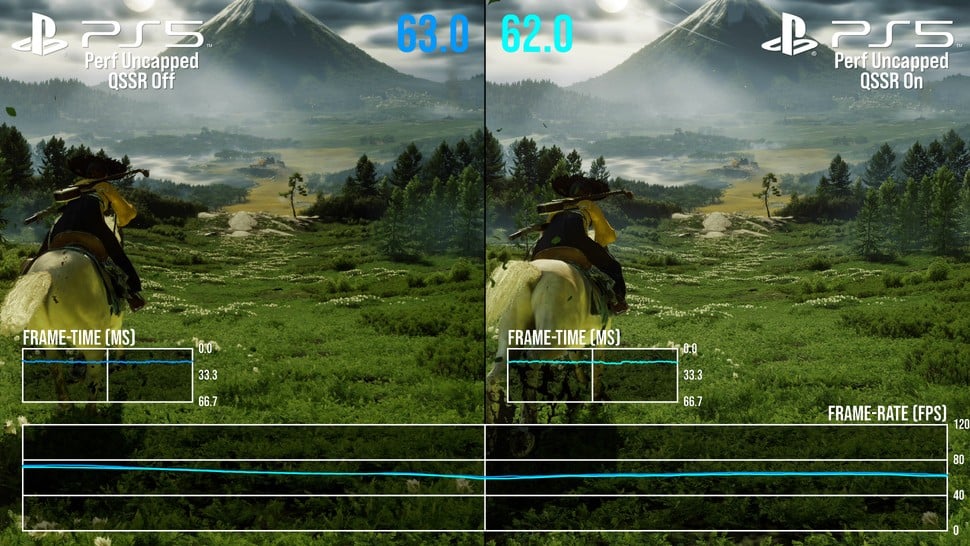
On the other hand, running Ghost of Yōtei’s performance mode without a cap with VRR allowed QSSR to perform almost identically to its original FSR 3 implementation. It’s just one game and we’ll need to confirm similar input and output resolutions, but assuming QSSR is as fast as FSR 3, that makes it a very interesting alternative for PS5 game developers. We will need more games to analyze if this is confirmed.
The integration should be relatively simple for game creators. If their title supports PSSR for Pro, QSSR for the standard PS5 shouldn’t take too much effort. “QSSR is basically a drop-in replacement for titles that already support PSSR,” explains Daniel Craig. “That said, adjusting game settings takes a little longer, perhaps a few days. For example, teams may need to adjust streaming settings to ensure mips are of higher quality.”
Similar to the PSSR rollout of the Pro, we should also expect QSSR to be added to existing games. “Upgrades are relatively easy and pose little risk, but I’m very excited about future titles written with both QSSR and PSSR in mind.”
It will be up to Rockstar to decide whether QSSR and PSSR are supported in Grand Theft Auto 6, but the fact is that the tools are there to be used – and image quality was one of our few criticisms with the recent “extended look” trailer. And more generally, many titles of this generation pushed the upscalers too hard – native 720p rarely looks appealing when upscaled to 1440p or 2160p. Now there’s a potentially game-changing alternative – and we can’t wait to test more supported titles.
Gn tech