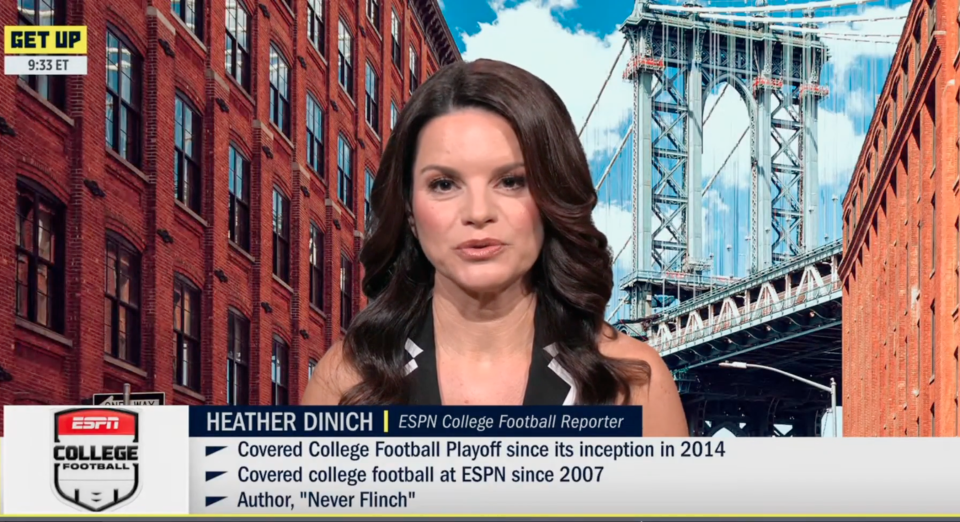
During Tuesday night’s College Football Playoff rankings show on ESPN, insider Heather Dinich revealed a new nugget of information about how the committee ranks teams.
This year, Dinich said, the committee is looking at schedule strength specifically for conference games. Dinich used this explanation to describe why, for example, South Carolina remained ranked 21st after a bad loss to Arkansas.
Almost immediately, close supporters of the CFP and the ranking process pushed back.
“I legitimately believe she thinks she’s informing us (and) has no idea how angry she’s making everyone (with) this explanation,” wrote Will Compton, an ESPN contributor.
CBS Sports reporter Bud Elliott then came up with a prediction that would ultimately prove true.
“Prediction: They will clarify this in the morning and explain that it’s about looking at the overall quality of the team you faced in your conference schedule to gauge depth and if so, great,” Elliott wrote on X.
The Athletic’s Chris Vannini also weighed in, categorically refuting Dinich’s comments.
“That’s not true. I checked this in September,” Vannini wrote on
Then, Wednesday morning on ESPN Get upDinich set the record straight. She clarified that the new metric is used to determine the strength and depth of conferences relative to each other, not the individual strengths of teams’ schedules.
“Schedules within leagues are not equal,” she said.
“It’s inside baseball, I get it, it’s true, but it’s important for people to know that it’s just a fraction. It’s a piece of the puzzle. They watch college football games too, okay?”
“Planning within the Power Four is not equal.”
Heather Dinich breaks down the strength of the conference metric… https://t.co/UJHe0Q9FU1
— Brad Crawford (@BCrawford247) November 18, 2026
However, Dinich did not appear to remedy the previous day’s mistake during the rankings show.
There’s a big difference between removing non-conference games from calculating a team’s strength of schedule and simply using the results to compare teams within the same conference. The committee has the difficult task of trying to pit, say, Indiana and Texas against each other given the very different contexts of their seasons. A metric like this seems useful.
However, many fans are already assuming the committee and ESPN are in the bag for the SEC. The way Dinich explained the new measure would clearly benefit the SEC, essentially letting it play against itself.
Explaining that in ESPN’s rankings is exactly what Dinich is supposed to do. The next morning’s correction is the correct way to handle the error, but the rankings theoretically exist for the sake of transparency, and college football fans didn’t quite get it in this case because Dinich subtly corrected the record without responding to his earlier quote.
Gn sports