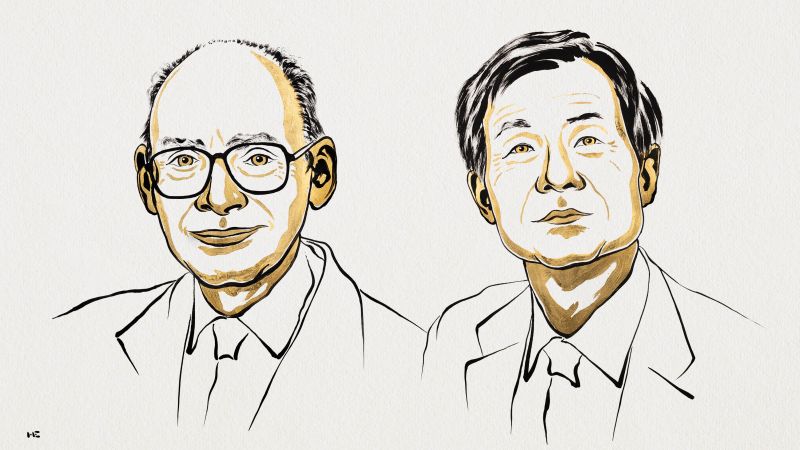
Henri Kagan and Kenso Soai receive the Nobel Prize in Chemistry for unraveling the mystery of mirror molecules

Henri B. Kagan and Kenso Soai have won the 2026 Nobel Prize in Chemistry for designing groundbreaking experiments replicating chemical asymmetry, a feat previously observed in nature.
Their work solved one of the field’s most enduring mysteries and advanced pharmaceutical manufacturing, the prize committee said at a news conference Wednesday at the Royal Swedish Academy of Sciences in Stockholm.
The duo’s work revolves around the concept of chirality: the structure of molecules fundamental to life includes mirror image shapes, much like our hands. However, only one of these variants is actually found in the cells of living things. This phenomenon, known as homochirality, has long intrigued scientists because for years they were unable to reproduce it in the laboratory, where chemical reactions typically created a 50-50 mix of left-handed and right-handed molecules.
“Henri Kagan and Kenso Soai have provided a solution to a more than century-old chemical mystery: how homochirality can emerge spontaneously. The chemical reactions they developed are spectacular,” said Heiner Linke, president of the Nobel Committee for Chemistry, in a statement.
In the early 1980s, the French chemist Kagan found ways to control chemical reactions with different types of catalysts, allowing scientists to produce a greater excess of one of the mirror-image molecules. Soai, a Japanese scientist based at Tokyo University of Science, then built on this work by designing a chemical reaction in which only one of two possible images was formed.
“Apart from life itself, no one has yet achieved this feat,” noted the Nobel committee.
Receiving the Nobel Prize marked “one of the most exciting days” of his life, Soai said in a telephone interview upon receiving the prize. He revealed he was “out shopping” when he got the call telling him he had won.
The Nobel committee said at the news conference that it was unable to immediately reach Kagan.
The one-handed puzzle of life
The duo’s research has both given chemists fundamental new tools widely used in their daily work and piqued their interest in the chemistry of the origins of life, the committee said.
Phillip Broadwith, economics editor of Chemistry World, published by the Royal Society of Chemistry, said Kagan and Soai’s achievements allowed scientists to choose which mirror image of a molecule to produce, a crucial ability for making products like medicines or even flavors and fragrances.
“It also helps explain how all the chiral molecules on Earth – our proteins, our sugars and our biomolecules – settled in one specific direction rather than another, so it’s fascinating science,” he added.
Last year’s prize went to Susumu Kitagawa, Richard Robson and Omar Yaghi for developing “metal-organic structures,” a form of molecular architecture that packs large amounts of space into tiny structures – which the committee compared to Hermione Granger’s magical handbag in the “Harry Potter” novel series.
Kagan and Soai share the 12 million Swedish crown ($1.2 million) chemistry prize announced Wednesday – the third prize announced this week. On Monday, the Nobel Prize in Medicine was awarded to a trio of scientists for their work developing a technique to decode the inner workings of the brain. On Tuesday, the physics prize was awarded to Francis Halzen, a pioneering Belgian astrophysicist whose work developing a massive observatory in Antarctica to detect “ghostly” cosmic particles laid the foundation for an “entirely new type of astronomy,” the committee said.
The literature and peace prizes will be announced on Thursday and Friday respectively, followed by the Nobel Memorial Prize in Economic Sciences on October 12.
This story and its headline have been updated with additional reporting.
Gn headline