
Nvidia (NVDA -1.43%) has made investors significantly richer over the past four years, turning a $10,000 investment into nearly $179,000 as of this writing.
This massive rise in Nvidia stock has been fueled by the advent of artificial intelligence (AI). When OpenAI’s ChatGPT, introduced publicly in November 2022, became a big hit, companies lined up to buy Nvidia’s graphics processing units (GPUs) after it emerged that the semiconductor giant’s chips were instrumental in shaping the chatbot.
The AI economy and Nvidia have come a long way since then. AI is now finding its way into several sectors, boosting productivity and economic growth. The good news for Nvidia investors is that AI adoption shows no signs of slowing down, which is why the company continues to deliver robust growth even after significant growth over the past four years.
We’ll take a closer look at the company’s prospects in this article and assess whether investing $10,000 in Nvidia stock over the next five years could be a profitable move.

Image source: Nvidia.
Nvidia is the biggest company in the world, but it can get even bigger
Nvidia’s rise through AI has made it the largest company in the world with a market capitalization of $5.2 trillion. It would therefore be completely absurd to expect another 20x increase in Nvidia’s stock price over the next five years, as this would take its market capitalization to over $100 trillion. However, that doesn’t mean Nvidia stock can’t climb over the next five years.
NVDA Nvidia
$214.13-$3.10 (-1.43%)
NASDAQ · At 4 p.m. ET on 10/16/26
After all, the company continues to grow at an impressive rate despite the scale it has reached. Nvidia’s revenue in the first six months of fiscal 2027 (which ends in January 2027) increased 96% from the same period last year to $177.8 billion. The company expects third-quarter revenue of $108 billion, up 89% from the year-ago period.
Analysts expect Nvidia’s fiscal 2027 revenue to rise 91% to $411.6 billion. Meanwhile, earnings per share are expected to nearly double in fiscal 2027 to $9.31. Importantly, Nvidia CEO Jensen Huang is confident that the company’s growth will continue unabated next year. He recently highlighted at a conference that the number of chips sold by the company will double in 2027, according to CNBC.
Huang added that continued investments in AI infrastructure will drive this incredible growth, as businesses and governments seek to make the most of the benefits of the technology. For example, the World Economic Forum noted earlier this year that AI could increase labor productivity by 1.5% to 3% over the next decade, citing the chief economist at consulting giant EY.
Additionally, investors would do well to note that AI is moving beyond data centers to real-world applications, such as robots and cars. Known as physical AI, Nvidia is entering this niche where machines can make complex decisions on their own. Whether performing precision-related tasks such as threading needles in surgical departments or operating on a treadmill, Nvidia is crossing a new frontier that could boost its long-term growth.
Nvidia’s physical AI offerings are already used by companies like Amazon and Japan’s national AI company, and I won’t be surprised to see the tech giant attract more customers. Indeed, revenues from the physical AI market are expected to reach €430 billion by 2030, suggesting that this niche could shake things up significantly for Nvidia over the next five years.
Add to that the $3 trillion to $4 trillion revenue opportunity that Nvidia sees in the AI infrastructure market in 2030, and it’s easy to see why analysts have become extremely optimistic about its growth prospects through fiscal 2029 (which ends in January 2029).
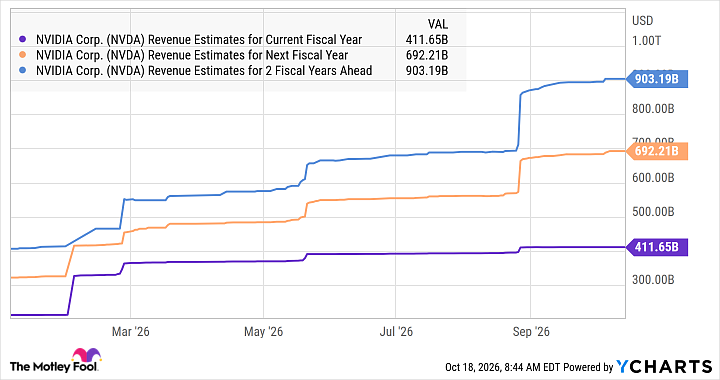
NVDA revenue estimates for current fiscal year data by YCharts
According to the chart above, Nvidia’s revenue could grow 68% in fiscal 2028, which is almost in line with the company’s 70% growth forecast. This is expected to be followed by a 30% increase in fiscal 2029, to $900 billion. There’s a good chance that Nvidia will also maintain strong growth in fiscal 2030 and 2031, which could set the stock up for further gains.
The stock can still generate impressive gains
Assuming that Nvidia’s revenue grows even 10% in fiscal years 2030 and 2031 (which end in January 2031), its revenue could reach $1.09 trillion in 2030 (given that fiscal 2031 will coincide with the majority of calendar year 2030).
Now, this AI stock trades at 18 times sales. Assuming Nvidia trades at half that sales multiple after five years, its market cap could climb to $9.8 trillion (based on a revenue estimate of $1.09 trillion). This implies a potential upside of 88% from current levels. So, a $10,000 investment in this semiconductor stock will be worth over $18,800 by 2030.
However, this could be a conservative estimate, as Nvidia could grow faster and enjoy a premium valuation after five years. This is why investors can always consider buying this AI barometer, as it has the potential to make them richer through emerging niches within the AI ecosystem.
Gn bussni