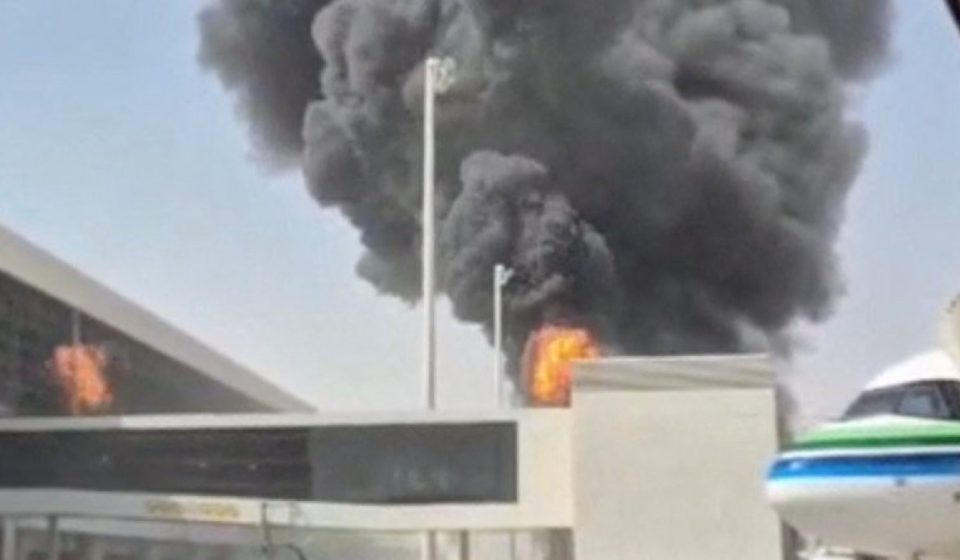

Saudi Arabia said three people, including a pilot, were killed in Houthi attacks on Riyadh’s King Khalid International Airport on Thursday.
In a statement posted on social media on Friday, the General Authority of Civil Aviation (GACA) said the attacks on the airport killed an airline pilot and two other Saudi citizens, while several people “of different nationalities were injured.”
Recommended Stories
list of 3 elementsend of list
“It is with deep sadness that Saudia announces the death of Captain Hamoud Ali Alkalthami,” the airline said in a statement, citing an “incident” at Riyadh airport.
Dozens of people injured in the missile attacks suffered minor to serious injuries. The attacks also caused material damage, including to a plane operated by the national airline Saudia, GACA said. Airport operations have now resumed and air traffic has returned to normal, according to Saudi media.
Saudi Arabia has been the scene of several Houthi attacks in recent days, with airports appearing to be the main target.
GACA said Wednesday that attacks earlier this week killed three civilians and injured 36 others at Abha and King Khalid airports. At least three people were also injured in other attacks on airports in Jazan and Najran, near the border with Yemen.
A Houthi military spokesman said Thursday that the armed group launched a ballistic missile toward King Khalid Airport, saying the missile successfully hit its target, causing damage and disrupting air traffic.
The Houthis’ military campaign appears to be a resurgence of a tactic seen last month. On September 18, Saudi-led coalition forces said they had intercepted and destroyed a suspected Houthi ballistic missile fired toward King Khalid Airport. A day later, at least one explosion was heard near Riyadh airport, and a large plume of black smoke was seen rising from a fuel storage area.
The Iranian-backed Houthis, an armed group also known as Ansar Allah (Arabic for followers of God), have warned airlines to avoid using Saudi airspace, saying any plane operating there except over the holy cities of Mecca and Medina is a target.
Al Jazeera’s Yousef Mawry, reporting from Sanaa in Yemen, said the Houthis wanted to impose a blockade on all Saudi airports.
“This is part of the blockade for blockade equation, the airport for airport equation. Because Sanaa remains under siege by Saudi Arabia, the Ansar Allah Houthis want to impose a blockade on all Saudi airports,” Mawry said.
The Houthis claim the strikes are retaliation for Saudi attacks on Yemen’s Sanaa International Airport and Hodeidah Airport, he said.
Fighting intensifies in Yemen
The resumption of attacks on Saudi airports comes as Yemeni forces continue their counter-offensive against the Houthis.
On Friday evening, airstrikes were reported in the Yemeni capital, Sanaa, which remains under the control of the Houthi movement, which seized the city in 2014.
Heavy explosions were also reported in the southern port city of Aden, where Yemen’s internationally recognized government is based.
The Saudi-led coalition supporting the Yemeni government also said Friday it had destroyed three rocket launch platforms used by the Houthis “to threaten regional security.”
Coalition spokesman Col. Turki al-Maliki said all Houthi attacks on civilians and civilian facilities “will be resolved” by the Saudi-led coalition.
The offensive by Yemeni forces and the Saudi-led coalition was launched after the Iran-aligned rebel group last month seized a large swath of territory in Yemen along the strategic Bab al-Mandeb Strait, which connects the Red Sea to the Gulf of Aden, in a sudden surge.
Yemeni government forces this week claimed significant gains around the Bab al-Mandeb coast, but intense fighting continues.
The conflict, frozen for years but reignited after the US-Israeli war against Iran, has fueled new upheaval in a region already destabilized by Israeli wars against Gaza and Lebanon.
It now threatens to drag other states into the conflict, with Pakistan and Turkey agreeing to deploy troops as part of a mutual defense deal signed with Saudi Arabia earlier this year.
Pakistani Foreign Ministry spokesperson Sajjad Haider Khan said Friday that the country now has a “substantial number of forces as well as resources… in Riyadh.”
Pakistani military personnel “would not cross the borders to the other side to attack the Houthis, but of course (would act) to defend the territory”, he noted.
UN Security Council members condemn Houthi attacks
Meanwhile, at the United Nations on Friday, Yemen’s internationally recognized government and Saudi Arabia called on the Security Council to take action to address the escalating situation in Yemen.
“The increasing targeting of civilians, the persistent threats to navigation security in the Red Sea and the Bab al-Mandeb Strait, and the resulting repercussions that extend beyond Yemen and the region, negatively affect international peace and security,” Saudi Arabia’s representative to the UN, Abdulaziz al-Wasil, told the council.
Abdullah Ali Fadhel al-Saadi, the U.N. representative to Yemen’s internationally recognized government, said the threat posed by the Houthis “is no longer an internal Yemeni matter that can be contained within our borders.”
Gn world