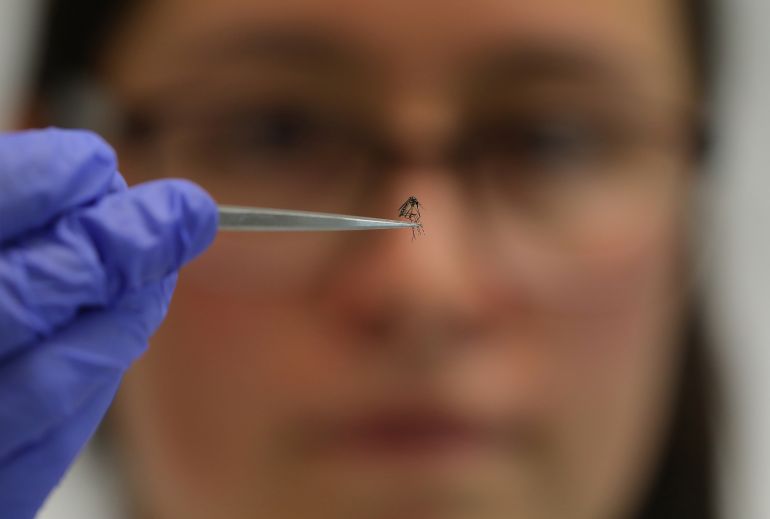
In Brazil, scientists have successfully tested a new way to fight dengue fever: by infecting mosquitoes with harmless bacteria instead of killing them or avoiding their bite.
Researchers presented encouraging results from a major study of thousands of children in Brazil, one of the world’s hotbeds of dengue fever, at an international conference on Saturday.
Recommended Stories
list of 4 elementsend of list
The tests were carried out after the research team released millions of mosquitoes that had been engineered to carry a naturally occurring bacteria called Wolbachia, which makes it harder for viruses like dengue to grow. Tests indicated that dengue infections decreased by 68.5 percent.
It’s the latest effort to redesign mosquitoes to combat the diseases they transmit to humans. The research findings were released as the US state of Florida grapples with a dengue outbreak, believed to be one of the largest in the US since the 1940s.
“It’s really exciting,” David Hamer, a global health expert at Boston University who was not involved in the Brazilian study, told the Associated Press news agency.
Hamer predicted that using more Wolbachia mosquitoes could “drive dengue down to much lower levels” in many places.
Here’s what we know:

What did the study do?
An international team of researchers from the Brazilian Ministry of Health, Emory and Yale Universities in the United States, and the US National Institute of Allergy and Infectious Diseases conducted the study in Belo Horizonte, southeastern Brazil, from 2020 to 2024.
Scientists infected Aedes aegypti mosquitoes with Wolbachia, a naturally occurring bacteria that does not harm humans but can significantly reduce the mosquitoes’ ability to transmit certain viruses. While the bacteria is present in around 50% of insects, Aedes aegypti – responsible for the transmission of dengue, chikungunya, Zika and yellow fever – does not carry it.
The researchers then released the mosquitoes and then randomly tested 5,700 children for dengue symptoms, including those living in areas where infected mosquitoes had been released and those where standard measures such as insecticides were used. The researchers also tested for a range of other diseases transmitted by mosquitoes, ticks and sandflies to catch asymptomatic patients.
Only 4 percent of routine blood tests came back positive in areas where Wolbachia-created mosquitoes were released, compared to 14 percent in other neighborhoods. Dengue cases fell by 68.5 percent while chikungunya cases declined by 73.3 percent, according to the study.
The number of dengue infections in Brazil is among the highest in the world, accounting for around a tenth of all cases worldwide. Belo Horizonte, a densely populated city, was experiencing its worst outbreak during the research period, demonstrating the effectiveness of the Wolbachia method.
The results were presented at a meeting of the American Society of Tropical Medicine and Hygiene in the US state of Maryland.
Is this the first use of Wolbachia?
The World Mosquito Program (WMP) pioneered the Wolbachia method for its ongoing Wolbachia mosquito release project.
The intervention, carried out since the mid-2000s, focused on regions including Colombia’s Aburra Valley and the Brazilian city of Niteroi, which together have a population of around 4.5 million. Dengue infections there fell by 92 percent in about a million people studied, the organization reported. The researchers emphasized that this method is highly self-sustaining and more environmentally friendly than fumigation, which can be costly and toxic.
In Singapore, authorities have adopted a population suppression approach linked to Wolbachia since 2016. This involves releasing male mosquitoes carrying the bacteria to mate with urban wild females, who then produce eggs that do not hatch.
The scientists’ main goal is to create local populations of Wolbachia-carrying mosquitoes in the study areas. As part of the WMP intervention, scientists worked with local community leaders to release adult mosquitoes or place their eggs in take-out food boxes, in the hope that they would develop into adults and mix with the local mosquito population. Over time, researchers believe, the Wolbachia population will reproduce and become established.
Where else have mosquitoes been used to fight disease?
Mosquitoes, particularly female Anopheles, also transmit malaria, which is endemic in African countries. Children and pregnant women are most vulnerable to this disease, which can be fatal.
In 2024, researchers at Leiden University Medical Center and Radboud University in the Netherlands have engineered mosquitoes to deliver vaccines that could provide immunity against malaria.
They achieved this by infecting mosquitoes with a modified strain of the malaria parasite, Plasmodium falciparum, which causes the most deadly strain in humans.
The parasite infects humans through mosquito bites. The insect uses its long, needle-like mouth to pierce the skin and inject its saliva into a person’s blood before sucking the blood. Parasites in saliva, which prevent blood from clotting and reduce pain, then travel directly to the liver, where they quickly reproduce and infect malaria red blood cells.
In the trials, researchers reflected the transmission of malaria to enhance liver immunity. However, even if 80% of a group of participants developed immunity, the trial size was deemed too small to generalize to just 20 people. It was unclear whether the method would be more durable than actual vaccines in the long term, the scientists involved said.
Similarly, US researchers used the same method in a small trial with 26 participants in 2022 and found it to be 50% effective.
Meanwhile, in Japan in 2010, scientists modified mosquitoes to carry a vaccine against leishmaniasis, a parasitic disease usually spread by sandflies. Rodents bitten by the “flying vaccinators” developed antibodies against the parasite.
Gn Health