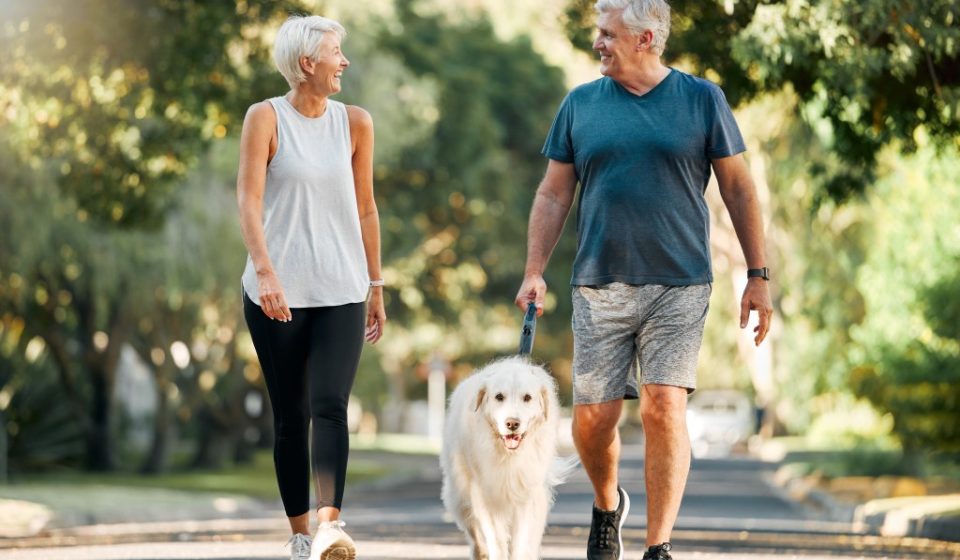
Do you want to live longer? Go for it.
You don’t necessarily need 10,000 steps a day, a misconception that actually dates back to a 60-year-old marketing campaign.
“Everyone talks about 10,000 steps a day,” a workout that can last more than two hours, said Dr. Theodore Strangegeriatrician and internal medicine specialist at Northwell Staten Island University Hospital.
In contrast, taking fewer than 2,000 steps is considered sedentary, he noted.
So what is the happy medium between the two?

Strange’s advises tracking your steps for a few days, as increasing your base value improves health.
Research shows that anything over 2,200 steps helps you live longer.
“Get them up to that range of 5,000 to 6,000, then try to get to 7,000 to 8,000 a day,” he suggested, noting that that range is “exactly where you want to be.”
Officially, the National Heart, Lung and Blood Institute recommends 7,000 steps or more, a threshold that research shows reduces mortality risk by 70%.
“If you can get to 10,000, that’s great,” Strange says. “Beyond that, you’re an athlete; you’re a star.”
However, step counts don’t tell the whole story.
A new study shows that walking speed is also a powerful indicator of longevity.
I’m walking here!
Perhaps not surprisingly for fast-walking New Yorkers, a faster pace is associated with a lower risk of premature death.

Researchers looked at data from more than 10,000 older Britons, with an average age of 69. They found that walking faster – whether in the lab, during daily activities, or by consciously walking faster – was associated with a 17 to 23 percent lower risk of premature death.
Even a tiny increase in speed of 0.1 meters per second was correlated with lower mortality.
Importantly, the authors note that it’s not the act of walking briskly that makes you live longer. Rather, walking quickly indicates that the body’s internal systems are functioning well.
Walking quickly requires good cardiorespiratory function, muscle strength, balance and a healthy nervous system, Strange explained.
Fast walkers are also more likely to nourish their bodies properly and live free of energy-sapping chronic diseases.
If any of these underlying systems decline, “walking speed could be one of the first functional measures to decline,” Strange said. “And as you lose that, you’re likely at increased risk of falls, frailty, decreased cognitive decline, and ultimately increased morbidity and mortality.”
How to walk better
As with any major lifestyle change, start with small steps. Well, not literally — just start walking, Strange said.
“Start gradually. Go slowly, meaning at a speed that’s comfortable for you,” Strange said. “Do it consistently.”
Devices like smartwatches can be helpful in giving you “real, objective data you can measure,” including step counts and cadence, as this new study examined.
Once you’ve established a baseline, Strange suggests increasing your weekly walking time by just a few minutes.
To prepare for a successful walk, he highlights a few key principles.
First, maintain good posture by standing straight with your shoulders back, keeping your body relaxed and letting your arms swing naturally.
Make sure you stay adequately hydrated and fueled before heading out. To avoid tripping, focus on short, controlled measurements.
Listening to your body is also crucial. If you feel any discomfort, slow down or stop altogether.
Gn Health