
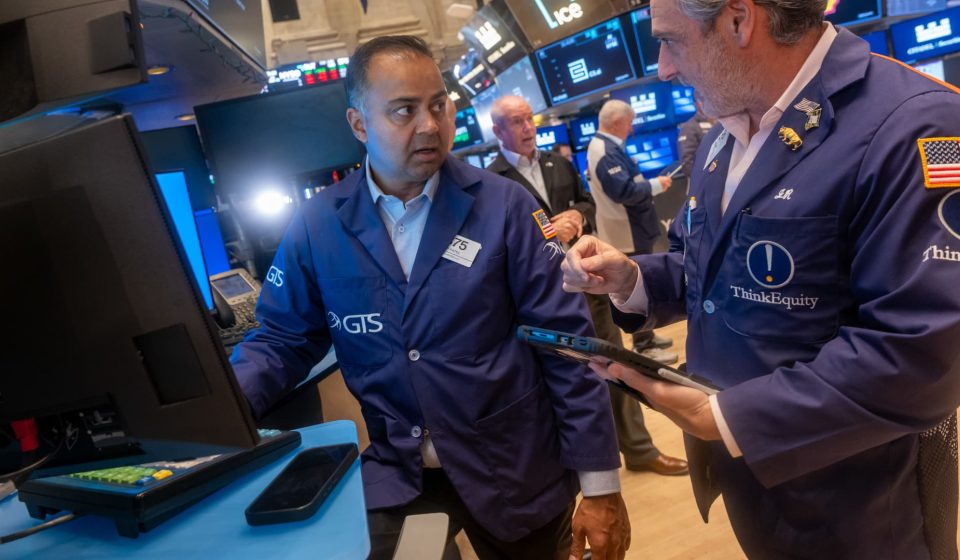

The “Magnificent Seven” could cede their leadership to the entire market, if early profit projections are to be believed. As a group, the artificial intelligence darlings are expected to have increased their profits by 20.3% in the third quarter compared to the previous year. That’s a slower rate than the rest of the S&P 500, which analysts expect will grow profits by 27.7%, according to Russell Investments. That would be a stark contrast to the second quarter, when the Mag-7 saw its profits double while the rest of the index’s results rose 30%, according to FactSet. The outperformance of the non-magnificent S&P 493 would come at a key time for the stock market, which has held up well overall thanks to megacaps but has seen its scale weaken considerably beneath the surface. This is a worrying development that, for some, implies a broken market. For others, however, it suggests a buying opportunity. “The earnings being much broader and the valuations of some of the non-hyperscaler companies being a little bit cheaper than the valuation of some of these hyperscaler companies,” said BeiChen Lin, head of Canadian strategy at Russell Investments. “I think it’s reasonable to expect that eventually market performance will expand as well, beyond just fundamental earnings.” The strategist expects the S&P 500 to finish the year up 5% from its current level, with potential for further strengthening in 2027. Most stocks aren’t participating in the rally — and yet the Mag-7 is the main reason the stock market isn’t performing as poorly as the average stock. Thanks to its overconcentration in tech, the S&P 500 reached an all-time high on Tuesday. Nvidia – its largest component with a weighting of around 8% – also hit record levels. The technology sector also represents almost 40% of the S&P 500 in terms of market capitalization. But the rest of the market hasn’t participated lately. The equal-weighted S&P 500 is about 6% off its record high. Meanwhile, 75% of S&P 500 stocks closed September in negative territory. But that wasn’t the story a few months ago. Until recently, value stocks outperformed growth and small caps outperformed large caps, while the Magnificent Seven was virtually flat for the year. That was until a surge in oil prices and bond yields in recent months prompted investors to return to their old favorites. .MAG7 3M mountain Magnificent Seven, 3 months But the third-quarter earnings season — which begins Thursday with reports from Delta Air Lines and PepsiCo — could make stocks outside the Magnificent Seven attractive to investors again. FactSet’s John Butters noted last week that a record number of S&P 500 companies are issuing positive guidance, an auspicious sign. Stock Market Dislocations To be sure, an acceleration in earnings growth won’t necessarily translate into increased equity participation in the record rally, especially when the stocks most punished in recent months are also the most vulnerable to deteriorating macroeconomic conditions. But investors suspect many of these same names have been punished too much at this point. Some also expect the third-quarter earnings season to confirm that the strength of corporate fundamentals – not prevailing external forces – will determine the next direction of stocks. Art Hogan, chief market strategist at B. Riley Wealth, believes the outlook period will reward the hardest hit sectors, like small caps and healthcare. He likes financial stocks at this point, given that the group was down 7% in September. “Everything that wasn’t technology and communications services was just put in a bag,” Hogan said. “I just think you’ll have the opportunity, once some of these banks and credit card companies start reporting, to see a real rebound.” Russell Investments’ Lin also said the season is expected to be a continuation of recent quarters, proving that the AI boom is only just beginning. “This is an environment where companies, from our overall perspective, are, generally speaking, in a pretty strong financial position. And that creates a lot of opportunities for investors, despite, of course, all these headlines going around,” Lin said. “Ultimately, we think it’s important for investors to remember that volatility is part of the normal market cycle,” he added. “And sometimes it’s actually that volatility that can create temporary disruptions that allow investors to get in at a better price.”
Gn bussni