The first time I slept without my phone in my room, I woke up to 13 missed calls.
My roommate had accidentally locked herself out of our apartment in New York when she went out to do laundry in the basement. I was asleep when she called me to ask me to let her in, unable to hear my phone ringing in our living room. Without a way to get in, she slept at a friend’s house and missed the non-refundable flight she was taking the next morning.
So when a sleep therapist suggested I make my bedroom phone-free earlier this year, I grimaced and said “no way.”
Amid increasing scrutiny of excessive smartphone use and addictive features of social media, people are redefining their relationships with gadgets to improve their well-being.
Research shows that late night phone use reduces teens’ sleep time. But teens aren’t the only ones struggling: About 62 percent of adults under 30 say smartphone use interferes with their sleep, according to a September report from the Pew Research Center.
Putting some distance between you and your phone can help you get a good night’s sleep, experts say, but it’s sometimes easier said than done. Here’s what to do.
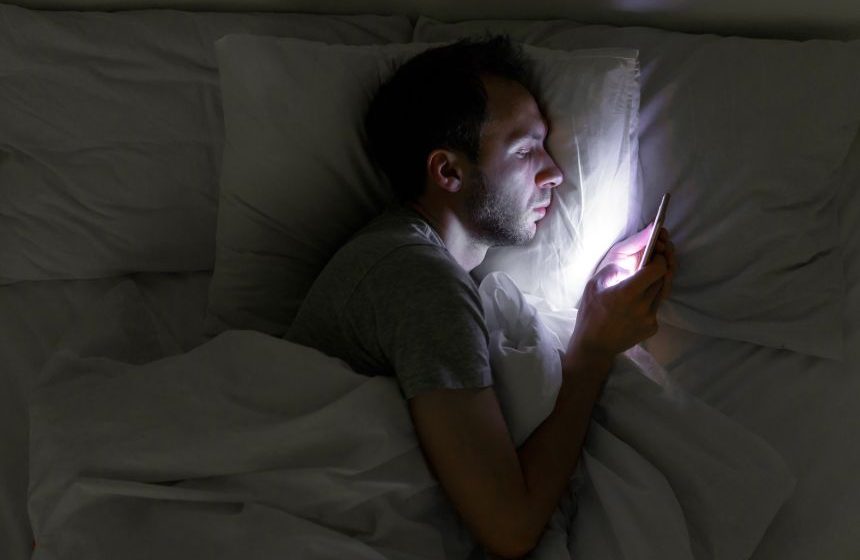
People don’t just keep their phones in their bedrooms; they also parade under the covers. Study participants spent 42% of their time in bed using their smartphones before falling asleep at night, which was associated with decreased sleep quality, according to a 2022 study published in Personal and Ubiquitous Computing.

Some use their phone as an alarm clock or as a way to be reachable in an emergency, while others have their device in their bedroom out of habit, said Kristin Szuhany, a clinical psychologist who specializes in cognitive behavioral therapy for insomnia, or CBT-I, at NYU Langone Health in New York.
The blue light emitted by screens can disrupt the body’s circadian rhythm, which naturally prepares you for sleep at night. Even though smartphones offer filters to limit this brightness, activating such a filter does not prevent the negative effects of using your smartphone at bedtime, according to experts.
“Often what we do on our phones helps keep our brains more active,” Szuhany said. Stimulating content can make it harder to relax long enough to fall asleep when you want, she added.
Even if you don’t use it, having your phone nearby can make it difficult to sleep, said Jamie Zeitzer, a professor of psychiatry and behavioral sciences at Stanford University and co-director of the university’s Center for Sleep and Circadian Sciences. Notifications – and their anticipation – can trigger awakenings that can be disruptive in the middle of the night.
Sleep psychologists like Szuhany often introduce their patients to “stimulus control” to help them improve their sleep. The goal is to “reduce the signals that keep our brains and bodies awake,” Szuhany said.
Reserving the room for sleeping and making love strengthens the mind’s association with those activities in that location, Szuhany explained. Removing the phone from the room at all times of the day or avoiding using it in bed can reinforce the association that being there means it’s time to sleep.
Researchers asked a group of participants to leave their phones outside their bedrooms for a week in a 2018 study published in Computers in Human Behavior.
According to the study, three out of four participants reported falling asleep faster and experiencing better quality sleep, as well as reduced anxiety and improved overall well-being. It also benefited relationships: In the absence of their phones, single participants spent time thinking about friends and family, while others reported talking to their partners more at bedtime.
Nicola Hughes, the study’s lead author, likened having a phone in the room to shared attention; even when you’re doing something else, part of your mind remains focused on the phone. “If you put a barrier between you, you kind of interrupt that impulse,” said Hughes, a creative strategist and positive psychologist who studies optimal human well-being.
Too nervous to leave my phone out of the bedroom again, I started putting it on my dresser at the foot of my bed. This level of friction helped at first; I had to physically get up to turn off my alarm. But over time, it became too easy to grab it, slip under the covers, and scroll through it in the morning.
“I don’t think having the phone in the room is necessarily a bad thing, except that for a lot of people it’s just too strong a temptation,” Zeitzer said.
In some circumstances, having your phone nearby is a reasonable concern.
Zeitzer, whose parents are elderly, now keeps his phone in his bedroom in case of emergency. His phone’s Do Not Disturb feature automatically turns on at bedtime, limiting notifications so he doesn’t get pinged multiple times at night unless it’s a call from his parents. He would have to get out of bed to reach it on the floor, which is distracting enough to keep him from grabbing it often, he said.
“It’s kind of balancing the anxiety part and the reality part,” Zeitzer said. Recognizing when phone separation causes anxiety is the first step.
Changing societal expectations around accessibility can make it difficult to remember that for most of human history, people went to sleep without a phone in their bedroom, Zeitzer said. Old-fashioned solutions, such as landlines and physical alarm clocks, can still help ease the fear of sleeping too much or being completely unreachable.
For people whose emergencies are less likely, Szuhany suggests putting their worries to the test with a behavioral experiment: Pick a night to keep the phone out of the bedroom and see what happens.
“Often nothing bad happens,” Szuhany said. If something happens, think about it afterwards. Ask yourself if it was as bad as you expected and if you could cope if it happened again.
Gradual exposure can also help you navigate things more easily, Szuhany added. Try moving your phone out of reach in your bedroom first before taking it out of the room completely, she said.
While I was making this transition, I kept a regular clock next to my bed so I knew what time it was without checking my phone. I also adjusted my iPhone settings so that if someone called me more than once within three minutes, my phone would ring even with Do Not Disturb turned on. Most Apple and Android devices allow you to enable this feature for repeat calls in your phone’s DND settings.
Over time, I felt comfortable enough to leave my phone in the living room again. There are times when I’m in my room and I want to grab my phone, but I’m too tired to get up and grab it. Turns out this lifestyle change was exactly what I needed to sleep better.
Cordilia James is a lifestyle journalist and writer based in New York. She has written for the Wall Street Journal, the Washington Post and People.
Be inspired by a weekly summary on living well, made simple. Sign up for CNN’s Life, But Better newsletter for news and tools designed to improve your well-being.
Gn tech