Human “mini-brains” spent 40 days in space. Scientists have found clues to Alzheimer’s disease. : Science Alert

Studying Alzheimer’s disease presents multiple challenges: it takes a long time to develop, involves many different neural processes, and occurs deep in the brain, where analysis of living tissue is particularly tricky.
Donor brains can be studied, but then everything stops.
One way to overcome these challenges could be to study Alzheimer’s disease brain cells in space, researchers think, and that’s not as strange an idea as it might seem at first.
We have ample evidence that space accelerates cellular aging and puts more strain on our biological systems from radiation and other stresses.
Space could give us the opportunity to better understand neurodegeneration, the way brain cells wear out and lead to conditions such as dementia.
In a new study in Scientific advancesResearchers led by a team from the University of California, San Diego, have reported on a batch of “mini-brains” (called organoids) that spent 40 days aboard the International Space Station (ISS).
The lab behind it, led by Alysson Muotri, a neuroscientist and lead author of the study, has been flying brain organoids for years, and previous experience helped set up a clinical trial of a candidate treatment for Rett syndrome.
When the organoids were analyzed upon their return, they showed changes in their chemistry and composition that suggest this is an area of research worth pursuing.
“Spaceflight provides a unique environment to study neuronal responses relevant to neurodegenerative diseases,” Muotri and his team write in their published paper.
“These exploratory results indicate that spaceflight reshapes neuronal regulation in human brain organoids, revealing coordinated molecular responses relevant to Alzheimer’s disease biology.”
The mini-brains were grown in the lab to mimic some of the genetic mutations associated with Alzheimer’s disease, with normal and “healthy” versions included as controls.
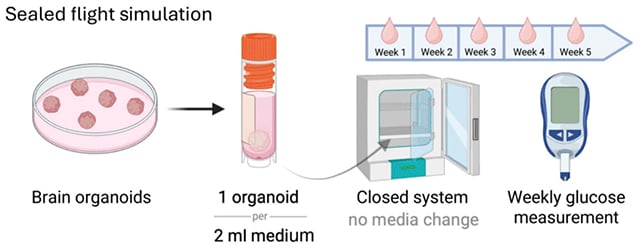
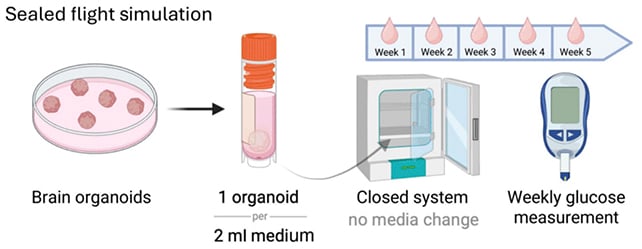
Nothing special was done to the organoids while they were aboard the ISS.
They were kept sealed in a laboratory box for the duration of the visit and maintained at body temperature, while other controls were maintained under the same conditions on Earth.
 ))>
“The space environment, characterized by microgravity, radiation exposure, varying magnetic fields, and circadian disruption, produces a combination of physiological stresses, including increased oxidative stress and mitochondrial impairment, as well as changes in inflammatory systems,” the researchers write.
When the space organoids returned, the Alzheimer’s samples showed notable differences.
For example, some contained more of the amyloid beta and phosphorylated (chemically labeled) tau proteins that collect in the brains of people with Alzheimer’s disease.
Certain signals associated with the early development of Alzheimer’s disease have also been identified. Organoid cells appear to respond to the added stress of life in orbit by speeding up certain internal processes, particularly those generating energy.
We’re still in the early stages of understanding what this all means, but the mini-brains showed enough Alzheimer’s-related changes to indicate we could use them to study the disease in the future.
“Our results demonstrate that spaceflight exposure induces coordinated neuronal and molecular remodeling in Alzheimer’s disease-derived organoids,” the researchers write.
It’s worth keeping in mind that these organoids are not exact copies of our brains, and the genetic modifications that researchers have made to them are linked to a very small number of cases of Alzheimer’s in humans. These factors must be taken into account when interpreting the results.
However, now that these experiments have produced encouraging results, more complex organoids can be tested on the ISS, using a system that automatically updates their growth media.
A potential next step would be to add immune cells called microglia, to provide a more realistic simulation of Alzheimer’s disease and its progression.
 ))>
It seems more likely than ever that the brain changes observed in astronauts could benefit health research.
Figuring out how to keep humans safe during long-distance space missions may well overlap with research aimed at treating the most stubborn diseases we face here on Earth.
“(Further studies) will include mature neuroimmune assembloids and microglia-infused cortical organoids, thereby allowing a more comprehensive investigation of maturation, inflammation, and aging processes in various brain cell types under spaceflight conditions,” the researchers write.
The research was published in Scientific advances.
This article was fact-checked by Rebecca Dyer and edited by Rebecca Dyer. Although we are proud of our process, we are only human. If you spot an error, please let us know.
Gn Health