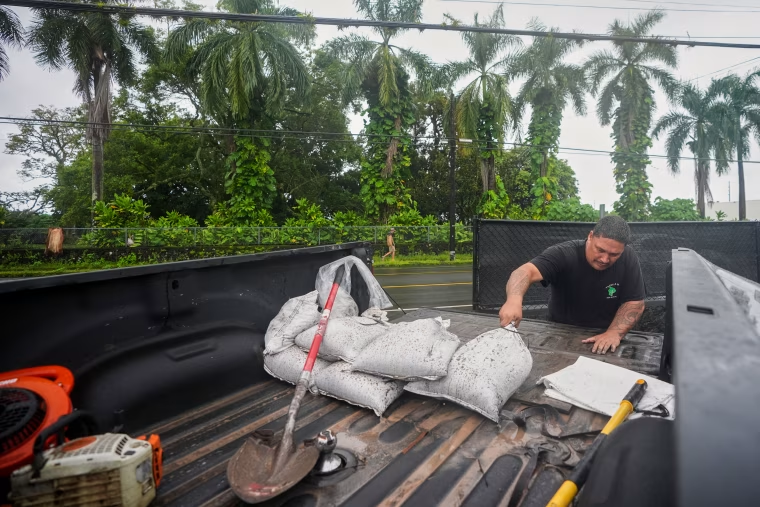

Hurricane Nolo circled the Hawaiian Islands as it gained intensity Saturday, but authorities said it still posed a risk of flash flooding, dangerous winds and extreme waves in areas recovering from previous storms.
Nolo was rotating very slowly south of the Big Island with maximum sustained winds of 90 mph. Its center was about 165 miles south-southwest of Hawaii’s southernmost point and it was forecast to strengthen into a major hurricane late Sunday and early Monday as it tracked west toward the southern islands.
A hurricane watch was canceled and no direct landfall through the center of the storm was expected. But forecasters said its outer bands could cause life-threatening flooding and mudslides, and parts of the Big Island were expected to see rainfall totals of up to 20 inches. Heavy rain was also expected on the other islands.
“Don’t venture out if you don’t have to in a dangerous environment of flooding, but also high winds. We can bring down trees and power lines,” said Michael Brennan, director of the National Hurricane Center.
Heavy rain continued to fall on the southern part of the Big Island in the afternoon, leading to the partial closure of one of the major highways connecting Kailua-Kona in the west to Hilo in the east.
Near the community of Naalehu, on the southern tip of the island, members of the National Guard were seen guiding a man through flooded streets as he tried to leave his home in a heavy downpour. More than 120 Guard members were activated on the island, out of about 400 statewide, after the governor issued an emergency proclamation.
The nonprofit humanitarian group CORE and other partners spent the week packing and shipping supplies such as camping stoves and hygiene products via air freight from Oahu to the Big Island for a community relief center active since Hurricane Lala in August.
Residents are still recovering from Lala, which produced heavy rain and winds strong enough to sweep about 100 homes off their foundations on the Big Island.
National Guard Specialist Sherie Kaili was on the ground during Lala and recalled the dire conditions.
“It was dark, you know, the service was down, the power was down, the rivers were coming out of nowhere,” she told NBC News on Saturday.
Hawaii prepares on the northern edge of Nolo
About a dozen people were in the water Saturday morning at Carlsmith Beach Park in Hilo on the Big Island, despite signs indicating the beach was closed. Andrea Gill had been out swimming regularly before returning home to relax with family.
“I hope it stops there and moves on and goes somewhere else,” Gill said of the slow-moving storm.
Businesses closed their doors and events were canceled. Gill said storms are common, but hurricanes are rare. She remained hopeful that the islands might not take the full impact.
“We’re used to a lot of rain. We’re not used to wind. So it’s always a blessing when we don’t get hurricane wind,” she said.

President Donald Trump approved an emergency declaration for the state on Friday, authorizing the Federal Emergency Management Agency to coordinate aid and provide financial support.
Hawaii officials asked residents to prepare emergency kits, and the governor issued an emergency proclamation, activating hundreds of members of the Hawaii National Guard.
Officials in Hawaii County on the Big Island urged residents in flood-prone areas to consider taking shelter in shelters or elsewhere.
Hawaiian Electric, the state’s main utility, said crews that helped restore power to Kauai after this month’s Hurricane Lowell have returned to Oahu, Maui and the Big Island in response to the storm.
In Maui, a bush fire broke out Saturday on the west coast of the island, prompting the mandatory evacuation of some residents and the closure of parts of a highway. The fire was burning near the Olowalu area, about 7 miles south of Lahaina, site of deadly 2023 wildfires. County officials set up two evacuation centers north and south of the fire.
The weather service issued a high wind warning for parts of Maui Saturday evening, meaning winds could reach at least 40 mph with gusts above 60 mph.
The Pacific has been unusually active this season, according to National Weather Service chief forecaster Bob Oravec, with above-average storm activity during what is already the peak of hurricane season. He said this trend is consistent with El Niño years, when the Pacific often experiences more tropical storms and hurricanes.
The powerful Polo on its way to Mexico
Meanwhile, Mexico was under threat from Hurricane Polo as it headed toward the Baja California peninsula after bringing storms to the southwest coast. Polo had maximum sustained winds of 120 mph, making it a Category 3 storm, but it was expected to weaken somewhat before making landfall Monday.
One of the towns in the hurricanes’ predicted path is San Juanico, a small fishing community on the Pacific coast of Baja where access to basic needs is already unstable.
“Our people are concerned about this event,” said Gloriely Robles Meza, manager of a small hotel. “We have not faced such a worrying situation for many years.”
The city has only had full-time electricity for a few years and still experiences frequent outages. Without electricity, residents cannot refrigerate food or pump water. The nearest gas station is so far away that fuel is stored and sold from tanks, and the supply often runs out during times of high demand.
Robles Meza said the community feels obligated to prepare for the storm without help from authorities.
“We must prepare on our own – each of us protecting our homes and property,” she said, adding that she would like authorities to preposition heavy machinery to clear roads, as well as backup generators.
For now, she said, the only plan is to turn the local elementary school into a shelter.
“While this is important, we also have other impacts to consider,” Robles Meza said, such as what the city will do if it is cut off from aid.
San Juanico has experienced storms in late summer, but Polo feels different, said Jeffrey Westman, an American who was first drawn to the city’s world-class surf break 40 years ago and who owns property there.
Flooded roads could block access to the nearest medical facility, about 80 minutes away in Ciudad Constitucion.
Westman, 63, said he hopes Polo will behave like some past storms, losing intensity before reaching the peninsula.
“A lot of times they start to run out of steam,” he said. “I hope so.”
Gn headline