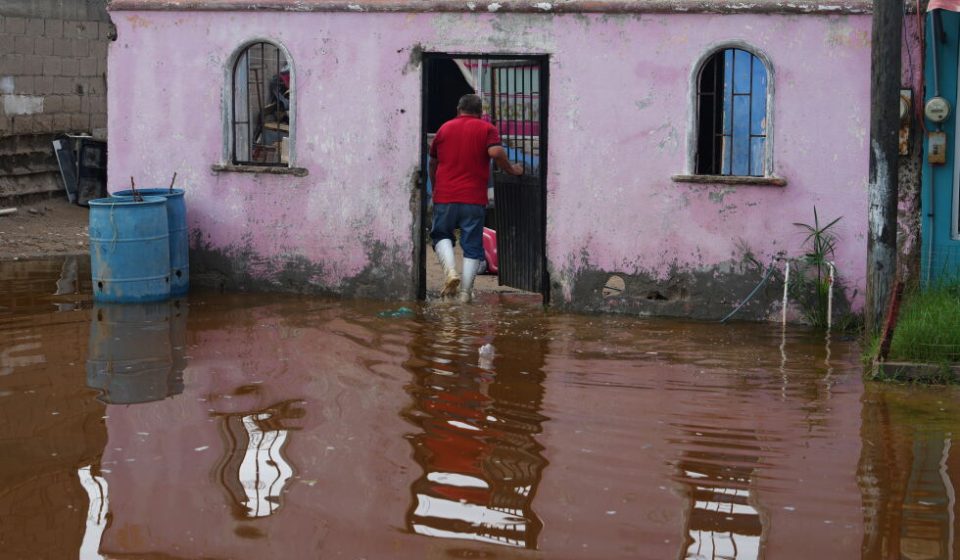
Hurricane Polo causes flooding in northern Mexico as rains lash the southwestern United States

PUERTO SAN CARLOS, Mexico (AP) — Hurricane Polo hit the Mexican The state of Baja California Sur was hit by strong winds and rain when it made landfall on Tuesday, leaving coastal areas flooded and streets littered with fallen trees.
The Category 2 hurricane made landfall just south of Las Barrancas, Mexico, about 80 miles (130 kilometers) north of Cabo San Lazaro with maximum sustained winds of 110 mph (175 km/h).
About 700 people were still in shelters Tuesday. But they were expected to return home, and no serious damage or deaths were immediately reported, according to authorities.
By midday Tuesday, Polo made landfall for the second time and weakened to a tropical storm as it moved inland across the Mexican state of Sonora after crossing the Gulf of California.
The remnants of the storm are expected to move northeast, adding to heavy rains already causing flooding in parts of the southwest United States.
Forecasters warned that north-central New Mexico, including Albuquerque and Santa Fe, could take the brunt of the complex tropical system, with up to 3 to 4 inches (about 8 to 10 centimeters) of rain through Wednesday and possibly more.
“We were lucky”
After Polo passed through the small fishing town of Puerto San Carlos on the Baja California peninsula, residents waded among downed trees in ankle-deep water that flooded some homes. Seeing their community largely intact brought relief to those who had prepared for the worst.
Trader Elbia María Bachomo, 40, rummages through furniture scattered around her house. She and her three children quickly gathered their clothes and headed to a shelter Monday as water began to flood their home.
Her husband was fishing for sardines when Polo struck. Bachomo said he was lucky to make it out alive.
“I thought, ‘Oh no, what are we going to go back to? There’s nothing left for us.’ But we were lucky,” she said.
Polo was expected to produce 6 to 12 inches (about 15 to 30 centimeters) of rain over parts of Baja California Sur.
Forecasters predicted Polo would hit the Mexican mainland with life-threatening winds and flash floods. Sonora authorities suspended all “nonessential” activities, including school, sports and nonessential work in the state capital and more than a dozen municipalities.
Meanwhile, the hurricane center reported that Tropical Storm Rachel was moving parallel to the Mexican coast Tuesday morning. The storm was about 260 miles (425 kilometers) southwest of Lazaro Cardenos with maximum sustained winds of 65 mph (105 km/h). It was moving west-northwest at a speed of 13 mph (20 km/h).
Southwest U.S. experiences heavy rain and flooding
Bands of rain continued to sweep across the southwestern United States on Tuesday, causing desert rivers to swell and mostly dry arroyos to rage with floodwaters. Nearly the entire region was under a flood watch as the complex tropical weather system – with Polo as the main event – extended into northeastern Mexico.
“We’re definitely looking at urban flooding risks,” said Carter Greulich, a meteorologist with the National Weather Service in Albuquerque. “Do not drive on flooded roads. Stay out of arroyos, especially in our urban areas.”
The system moved through Phoenix early Tuesday, dumping up to two inches of rain before tapering off. North of the city, a truck was swept away during a car wash in the New River neighborhood. The driver escaped unharmed, Maricopa County sheriff’s officials said.
The rocky, desert area typically receives less than 10 inches of rain per year with little vegetation to absorb it, making flash flooding a perpetual risk.
Near Utah’s Zion National Park, the East Fork of the Virgin River raged with chocolate floodwaters carrying a shipping container downstream.
In the small town of Orderville, Utah, where flooding began Monday evening, Sabrina Dubay was driving home when her partner called her and told her to stay away.
“The river came in and swept away our entire house,” Dubay said, adding that his partner told him, “We are about to lose everything.”
A camper, snowmobile trailer and other items from Dubay’s yard were swept away by the river. Neighbors and friends arrived to dig a trench around the house as water rose around their house.
“It was coming in through our front doors,” she said.
Flooding was also reported in southern New Mexico. An unusually soggy September in the region set the stage: When the ground is saturated, precipitation has no choice but to run off.
“Runoff will likely start much more quickly and lead to flooding more quickly,” Greulich said.
Forecasters said the risk of flooding would shift to parts of the central United States beginning Tuesday evening and continuing through Wednesday. Starting Wednesday evening, widespread heavy rain is expected to hit the Dallas-Fort Worth, Austin and San Antonio areas. Life-threatening flash flooding was possible, with low-lying areas particularly vulnerable.
Parts of West Texas, Oklahoma, Kansas, Nebraska and Iowa were under a flood watch through Thursday, with some areas expecting up to 5 inches of rain.
Above-normal Pacific storm activity this season
In the central Pacific Ocean, Hurricane Nolo remained a dangerous Category 3 hurricane Tuesday as it moved away from Hawaii after flooding parts of the Big Island this weekend.
Storm activity in the Pacific has been above average during what is already the peak of hurricane season. This model is consistent with El Niño years, when the Pacific often faces more tropical storms and hurricanes.
Nolo was about 270 miles (435 kilometers) south-southeast of French Frigate Shoals with maximum sustained winds of 110 mph (175 km/h) moving north at 9 mph (15 km/h).
The hurricane was approaching the Papahanaumokuakea Marine National Monument, a marine conservation area, according to the hurricane center.
___
Janetsky reported from Mexico. Eduardo Verdugo in Puerto San Carlos, Mexico, Julie Walker in New York, Mead Gruver in Fort Collins, Colorado, Mikella Schuettler in Phoenix, Sarah Raza in Sioux Falls, South Dakota, and Eugene Garcia and Gregory Bull in Hilo, Hawaii, contributed to this report.
Gn usa