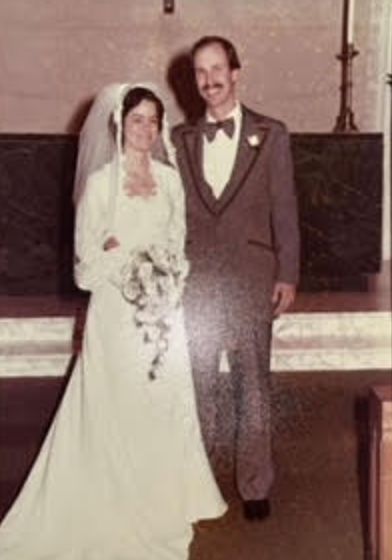
Lee died in February. We celebrated his life the Saturday before Father’s Day. I should have been grieving. Instead, I received flowers and prepared brisket for the meeting after the service. I hugged my brothers and sisters, my grandchildren and my neighbors. I was emailing former colleagues and setting up Zoom links for far-flung friends. But it was okay; I had been grieving the loss of Lee for a very long time – in fact, for years spanning the distance from middle age to old age. I may never completely complete this process, but it’s certainly nothing new; Anyway, I’m pretty used to it.
I am a historian. My world is structured by events and dates. Lee and I met in 1977 and married in 1978. I was 26 and he was 36. Our four sons were born between 1980 and 1983. (Yes, the youngest are twins.) We went through a lot of ups and downs and managed to stay married until 2010 when we divorced.
Our separation was horribly painful; it was difficult to untangle 32 years of friends, possessions and expectations. We have generated enough anger and resentment to flood the gulf of silence between us. Lee had two significant committed relationships with women after the divorce, further cementing our estrangement.
We had virtually no contact until our twins’ weddings in 2016 forced a rapprochement. From then on, interactions became easier. The conversation was awkward at first, then slipped into familiar patterns. Old memories created a scaffolding for a tentative new friendship. We even danced together. It all seemed adult, civilized and strangely easy. He didn’t have to hate me anymore. I didn’t have to fear or be responsible for his bad behavior.
Then, in 2019, shortly before his 78th birthday, Lee was diagnosed with Parkinson’s disease and Lewy body dementia. No one was surprised; he had been showing signs of cognitive slippage for years. But his girlfriend contacted our sons and me, telling us about her diagnosis and explaining that she couldn’t take over his care.
It was an extremely wise and loving decision, one that focused the family’s concerns and jump-started a legitimate response. To everyone’s surprise, including my own, it turned out that I was still part of Lee’s family.

Courtesy of Lucinda Myles McCray
Lee was not an easy person to help. He had an Ivy League Ph.D. and the ego that goes with it. He had a terrible character. He drank too much. He dominated conversations and was always sure he was right about everything.
Although he was also charming and very funny, his diagnoses scared him and made him see enemies everywhere he looked. The doctors misdiagnosed him. The state, wrongly, did not allow him to continue driving. His sons conspired to break up his romantic relationship and prevent him from spending the winter from Wisconsin to Arizona. But, for some reason, he listened to me.
I convinced him – over and over again – that it made no sense for him to move to Arizona. And I started thinking about moving to Minneapolis, where I could be closer to our grandchildren and help take care of Lee.
Even before moving, I started helping. I spent three weeks in Lee’s house, emptying it so it could be put up for sale. I got rid of his bookcase, which filled four rooms. I made countless trips to charity shops to get rid of clothes and household items that Lee would never use again.
Perhaps most importantly and most painfully, I went through his paper files. This had to be done page by page, because Lee had kept copies of all of his financial documents, including his personal checks, since we separated. These were mixed with correspondence, printed bibliographic research and 50 years of research notes and teaching materials.
Lee saved and filed everything. During his last years of independence, he lost the ability to prioritize or categorize anything. Her house became a physical map of her illness: cluttered, untidy, dirty and terribly sad. I cried while burning two shredders and making repeated trips to the recycling center 13 miles away. His magnificent big brain had left home long before Lee. Go, go, go.
I closed the door to Lee’s quiet, clean, empty house and returned home to Wyoming. The boys told me Lee was doing well, settling into his one-bedroom apartment in a nice new building downtown. I had a puppy and did a lot of cross-country skiing.

Courtesy of Lucinda Myles McCray
Then Covid came down. So on March 20, 2020, I packed up the dog and drove 1,000 miles to Minneapolis, planning to help care for my two granddaughters, then ages 2 and 4, so their parents could work from home and I could be near my family during the pandemic.
Our local son and daughter-in-law were Lee’s closest relations and family support system for years. He went to my daughter-in-law’s parents for the festive meals; our son cut Lee’s horrible nails and got a haircut. However, the pandemic and my move to Minneapolis changed that. Everyone needed more help. And Lee was getting sicker and sicker.
At first, I did things that were easy for me, like finding him new care providers: a new primary care doctor. A new neurologist. A new ophthalmologist. A new dentist. When Lee became too confused to live independently, I helped find him a memory care center. Then, non-intervention gradually transformed into practical intervention.
As the pandemic eased, I took him to medical appointments and became both his health care advocate and family interpreter and communicator of his medical information. I often drove him to and from family social events. We went out to lunch. I bought her clothes and tried to organize her closet and hopelessly confused closets. I comforted his terrible anxiety about his phone, his wallet, his watch, his belt, his lists.
Parkinson’s disease and Lewy body dementia are horrible. There are medications that mask the progression of symptoms for a period of time, but the damage is continuous and relentless. Lee lost much of what made him Lee in the three and a half years between diagnosis and death.

Courtesy of Lucinda Myles McCray
Very early on, due to short-term memory loss, he could no longer read and write, follow a televised sporting event or watch an old movie. His 6-foot, 3-inch body bent and stiffened until he could no longer move or sit without pain. He could neither walk faster than a shuffler, nor sit down or get up from a chair easily. Getting in and out of a car was a miserable ordeal. And the emotional aspects were as horrible as the physical aspects. Lee was bored, anxious and depressed.
But his incredible long-term memory outlasted almost every other aspect of his personality. And I was the only one who shared some familiarity with the people, places, and events of his past. Almost until he lost the ability to speak, we discussed old colleagues and friends, ideas for research projects and trips we had taken. Through these slow, disjointed, quiet conversations, Lee retained his identity and I found that the things fractured by our separation and divorce were beginning to heal.
One of those things was the family we started together. Our sons were adults when we separated, but they continued to suffer from the pain and betrayal that accompanied divorce. They viewed our marriage and family as special, unusual, and somehow indestructible. They hadn’t seen the cracks in this carefully constructed edifice – cracks that I had done my best to hide from them.
The feeling of betrayal ran deep and was compounded by Lee’s relentless – and ultimately unsuccessful – efforts to find a new partner: a woman who would support and care for him. Our sons had to tolerate, and sometimes embrace, Lee’s ladies. At the same time, while being faithful to their father, they maintained strong romantic relationships with me.
An important and unexpected benefit of my involvement in Lee’s end-of-life care was a family reunification of sorts. The boys from out of town came to visit us. We spent a few vacations together and passed our grandchildren from one pair of elderly laps to the next at Sunday dinners and backyard barbecues. We remembered that Christmas long ago when we were all sick and wore our pajamas all day and watched movies, snuggled up on the couch. We took lovely group photos and talked, with loving tears, about caring for Dad. And when the end came, we faced it and lived together.

Courtesy of Lucinda Myles McCray
Just before Thanksgiving 2022, I received a call from the memory care nurse around 1 p.m. Lee hadn’t moved from his recliner all day. He didn’t come to the meals. He didn’t speak. Could I come?
This was the start of the final stage. Palliative care. Moving family farewells. A strange holiday season. The long wait became daily.
I got used to perching on Lee’s wheelchair next to his hospital bed and feeding him little pinches of coffee cake with my fingers. I asked the friendly and knowledgeable nurses at the hospice about ways to prevent pressure sores. I requested a steady increase in morphine doses to ease Lee’s discomfort. And I did what people have done for their dying loved ones since the beginning of human time: wait out the end.
It happened on a sunny February afternoon. Our oldest son had arrived from California the day before. He was with Lee when he died.
I say “my loved ones”. There are many kinds of love. At some point in the last two years, Lee asked me, “What is our relationship like now?” And I replied: “We are old and dear friends. » It was as true as it could be. Lee introduced me to his caregivers as his wife; this was also true in some important respects. It wasn’t legally accurate, but it expressed the central fact that Lee and I had been married for most of our adult lives. He was with…
Gn Health