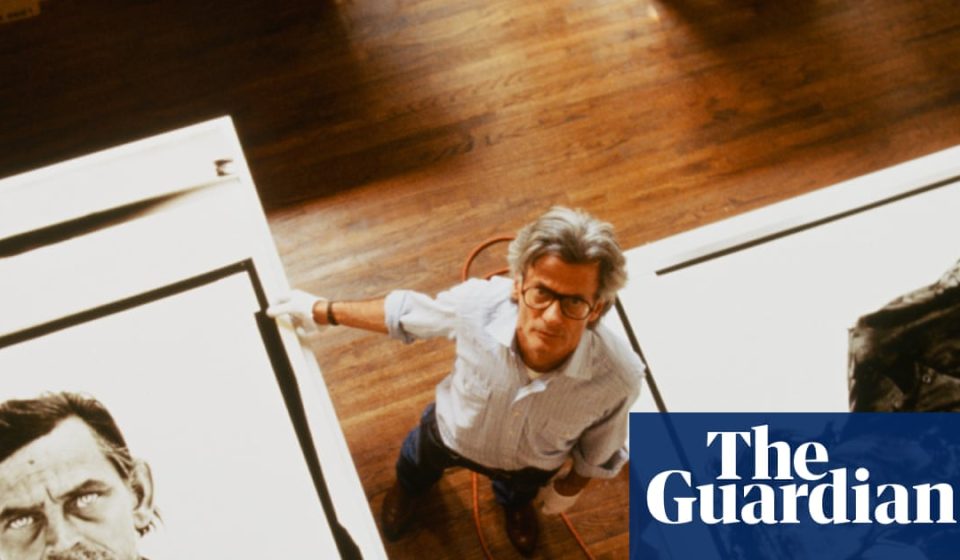
“I look for faces that surprise me”: how Richard Avedon photographed the soul of his subjects | Documentary films

A.Richard Avedon had only taken a few images when he accidentally hit his head on a lamp held above him. The Dalai Lama burst out laughing. That’s when Avedon took two more pictures and announced, “Oh, I got it!” »
Avedon’s assistant, Sebastian Kim, was baffled. “I was wondering, what happened? There are only four images on a roll of 12 images,” he recalled in a telephone interview. “I realized that he knew at that moment that something had happened, that something had gone wrong: he hit his head and the Dalai Lama lit up.”
Kim, 52, now a prominent photographer in his own right, is among the interviewees featured in a new documentary, Avedon, directed by Oscar winner Ron Howard, which premiered at the Cannes Film Festival and is streaming on Netflix this week.
The film explores the six-decade career of the fashion and portrait photographer renowned for his distraction-free white backgrounds and for his photos of people ranging from Marilyn Monroe and Charlie Chaplin to civil rights activists, anti-war protesters and the American working class.
Avedon grew up in New York. His father, Jacob Avedon, co-founded a specialty store on Fifth Avenue that disappeared overnight during the Great Depression. Avedon struggled academically and dropped out of high school despite winning a citywide poetry prize.
He once said, “My father wanted me to be highly educated, physically strong, and earn a living. But I always felt like I had failed. I grew up thinking that I was undeniably stupid. I couldn’t graduate from high school. I failed at everything.”
During World War II, Avedon joined the merchant navy. Assigned to the photographic unit, he took more than 100,000 photos of identity cards and produced autopsy documents. Observing countless faces on white backgrounds taught him that no two faces are alike.
At the New School’s Design Laboratory, Harper’s Bazaar art director Alexey Brodovitch introduced Avedon’s core philosophy: “Amaze Me.” When Avedon struggled to design a neon sign using traditional media, Brodovitch suggested using pipe cleaners or spaghetti, teaching Avedon to never let technical limitations hold him back.
Commissioned by Harper’s Bazaar magazine, Avedon brought theatricality to fashion. Observing Christian Dior’s The New Look collection from 1947, Avedon captured models moving, twirling and laughing in the streets of Paris, transforming fashion photography from static poses to dynamic visual storytelling.
His approach to portraiture was no less distinctive. Avedon’s studio aesthetic was based on a stark, seamless white paper backdrop, outlined by a bold black film border. He once explained: “It’s existential whiteness. The only thing we see is the geography of the face. One of the functions of art is to eliminate in order to make more powerful or stronger what the artist wants to convey.”
“I remember once I fasted for three days. I fasted with a friend. And she and I decided after the fast, how are we going to break the fast? We decided on a peach. I’ve never tasted anything like this peach in my life. Because everything, because of the fast, becomes so precious. It’s kind of a matter of getting rid of the background.”
For his 1957 photo of Monroe, Avedon waited hours of gleeful posing until the actor collapsed in silent exhaustion. Monroe slumped in a corner, allowing Avedon to capture her unguarded melancholy – a portrait often referred to as Sad Marilyn.
He believed that models were active creative collaborators rather than decorative props. He once said, “I know exactly what I want before I leave the house in the morning, but if the girl doesn’t feel like she’s part of it, if she feels like she’s someone who’s hired for an hour, a stick of wood who’s going to be told to stand there and do that, that’s exactly what you get from her.” »
By engaging participants through conversation, music and play, it created an atmosphere of mutual trust. Models like Penelope Tree and Lauren Hutton recall in the film that working with him was liberating, allowing them to let their guard down and express their vulnerability in front of the camera.
Dallas Brennan Rexer, 54, one of the film’s producers, said: “He was trying to get into their heads and their souls, in a way, through his photos. It was the same process for him anyway, and the models we interviewed explained that they weren’t treated like models who were just there to hold the clothes.
“He was a human being that he connected with and he asked them questions and he tried to understand what they were thinking and what they were feeling and tried to help them get something that radiated and gave them energy. That’s what made the photos special. It wasn’t just that they looked pretty and their clothes were pretty.”
Avedon photographed the Duke and Duchess of Windsor in their hotel suite. Aware of their polished public persona, he broke their guard by claiming his taxi had hit a dog.
Rexer says: “He knew how he felt about their politics and he didn’t want to let himself be used to make another pretty, polished photo of them. He wanted to say something much more pointed and important. He used photography in a very clever and specific way. He captured the moment where he felt he was saying everything that needed to be said about them.”
Although Avedon achieved commercial success – directing television campaigns for Calvin Klein – he channeled his resources into politically-oriented documentary work.
In 1963, Avedon reconnected with his high school friend James Baldwin, with whom he had co-edited a school magazine. Together they published Nothing Personal, combining Avedon’s portraits of civil rights leaders and psychiatric patients with Baldwin’s rich prose.
Rexer explains, “Dick was at a point in his life where he was ready to get involved in something political and he wanted to do something meaningful for civil rights. Nothing Personal is a phenomenal book. The text that James Baldwin wrote is poetic and beautiful, but it also resonates today.”
Avedon’s asylum photographs were deeply personal, influenced by his sister Louise, who suffered from serious mental illness. He said: “I photographed things that scared me so I could understand them. »
But when Nothing Personal received a scathing review in the New York Review of Books, Avedon was crushed. He admitted: “That criticism just kept me from working for about a year because I started to question myself as an artist. »
Avedon nevertheless continued his political commitment. During the civil rights movement, he quietly supported activists. Rexer notes, “In the background, very quietly, Dick would send the film to SNCC (the Student Nonviolent Coordinating Committee) because they were using photography to hold people accountable for what was happening in the South. Then they would send the film back, and he would take it to the lab and process it for them, quietly on the side to just keep the movement going.”
These efforts culminated in In the American West (1979-1984), commissioned by the Amon Carter Museum of American Art in Fort Worth, Texas. For five summers, Avedon photographed the American working class in front of white paper. Avedon said of the project: “I’m looking for faces that surprise me. I’m looking for a face that will hold up the wall.”
In 1992, at age 69, Avedon became the first photographer in the history of the New Yorker magazine, hired by editor-in-chief Tina Brown. He has produced portraits of world figures and controversial fashion essays, such as the Mr and Mrs Comfort portfolio.
In a statement provided by Netflix, Howard observed: “He had to learn to balance his commercial success with his creative endeavors, using his own resources to finance much riskier projects. He understood how to draw on the popular to make room for the unusual… In many ways, Avedon challenged the idea that there must be a division between art and commerce, highbrows and lowbrows, beauty and brutality.”
Avedon’s internal contradictions are at the heart of Howard’s documentary, which draws on unprecedented access to the personal archives held by the Richard Avedon Foundation, including hundreds of thousands of negatives, contact sheets and images taken behind the lens.
Rexer says: “The archive is intimidating at first because there have been 16,000 sessions, and that can only mean hundreds of thousands of images, so it’s a bit overwhelming for the first few months. »
Among the production team’s most extraordinary discoveries was a cache of casual audio tapes recorded in Avedon’s studio in the 1960s and 1970s with collaborators like Marvin Israel and Doon Arbus.
Rexer says, “They would put a recorder on the table and record and forget about it. So you could be a fly on the wall. He was working on a lot of questions about truth, identity, the self and all the big things like beauty. They would have these wonderful lunches with these abstract conversations about it, but then he could turn it into something concrete.”
Despite all the successes, the workaholic Avedon lived in a constant state of anxiety and doubt. His son, John Avedon, says in the film: “He had confidence like a bull’s. At the same time, he was completely unsure of himself. He absolutely suffered from performance anxiety, but then he absolutely performed. I think he had to be anxious to perform..”
For Rexer, this is the key to unlocking much of Avedon’s work. She explains: “You have to have the confidence to walk up to Henry Kissinger and say, ‘I’m taking your portrait right now and no, we’re going to do it this way, put your hands down and look into my lens.’
“But also insecurity or the lack of knowing everything to be able to ask…
Gn entert