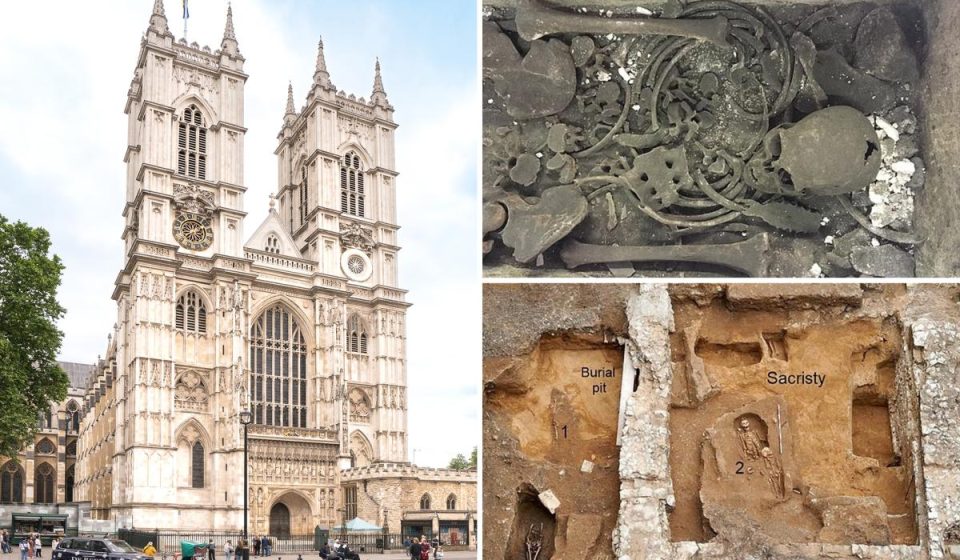

They lift the veil on this centuries-old mystery.
The identity of a mysterious skeleton discovered at London’s Westminster Abbey has potentially been revealed – more than 150 years after it was discovered.
“We have two viable contenders,” reported Professor Warwick Rodwell, a consultant archaeologist at Westminster Abbey who led the study, according to Livescience.
These remains were discovered in a stone sarcophagus unearthed by the monument’s chief mason in 1820, according to a study published in the Journal Of The British Archaeological Association. Workers had inadvertently stumbled upon it while digging on the north side of the abbey for an undisclosed project – and accidentally smashed the lid into six pieces.
Unfortunately, expert analysis revealed that the ship had been looted earlier this century, leading researchers to initially believe it was devoid of bones.
The incident was not officially recorded until 1869, when the stone was finally repaired.
It was then that they noticed on the side of the container a Roman-style sculpture with a Latin inscription dedicated “to the memory of Valerius Amandinus”.
This would seem to indicate that the occupant was Roman, except that there was a massive cross carved into the lid of the sarcophagus, suggesting that the tomb was reused for the burial of a worthy religious figure centuries later.
This mystery eluded archaeologists for 150 years until 2016, when the ship was opened for conservation, revealing that it did indeed house a skeleton.
Although the bones had been weathered over the years – with a hole in the skull and jumbled arm and leg bones – it was clear that they belonged to a middle-aged, average-sized man, who also had a history of gout, rib injuries and osteoarthritis.
Using carbon dating, researchers were able to deduce that he lived between 987 and 1052, confirming that the Roman-era sarcophagus had been reused.
But who was the occupant? To get to the bottom of the matter, Rodwell examined the birth and death dates of the abbots of Westminster as well as their tenure, ultimately narrowing the pool to two candidates.
These were Ælfwig, who served from 993 to 1020, and his successor Wulfnoth, who held the position from 1020 to 1049.
“We don’t know the date of birth of either of them,” Rodwell said, according to the Daily Mail. “But either would fit just as well if we assume the abbot was in his early 20s when the appointment was made and nearly 50 when he died.”
He added: “The fact that Aelfwig is already a monk of Westminster might favor him. »
However, the nature of the burial remains perplexing.
Rodwell noted that the recycling of Roman sarcophagi is highly unorthodox – no comparable cases having ever been documented – although he believes a clue might lie in the inscription itself.
The scientists noted that the “memoriae” (memory) on the box could indicate that Valerius Amandinus was himself an early Christian who could have been an important player in Roman London.
“Unfortunately, nothing is known about his career,” Rodwell lamented.
Gn world