It is a shocking panorama that awaits the visitor at the exit of the Hugo-Chavez international airport in Cap-Haitien, the country’s second city: kilometers of coastline strewn with waste and columns of smoke rising into the sky. The trash is burned in places, causing the rats to panic.
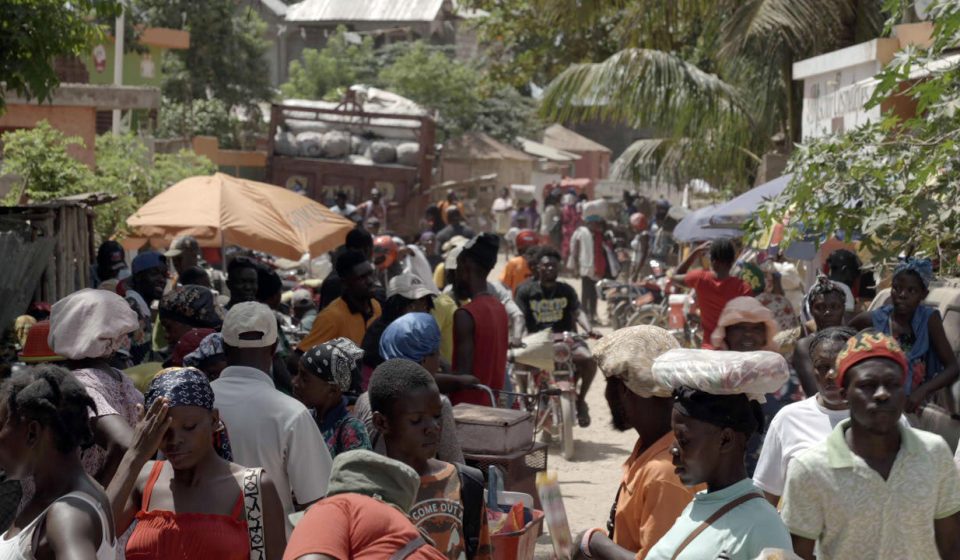
A beach along the road from the airport to the city is home to a noisy and chaotic market. Food is sold there in deplorable health conditions.
On a nearby boulevard pass white vans bearing the logo of the UN World Food Program (WFP), one of the main international organizations locally managing the deep humanitarian crisis that Haiti is experiencing.
This Caribbean country is experiencing one of the worst humanitarian crises in Latin America and the Caribbean: 5.8 million people suffer from acute food insecurity, or 52% of the population. According to the World Bank, Haiti is the poorest country in the region, with 58.5% of its population living below the absolute poverty line, on less than $2.15 per day.
For Wanja Kaaria, WFP director in Haiti, “needs far exceed resources”. The situation has continued to worsen in recent years for two main reasons. On the one hand, gang brutality has led to the forced displacement of nearly 1.5 million people. The precariousness of the population has also increased due to the intense drought linked to the El Niño phenomenon, which leads to “poor agricultural production”.
Flee violence, survive with agriculture
Traumatized by the shootings, homicides and extortions inflicted on them by the armed gangs controlling nearly 90% of Port-au-Prince and its surroundings, several hundred thousand families have chosen to get as far away as possible from the violence reigning in the capital by going into exile in the northwest of the country.
Also (re)read“Night of terror” in Haiti: around forty people killed in a gang attack
Faced with incessant racketeering, farmer Premise Desarmour chose to change markets and traveled 250 kilometers to market her produce in the village of Mare-Rouge. Here, they are sold four times cheaper than in the capital. “It is the insecurity in Port-au-Prince that forces us to come and sell in Mare-Rouge. Unfortunately, we sell the products at much lower prices,” she explains.

Premise Desarmour, Haitian farmer in Mare-Rouge, July 7, 2026. © Andrés Suarez Jaramillo, France 24
The low yield of its crops despairs Premise Desarmour. However, she has never stopped working this land which belongs to her and her husband. The latter chose six years ago to illegally reach the United States, from where he sends money when he can.
To balance her finances, in addition to harvesting green bananas, coconut or vegetables, Premise Desarmour decided to become a veterinary technician, to reduce the premature mortality of goats – animals omnipresent in Haitian villages and which constitute one of the main sources of protein in this Caribbean country. Unable to finance training of this type on its own, Premise Desarmour was able to benefit from courses financed by the NGO Heifer Internationalwhich fights hunger by supporting local farmers.
She now helps goat owners in Baie-de-Henne whose animals fall ill.
That day, a woman presented him with a goat that was no longer eating. Premise Desarmour kneels under the scorching sun to inspect the animal’s mucous membranes for possible anemia. Finally, she injects a vial of vitamin B into the animal using a syringe.
“I asked this lady to bring the goat to me in a few days to see how she is doing and if the treatment is working,” explains Premise Desarmour. She assures that thanks to the care, fewer animals die in this area and that those who had difficulty reproducing now have more young. The consultation costs around 4 euros, half to pay for the medication and the other half to pay. A way to compensate for his low agricultural income.
A high risk of drought with El Niño
Among his neighbors are Palmy Igles and Thérèse Augustin, both over 60 years old. Palmy Igles has banana plantations that require frequent irrigation, at least once every two or three days. “With the rain, there’s no need to water. And even if it doesn’t rain every day, the soil remains moist and can last a fortnight without irrigation. But in the event of drought, you can lose everything if you don’t water,” he explains.

Haitian farmer Palmy Igles, installed in Baie-de-Henne, July 8, 2026. © Andrés Suarez Jaramillo, France 24
With the El Niño phenomenon expected to be particularly strong in the coming months, countries in Latin America and the Caribbean risk being hit by two periods of drought by March 2027. The nations most vulnerable to climate change are expected to suffer hard, and the consequences are expected to be devastating. Fears are great in the northwest of the country, which suffers from desertification and soil erosion.
Also readDrought, deforestation, waste… Haiti faces the challenges of climate security
Thérèse Augustin’s fruit trees would already be in a critical situation without the irrigation system installed by the NGO Heifer International several years ago. A modular network of pipes that allows different communities in Baie-de-Henne to benefit from drinking water, irrigate crops or water animals.
Facing a papaya tree, Thérèse Augustin grabs her machete to dig a channel in the ground, while tubes are connected together so that the water stored in a reservoir comes to irrigate the roots. “This system is a blessing for us. Before it was built, we had to walk a lot to fetch water,” explains Thérèse Augustin.
With the drop in precipitation linked to the El Niño phenomenon, Premise Desarmour, Palmy Igles and Thérèse Augustin fear seeing their harvests reduced and fear that the shortage of water and food will prevent them from properly feeding the animals.
This article has been adapted from its original Spanish version.