They waited for hours in the rain and cold of this never-ending winter in Joinville, in the south of Brazil, this Saturday, September 19. In the exhibition center of this city in the state of Santa Catarina, which once hosted the largest arms fair in the country, activists can’t believe it.
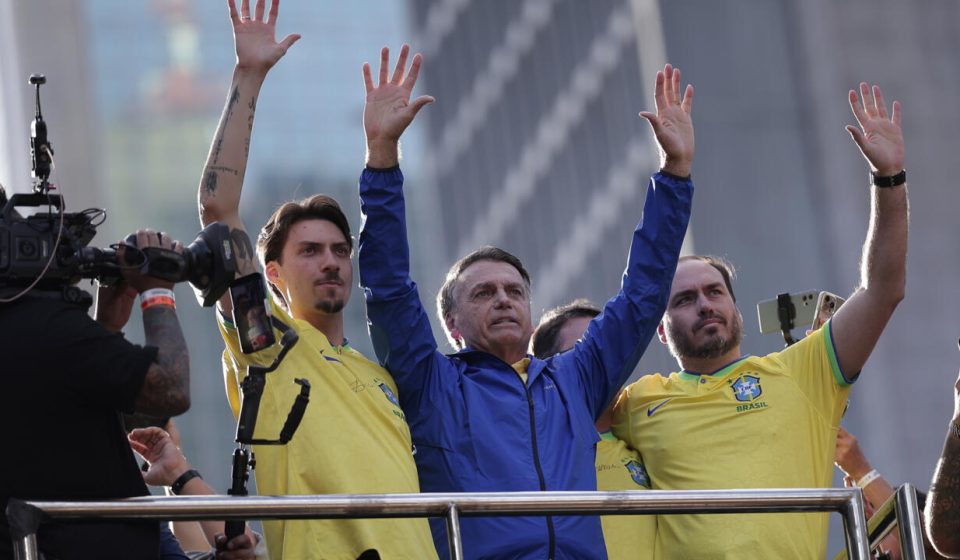
It must be said that his voters in the Bolsonaro family are spoiled: on stage, they have not one, but two Bolsonaros. The eldest son Flavio (45 years old), nominated by his father Jair as Liberal Party candidate in the presidential election, is accompanied by his brother, Carlos (43 years old), who is running for the senatorial elections. “Why is your state exemplary? Because it has never been governed by the Workers’ Party!” chants Flavio, urging the public to vote for his little brother who is trying his luck in the Senate for the first time, in this southern region.
Municipal councilor of Rio de Janeiro for more than 20 years, Carlos is a pure carioca product parachuted here and who is regularly mocked for his excessive emphasis on the “ch”. He decided to move to the south a few months ago, guided, according to him, by the values of the population of this region. And above all to run for a position as senator which would be much more difficult to obtain in the tourist capital of the country, with an overly competitive political landscape.
A strategic location in the south of Brazil
Carlos Bolsonaro’s running mate, Carol de Toni brings her experience to bear in Joinville. “He helped participate in the management of a city like Rio, so our state next to it is a gift! We are a hardworking and conservative people, who adhere to the values that Jair Bolsonaro defended.” As if the aura of the father, sentenced last year to 27 years in prison for attempted coup d’état and banned from participating in the campaign, was traveling in the son’s body.
“I’m very religious. I wouldn’t go so far as to say that it’s a bit like the Holy Spirit, but there is a bit of that. Jair Bolsonaro is the hero of all of us. So if he can be with us a little through his sons, that’s so much the better!”, assures Carole de Toni. In fact, the portrait of the former president, like a talisman, sits everywhere on every campaign trip.
Also readPresidential election in Brazil: Flavio Bolsonaro targeted by an investigation for corruption
Behind Flavio, Carlos fades a little. Even in the absence of his big brother, his media interventions are rare. At campaign HQ, we remind you that “the schedules of Bolsonaro candidates are not communicated for security reasons”. For Felipe Pereira, journalist for the Universo Online (UOL) portal, it is above all a campaign strategy. “Remaining silent in the face of the national media and pouring everything out on their networks is an explicit request from Jair Bolsonaro,” he explains.
Its terrain is therefore not that of platforms, but that of telephones. All the same less charismatic than his father or his two older brothers, he speaks directly to activists and maintains a relationship of distrust with regard to institutions with the rather radical Bolsonarist base.
In the state of Santa Catarina, which voted almost 70% for Jair Bolsonaro in the last presidential elections in 2022, this method has found a loyal audience. Messages circulate in family and professional WhatsApp groups. A TikTok video denouncing Lula, the Supreme Court or the government’s environmental policies can be relayed in a few minutes.
A political scientist specializing in Bolsonarism at the State University of Rio de Janeiro, Joao Feres explains why this transhumance towards the south is strategic: “The family is banking on a national brand. These are candidacies without real local roots, which count on the Bolsonaro name to compensate for the absence of a link with the territory. The campaign is organized less around a program than around a carefully chosen political community: a conservative south, made up of large agricultural properties, which is recognizes in the flag, belief in God, the values of work, entrepreneurship, but above all, which viscerally rejects left-wing social policies.
Jair Renan, the youngest apprentice
An hour from the capital of Santa Catarina is Balneario Camboriu, nicknamed the “Brazilian Dubai”. This seaside resort with the tallest skyscrapers in Latin America essentially lives off money from the agri-food industry. An audience already committed to the cause of the former president. Jair Renan (28 years old), the youngest of the siblings, feels like a fish in water. He came to study law at the Avantis University Center. Jair Renan Bolsonaro was baptized in the evangelical church and then was widely elected municipal councilor 3 years ago. His niche? Talk to young people.
In his campaign office studded with photos of both father and son, activists even laugh at his physical resemblance to his patriarch. They assure that he is “the best candidate in the state, seeing him as a young person who wants it” and who “supports his father who no longer has the right to express himself”. However, he speaks very little in the council gallery, and when he speaks on the networks, his tone and his speech seem typed. Last April, he gave a confused speech on the Brazilian military dictatorship, evoking older elected officials for whom “it was the best time in Brazil.”
In front of the HQ, hairdresser barber Eduardo Souza had requests for cuts like “Renan”! He said it with a smile on his face, before a grimace appeared on his face. “He can surf on the name and even the first name of the father, but it is only him who can save our country from the communist Lula.”
Brazil: Lula and Flávio Bolsonaro launch their presidential campaigns
An extension in your browser appears to be blocking the loading of the video player. To be able to watch this content, you must disable or uninstall it.

Cover image: © France 24
For political scientist Joao Feres, moderation would contribute to “diluting” the Bolsonaro brand. “Radicalizing preserves it, but that limits the electoral ceiling,” he explains, inviting us to be wary of the idea of an automatic inheritance.
“Jair Bolsonaro’s political capital is not transmitted by inheritance,” he believes. His sons bear the family name and, with it, “access to an already established electorate”. But none would have yet constructed “an own direction which could be maintained without reference to the father”. Behind the flags and slogans, a question begins to emerge: can Bolsonarism survive Jair Bolsonaro without remaining prisoner of his shadow?