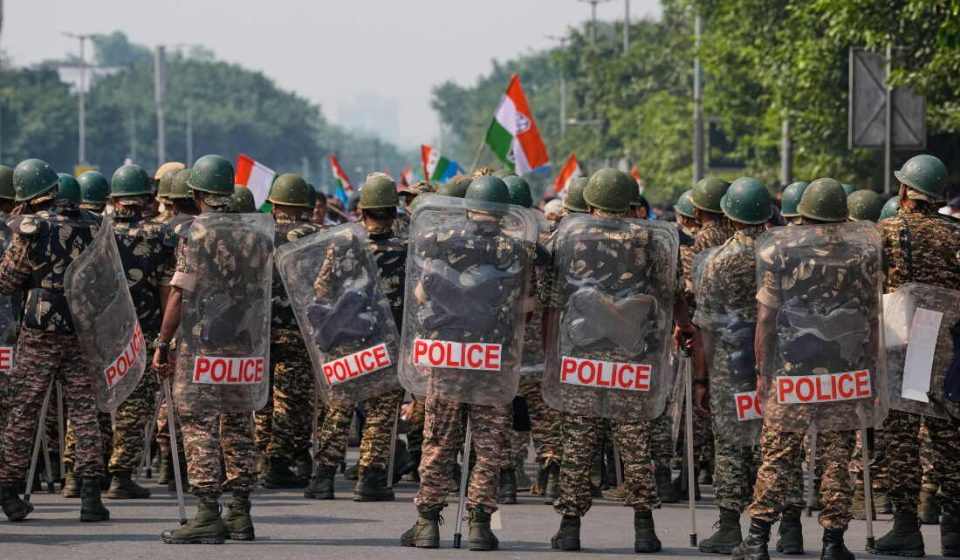


Security officers in riot gear arrive Monday to escort workers of the opposition Indian Congress party as they gather for a march to the Supreme Court demanding the resignation of Chief Election Commissioner Gyanesh Kumar in New Delhi, India.
Manish Swarup/AP
hide caption
Manish Swarup/AP
NEW DELHI — Indian opposition parties marched to the Supreme Court on Monday to protest a purge of voter rolls they say favors Prime Minister Narendra Modi’s party, after police arrested thousands of activists over the weekend in a sweeping crackdown in New Delhi.
Several opposition MPs and thousands of supporters marched in the capital and submitted a petition to the chief justice, alleging irregularities in the revision of electoral rolls nationwide.
Protests led by the “Cafard” youth movement have intensified since electoral authorities began the review last year, removing more than 130 million voters from the rolls. Protesters, including opposition parties, are demanding the resignation of Chief Election Commissioner Gyanesh Kumar.
Critics say the process is politically motivated and risks disenfranchising eligible voters. Modi’s Bharatiya Janata Party and the Election Commission deny allegations of manipulation, saying the move is necessary to remove duplicate and ineligible names.
Ahead of the march, authorities closed six metro stations in the capital on Monday and warned of traffic disruptions.
Opposition leader Rahul Gandhi of the Congress party described the growing protests as a fight to defend the constitution.
“We will not back down,” he told reporters in New Delhi.
Gandhi, a scion of India’s most influential political dynasty, is seeking to turn the protests into a broader challenge to Modi.
Gandhi briefly rode through the crowd in an open bus, holding up a copy of the Indian Constitution. Thousands of his party supporters, student activists and other demonstrators followed him. This turnout contrasts sharply with the weekend, when authorities briefly arrested thousands of people, including leaders of the “Cockroaches” movement and journalists, and effectively cordoned off much of the capital to prevent large-scale protests.
Modi has not commented publicly on the protests, but his party leaders have dismissed them, with some calling the activists “anarchists.”
Meanwhile, New Delhi Police announced on Monday that Jantar Mantar, a long-standing venue for mass protests in the capital, would no longer be a designated location for rallies. Police said three alternative sites had been chosen.

The “Cockroaches” movement staged a sit-in at Jantar Mantar earlier this year that lasted for weeks, forcing the resignation of Modi’s education minister in July.
Gn headline