In the early 1970s, Stephen King was a struggling and frustrated English teacher in Maine, with a wife, two young children, and a pile of bills that seemed to be growing much faster than his literary career. During the day, he taught teenagers at Hampden Academy. At night, he wrote short stories and rapid-fire terror tales for lower-tier skin magazines like Rider And Adam. The pay wasn’t high, but it…barely kept the lights on. “Two hundred dollars,” King said of his usual fee at the time. “Every once in a while it was $500. It was a huge paycheck. It bought a lot of groceries.” Things were so tight the Kings didn’t even have a phone.
Then, in 1972, King began tinkering with the idea of a painfully awkward teenage girl who is mercilessly bullied by her classmates and terrorized at home by her religiously fanatical mother. When the young girl discovers that she has telekinetic powers, she finally finds a way to fight back. The story will reach its cathartic crescendo at his high school prom, where a horribly cruel prank involving a bucket of pig’s blood turns what should have been the best night of his young life into an apocalyptic bloodbath. Her name was Carrie White.
Although he had no way of knowing it at the time, the book he had just begun to write would change the course of his life. And not just his. The 1976 film adaptation of Carrie would make Sissy Spacek a bona fide star, give Brian De Palma his first box office hit, and achieve something horror films almost never do, then or now: crush the Oscars. It would also mark the start of one of the most prolific – and lucrative – pipelines in cinematic history, with King’s stories adapted for the screen more than 60 times. Fifty years, multiple remakes, a famous Broadway musical, and an all-new Prime Video series later, Carrie White’s bloody footprints are still everywhere you look.
The inspiration for the novel that would become Carrie came from several places. Years earlier, while working as a janitor at a school, King had cleaned the girls’ locker room and noticed the sanitary napkin dispensers attached to the walls. He began to imagine a teenage girl experiencing her first period in the shower without understanding what was happening to her while his classmates responded by ridiculing him. He combined this image with his interest in telekinesis and his memories of two girls he had known growing up who had been treated as social outcasts. “I wasn’t bullied,” King says. “I think every kid feels a little bit bullied at school, but I was less bullied than the others.” But the girls weren’t so lucky. “They were savagely harassed about their clothes, their hair, their lack of social grace. They were country kids and they were treated really badly.”
What marked King was the impossibility of escaping the roles that high school had assigned them. Even when the girls tried to improve their appearance, their tormentors wouldn’t let them. “If they tried to wear new clothes or something after Christmas, they were harassed twice as hard,” he says. “No one wanted to let them get out of the box. » This heartbreaking observation would become the emotional foundation of Carrie. Sometimes the only way out is to burn the whole place down.

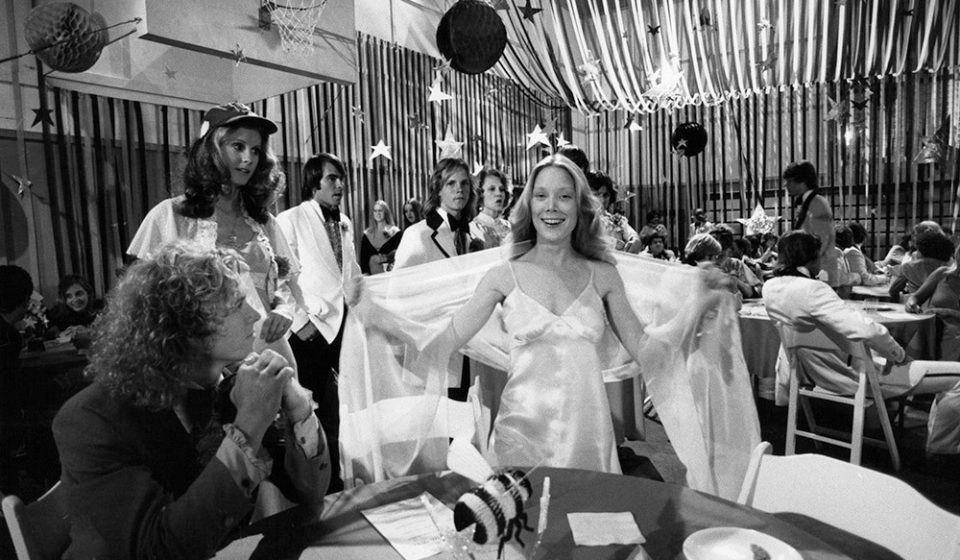
Carrie’s most powerful moment isn’t the prom massacre; it’s the look on Carrie’s face when she realizes she’s been crowned prom queen and believes, for perhaps the first time in her life, that she belongs there. Then the blood falls.
United Artists/Getty Images
John Travolta, who plays a mean boyfriend, combs the locks into his “stuntman image.”
Bettmann/Getty Images
At first, King envisioned the story as another quick sell to Riderwhich he called his “must-have magazine” at the time. “I thought, ‘Here’s a story idea: a girl who has her first period and she’s telekinetic and she gets revenge on these girls.’ » But almost immediately he ran into problems. On the one hand, he wasn’t convinced he knew enough about the female experience to make the opening believable. “I didn’t know anything about girls’ locker rooms,” he said, starting to laugh. “I didn’t know if there were towel vending machines. I didn’t even know what those napkins were, for God’s sake.” Worse, the story was already exceeding the magazine’s usual word count, and King feared it would become too long for a short story and too short for a novel, so he crumpled up the pages and threw them in the trash.
This could have been the end of Carrie White, if King’s wife, Tabitha, had discovered the abandoned manuscript, read it, and recognized something that her husband had not discovered. “Tabby fished him out and said, ‘You know, this is really good, so keep it up,'” King recalled. He did so, and over the next three months the little story he had abandoned became his first publishable novel. Fifty years later, when asked how many times he thanked his wife for retrieving these pages, King doesn’t even pause to think: “A lot.”
King’s manuscript eventually landed on the desk of Bill Thompson, an editor at Doubleday who had already read several of King’s previously rejected novels. Thompson saw something in Carrie and invited the budding author to New York. King could barely afford the trip. His mother-in-law gave him money for a Greyhound ticket and he traveled overnight from Maine, without money for a hotel. Thompson took him to lunch, where several gin and tonics were consumed at the publisher’s expense. “I was pretty bombarded,” King recalled. Afterward, he got hopelessly lost returning to the Port Authority Bus Terminal. When he finally got home, Tabitha asked him how the meeting went. “I think they could publish the book,” he told her.
In 1973, Doubleday bought Carrie for $2,500. The news came by telegram because the Kings still did not have a telephone. Tabitha received the message via Western Union and asked her husband to call the principal’s office through the school loudspeaker. King immediately thought of two possibilities: either one of his children had been injured, or he had sold the book. He still has the telegram, framed on the wall of his office in the much nicer Maine house he now calls home, bearing Thompson’s wonderfully prophetic message: “The future awaits us.” »
Carrie was released on April 5, 1974, with a modest first print run of 30,000 copies. It wasn’t an immediate sensation in hardback (it sold about 13,000 copies), but critics were intrigued by the newcomer. THE New York Times praised the novel’s poise and imagination, recognizing that its mix of supernatural terror and adolescent cruelty marked the arrival of a distinctive voice. King, however, felt that Doubleday was too absorbed in another of his titles: that of Peter Benchley. Jaws – to promote his book.
A Tale of Two focuses on key art in 1976.
Courtesy of the Everett Collection
Benchley probably also got a much bigger advance: King’s $2,500 was barely enough to splurge on a new Pinto. Nor did he amass a fortune selling the film rights. Veteran producer Paul Monash, whose credits included Peyton Place And Butch Cassidy and the Sundance Kidoffered a whopping $500 for the rights to the story. “And Doubleday got half of it,” King says. “So, $250. Big whoop. I could have made more with one of the Rider stories. » He still accepted the offer.
Fortunately, after the hardcover came out, there was a windfall when an editor at the New American Library fell in love with Carrieand paid $400,000 for the paperback rights. Again, Doubleday got half of it, but it was enough for King to quit teaching and start writing full time. He also used some of the money to help his mother, who was still working even though she was suffering from cancer. “I went over to where she was working and said, ‘You’re done,’” King recalled. “She cried. It was a very, very good moment.”
The film was put together by United Artists on a budget of $1.8 million – a modest figure even by mid-1970s standards. And the director the studio landed on was Brian De Palma, then 35, the New Hollywood movie kid who had directed the 1972 Hitchcockian thriller. Sisters and the delirious 1974 rock-horror musical The Phantom of Paradise. De Palma’s reputation was that of a dazzling visual stylist, fond of split-screen tricks, daredevil cameras and sexual provocation. The director’s long suspense sequences seemed to take pleasure in torturing the audience. Yet, for the most part, box office success had largely eluded him.
De Palma immediately recognized Carrieand I thought this could lead to the commercial breakthrough that Jaws had recently given to his friend Steven Spielberg. For his part, King was delighted with this choice. He had seen Sisters and captured a simpatico sensibility. The studio tapped unknown Lawrence D. Cohen to adapt King’s novel. Cohen streamlined the book, including its climax. In the novel, Carrie devastates much of her hometown after the ball. But in the film, the destruction is largely confined to the school gymnasium and her home, where she ultimately confronts her bigoted, authoritarian mother. The adaptation was less sprawling and more intimate.
When casting the film, De Palma and his friend George Lucas (who was looking for promising talent for…
Gn entert