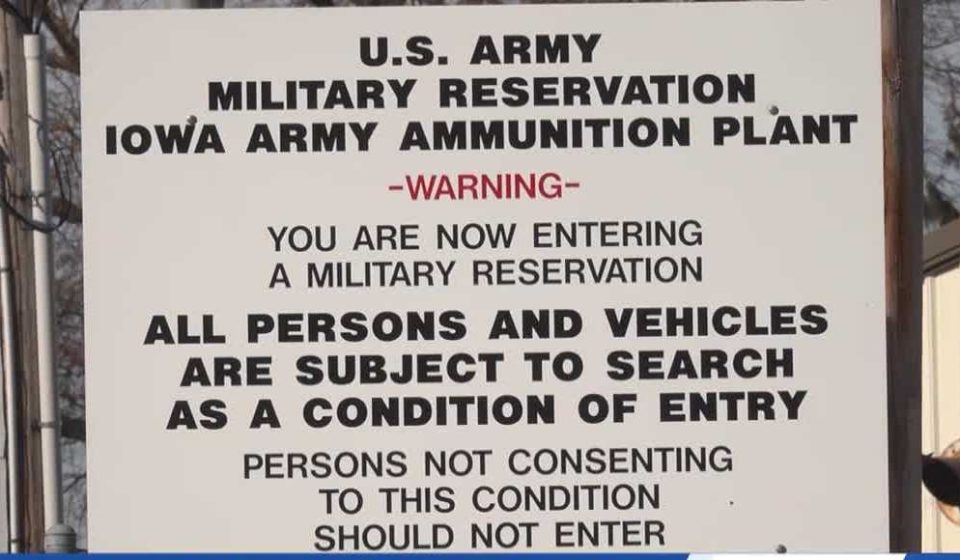

The U.S. military will delay Friday’s explosion of several tons of bomb-making chemicals in southeast Iowa after a wave of public concern that a cloud of lead dust could cause environmental contamination and health problems, pushing back plans until Monday.
Iowa Gov. Kim Reynolds was among those who called for the detonation to be delayed as time ran out Thursday. Environmental groups filed a lawsuit earlier today, seeking emergency legal action to stop the project. She released a statement Thursday evening after the announcement, saying she was grateful they delayed.
Planning for the detonation at the Iowa Army Ammunition Plant began after personnel found several dozen barrels containing lead azide that had degraded earlier this year, “creating a very unstable and dangerous situation,” according to an emergency permit approved last week by the EPA. Moving or moving it presented an unacceptable risk of accidental detonation, a possibility that increases in cold weather.
“This will delay detonation until as late as possible before an expected drop in temperature, potentially further destabilizing the material,” Acting Secretary of the Army Adam Telle said in an article on X.
The military shared more details at a public meeting in Middletown in October, but the EPA’s emergency permit cleared the way for a planned detonation Friday.
The permit required the military to model how detonated material might disperse in the air and on the ground, and resulted in a notice Sunday to communities up to 100 miles away.
This was the first time that many communities in the path of a potential drift were informed that they could be affected.
“Public communication is essential to public trust,” Telle said.
The military’s decision to delay the closure was made Thursday evening, but many schools and businesses in the area were already scheduled to close Friday.
Full statement from Acting Secretary of the Army Adam Telle on X
Public safety is the Army’s top priority, and I have ordered Army Materiel Command to postpone tomorrow’s controlled detonation at the Iowa Army Ammunition Plant in Middletown, Iowa, until Monday, November 23. This will delay detonation until the last possible moment before an expected drop in temperature, which could further destabilize the material.
In March of this year, the Army discovered degrading lead azide contained in bunkers at the installation and immediately began communicating with stakeholders and the public in Middletown and the modeled impact zone about the danger it posed. In coordination with the Environmental Protection Agency, experts and the local community, it was determined that a controlled detonation was the option that posed the lowest risk to the public in the immediate area.
Public communication is essential to public trust. Therefore, the Army will continue to actively collaborate with state and local authorities throughout the region to disseminate accurate and up-to-date information.
Environmental groups continue legal action
Environmental groups filed suit Thursday to try to stop the detonation, arguing that the EPA failed to ask the military to consider safer alternatives and that the military failed to give sufficient notice of its plans.
The detonation should be canceled outright, not just delayed, said Wally Taylor, legal chairman of the Sierra Club, one of the groups involved in the lawsuit.
“We don’t want the explosion to happen at all,” Taylor said Thursday after the announcement. “There are ways to do this without all the air quality issues and potential health issues.”
According to EPA and Army documents, alternatives such as neutralizing and breaking down the contents of the drums with other chemicals were considered. But officials said handling the drums would increase the likelihood of an accidental and deadly detonation.
The military also says that doing nothing could lead to an accidental detonation that results in “the sudden and uncontrolled release of vaporized lead, particulate matter, and toxic combustion gases.” Without weather-based planning, it could have “severe health impacts,” according to the Army’s environmental assessment.
The military said a group of experts in ammunition chemistry, engineering and environmental safety prepared the detonation plan.
Experts call on residents to take precautions
Patrick O’Shaughnessy, a professor in the Department of Occupational and Environmental Health at the University of Iowa, said it’s still unclear how much contamination will end up in the atmosphere and on surfaces.
Lead is a neurological toxicant that can harm the brain, nervous system and other organs.
With high doses over a short period of time, people can be prone to lead poisoning and start to feel sick, said Andrew Whelton, a professor of environmental engineering at Purdue University who has helped communities recover from chemical disasters.
Long-term exposure to low doses can lead to neurodevelopmental problems, especially in young children, O’Shaughnessy added.
The field extension office in Des Moines County, Iowa, was busy Thursday fielding calls from concerned residents who are “deathly afraid” for their health and that of their pets, said staff member Morgan Hoenig.
“We ran out of soil test kits yesterday,” she said.
More coverage
Gn usa