Iqbal in space: the Urdu poet’s verses unite India and Pakistan beyond Earth | Space news

Islamabad, Pakistan – Floating inside China’s Tiangong space station on Wednesday, Muhammad Zeeshan Ali turned to a poet from home.
Wearing a blue flight suit emblazoned with the green and white Pakistani flag and surrounded by five Chinese teammates, Pakistan’s first astronaut recited a verse by Muhammad Iqbal, the country’s national poet.
Recommended Stories
list of 4 elementsend of list
“Sitaron se aage jahan aur bhi hain / abhi ishq ke imtihan aur bhi hain”, Ali said.
He paused briefly between the two lines before repeating the opening phrase and finishing the verse, trying to steady himself as he floated.
He then smoothly switched to Mandarin, translating the meaning of the verse to his Chinese teammates.
“Countless worlds lie beyond the stars, and countless trials are yet to come,” he said.
As he finished with a thank you and a smile, the crew clapped and cheered before gathering for mid-flight hugs and laughter.
But this wasn’t the first time Iqbal’s poetry traveled from Earth to orbit.
The first such exchange took place in 1984, when Rakesh Sharma, the first Indian in space, invoked the poet’s words in responding to then-Indian Prime Minister Indira Gandhi’s question about what India looked like from above.
In 1997, another Indian-origin astronaut, Kalpana Chawla, heard Iqbal’s poetry quoted by then Indian Prime Minister Inder Kumar Gujral in conversation from orbit. Gujral recited the first line of the same verse that Ali would read to his Chinese teammates decades later.

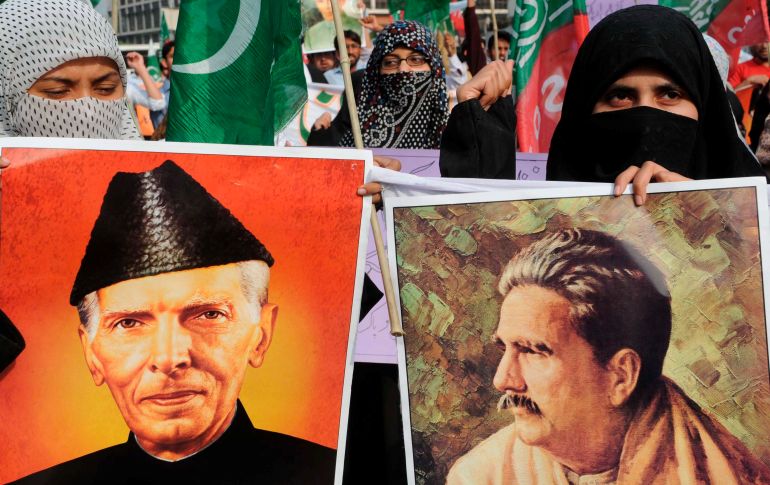
Who was Iqbal?
Iqbal was a poet, philosopher and political thinker whose ideas helped shape Muslim politics in South Asia in the early 20th century.
Born on November 9, 1877 in Sialkot, in what was then British India, he studied in Lahore, England and Germany; qualified in law; and earned a doctorate in philosophy.
Throughout South Asia he is still widely known as Allama, meaning the scholar.
He wrote mainly in Persian and Urdu. His Persian poetry also brought him lasting popularity in Iran, where he is known as Iqbal-e-Lahori, or Iqbal of Lahore.
In 1930, while presiding over the annual session of the All India Muslim League at Allahabad, he proposed that Punjab, the North West Frontier Province, Sindh and Balochistan be united into a single autonomous state, either within or outside the British Empire.
Although he did not use the word “Pakistan” in his speech, his proposal came to be seen as the intellectual idea that ultimately led to the creation of the country. In Pakistan, he is often described as the man who dreamed of the country.
Iqbal died in Lahore on April 21, 1938, nine years before Partition led to the creation of Pakistan in 1947.

When did the first Indian astronaut quote it?
Indian Air Force squadron leader Rakesh Sharma flew aboard the Soviet Soyuz T-11 mission on April 3, 1984. He spent nearly eight days aboard the Salyut 7 space station.
That month, Prime Minister Indira Gandhi spoke to him in a televised conversation.
“Upar se Bharat kaisa dikhta hai aapko?” » she asked. (How does India appear to you from up there?)
“Ji, main baghair kisi jhijhak ke keh sakta hoon ke sare jahan se achha”, Sharma replied. (I can say without any hesitation, better than the whole world.)
His response referred to Iqbal’s famous poem Tarana-e-Hindi, written in 1904, which includes the line “Sare jahan se achha, Hindustan hamara” (Better than the whole world, our India).
Later performed as a song, Sare jahan se achcha was one of the anthems of India’s struggle for independence. It remains one of India’s most popular patriotic songs, and the Indian Army Band frequently performs it on special occasions.

When did Indian Prime Minister quote Iqbal during space mission?
Chawla, born in the Indian state of Haryana, made her first spaceflight aboard the American space shuttle Columbia, launched on November 19, 1997.
During her next visit to space in 2003, she died along with her crewmates when the shuttle broke apart during its return to Earth.
Gujral, born in Jhelum, in what is now Pakistan, spoke fluent Urdu and had a penchant for poetry. During a conversation with Chawla aboard the 1997 shuttle, he turned to Iqbal.
“There is a saying by one of our poets who is very well known in the subcontinent, Iqbal.”
He then recited the first phrase of the same verse that Ali would quote almost three decades later.
“There are worlds beyond the stars. And now you have seen them. What do you think of them?” he asked.
“It’s a very special feeling… What you’re saying is becoming very literal,” Chawla responded.
“It’s a dome of dark sky and stars everywhere,” she said. “And it feels a lot like a storybook.”
Gn headline