Unlock Editor’s Digest for free
Roula Khalaf, editor-in-chief of the FT, selects her favorite stories in this weekly newsletter.
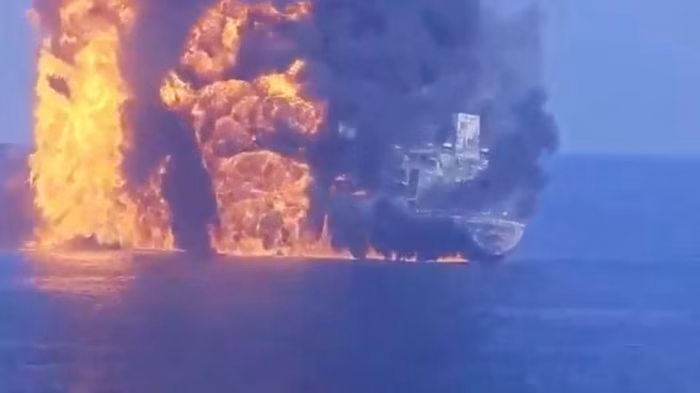
At least six ships have been hit twice by Iran in the past two months as Tehran deploys more aggressive tactics to stop oil tankers passing through the Strait of Hormuz, at the entrance to the Gulf.
Described by maritime security consultants as “double tapping,” the strategy is part of a relentless attack on ships in October and November, with attacks reaching their highest level since the United States and Israel launched their first strikes against Iran in late February.
Of the six ships hit at least twice, UAE national oil company Adnoc’s Navig8 Messi was reportedly hit three times, according to security consultancy EOS Risk, a maritime security adviser said.
Others include Tara Gas, which was hit first on November 16 and again on November 17, causing it to catch fire, and the Chinese oil tanker Gem No 2, which was hit on October 9 and 10, causing a major oil spill near the coast of the United Arab Emirates.
Adnoc said it “would not comment on the movement, route or operational status of individual vessels.”
The owners of Tara Gas and Gem No 2 did not respond to requests for comment.
Some shipping officials said that given the low number of ships entering and leaving the disputed waterway, it is natural that those who take the risk would be hit twice. But others suggested it was a concerted strategy by Iran to put the ships out of commission and disrupt rescue operations.
“It seems to be aimed at stopping and disabling the ships. Of course what they are doing is reckless (either way) and will kill people, but two missiles or drones in the back will do more damage and risk stopping the ship,” said a tanker industry official.
The lack of resolution to the Gulf conflict and the failure to restore freedom of navigation in the strait after nearly nine months of retaliation and faltering peace talks have begun to convince maritime leaders that traffic using the waterway is unlikely to return to pre-war levels.
“The genie is out of the bottle now,” Arran Kennedy, maritime security and geopolitical risk analyst at Control Risks, said at the Lloyd’s List Outlook event in London on Thursday. A return to normal is “the least likely scenario at the moment… Iran can exert pressure on Hormuz whenever it wants,” he added.
Lloyd’s List data released Thursday showed that despite more than 50 attacks on ships in October and November, the number of inbound transits to the Gulf reached a post-conflict record of 237 in October, driven by tankers carrying cargo to ships waiting off Fujairah outside the Gulf and then returning.
There has also been a steady increase in bulk cargo transits, which have roughly doubled since the early months of the conflict, Lloyd’s found, but remain well below pre-war levels.
Most of the ships took a route along the Omani coast under the protection of the US Navy, despite warnings from Iran that they were at risk of being hit.
Iran has continued to expand the list of ships it deems “non-compliant” with the regime it is trying to exercise on the strait, under which ships must register with the Persian Gulf Straits Authority, an organization under U.S. sanctions.
The majority of ships on the list are named after their collision, according to maritime analyst Windward. More than 260 ships are now on the list, many of which belong either to Gulf oil companies or to South Korean shipowner Sinokor.
Among the smaller number of ships crossing the strait from the Iranian side, at least a quarter were Chinese, said Bridget Diakun, Lloyd’s List research director.
China’s crude oil imports rose 11 percent to 311 million barrels in October, with the Middle East Gulf accounting for more than a third of supply, according to commodities platform Kpler.
Washington, for its part, continues its naval blockade against Iranian ports. The US military said Friday evening it had “neutralized a commercial vessel in the Gulf of Oman… after the crew attempted to impose the US naval blockade, despite multiple warnings.”
Gn world