
LONDON — Iran is stepping up its threat campaign on British soil, expanding its attacks beyond dissidents abroad and Jewish sites to now focus on harder military targets, the country’s domestic intelligence chief said Tuesday.
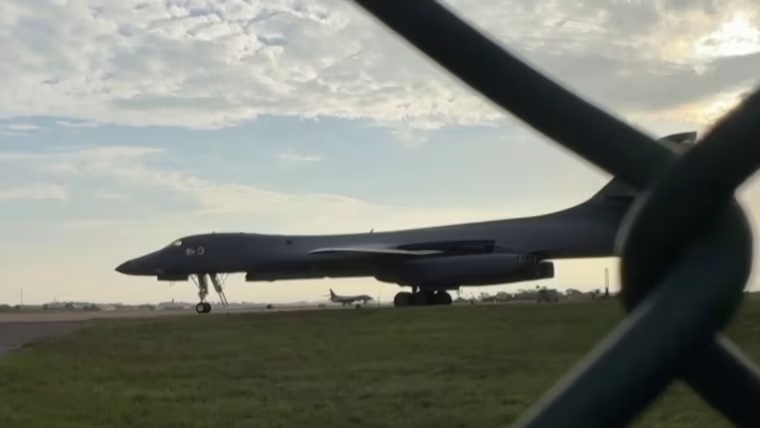
MI5 Director General Ken McCallum was speaking less than two weeks after the United States rushed to withdraw its bombers from a key airbase in England, with US officials saying there had been reports of a possible Iranian drone attack.
Giving an “annual threat update” at MI5 headquarters at Thames House in London, McCallum warned that Britain and Europe had “entered a new era of national security”, which he compared to the change that came after the terrorist attacks of September 11, 2001.

His speech comes at a time of tumult not only for the Middle East and Ukraine, which continue to be ravaged by war, but also for the rest of Europe, which has suffered so-called hybrid aggression from Moscow and Tehran, including sabotage, arson and cyberattacks. European governments are now openly asking their citizens to stockpile food and prepare to spend more of their taxes on defense, warning that Russia could launch a direct attack on their soil.
MI5 now devotes more resources than during the Cold War to countering threats from countries like Russia, Iran, China and others, McCallum said.
“Russia remains the No. 1 aggressor, while Putin’s Kremlin continues to attack the United Kingdom and its allies,” he added.
But another major belligerent is Iran, whose leaders have “attempted to expand their hybrid campaign” of “using criminal proxies to try to intimidate opponents, Iranian media and Israeli sites,” the intelligence chief said.

“Much of this aggression was aimed at British Jewish communities, with whom I wish to express my solidarity,” he said. But this year has seen a shift in “Iranian ambitions toward more difficult targets, such as military sites.”
Over the past year, intelligence operations have led to more than 50 Iran-linked arrests in Britain, he said.
McCallum referred to last month’s incident at RAF Fairford, the military base in the English countryside from where the United States launched the bombers involved in the assault on Iran. He declined to give details, citing ongoing investigations and operations, but said the case was “not unique.”
Details are sketchy, but in the early hours of September 27, a citizen called police after spotting three pickup trucks on a country lane near the base. Seven men in their twenties, including one with dual British-Iranian nationality, were arrested and released on bail.. Authorities said they found only gasoline in the vehicles.
British Prime Minister Andy Burnham told lawmakers in Parliament on Monday that the incident “was most likely coordinated in Iran, almost certainly directed” by Iran’s Islamic Revolutionary Guard Corps, the powerful political, military and economic group that holds enormous influence in the country.
A week after the incident, Washington hastily withdrew its bombers from the base due, according to two American officials, to reports of a possible drone attack against the site.
On Tuesday, McCallum played down fears that Iran could stage such a complex attack, saying that until now it had hired unsophisticated criminals for operations in the UK. But he warned that could change.

Regarding Russia, McCallum said its military and intelligence services are “once again intensifying their attempts at hybrid warfare,” taking care not to trigger NATO’s Article 5 threshold, under which other countries would be expected to defend their allies.
“We see them going out of their way to pay criminals to carry out their orders,” he said. “The goal of hybrid tactics is to try to intimidate us.”
As part of the UK’s “multifaceted relationship with China” – Beijing is a major trading partner of London – MI5 has focused on the Chinese government’s efforts “to carry out espionage, coercion or democratic interference”.
Regarding al-Qaeda and the Islamic State, or ISIS, terror group, MI5 has yet to respond to “attempts to carry out mass casualty attacks”, he said.

But perhaps the most serious warning concerns artificial intelligence, which he says could in the future be used by terrorist groups and other actors to create new “biological weapons.”
And “beyond the misuse of AI by human adversaries are the potential risks posed by AI itself,” he said.
“Simply put, human history has given us no experience dealing with an actor smarter than us. It is capable of outplaying us. This is truly new. And deserves the serious attention it is receiving, including within MI5.”
Gn world