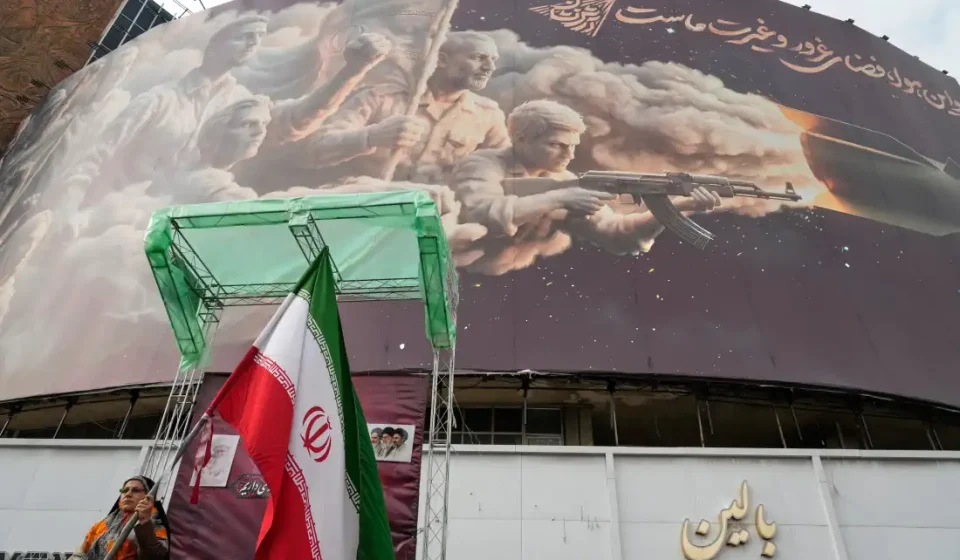

A woman holds an Iranian flag as part of a pro-government campaign beneath a billboard depicting a launched missile, a man with a rifle, people and current and remaining commanders of the Revolutionary Guards missile force, clenched fists, with a sign that says in Farsi: “The sky is a place of our pride and loyalty,” in downtown Tehran, Iran, on Monday.
Vahid Salemi/AP
hide caption
Vahid Salemi/AP
CAIRO — Iran fired drones at a U.S. radar facility in Bahrain on Tuesday in the third Iranian attack in recent days on U.S. military targets in the Persian Gulf island kingdom, and the United States retaliated by firing on Iranian targets along a major shipping route.
The attacks and counterattacks interrupted a roughly two-month lull in fighting, as Iran’s targeting of Bahrain drew condemnation from the region. Analysts said the impasse in peace negotiations and growing economic pressure from Tehran increased the risk of a substantial escalation.
Bahrain said its air defense systems had successfully intercepted “treacherous Iranian air attacks”. The U.S. military also said the attack caused no damage to U.S. equipment or injuries to U.S. personnel.
Hours later, a U.S. warplane carried out a strike on a missile launch site in the Strait of Hormuz belonging to Iran’s paramilitary Revolutionary Guards, a U.S. official said.
The official, who spoke on condition of anonymity to detail sensitive military operations, said “precision munitions” were used in the attack on Qeshm Island and that the United States was responding to an “assault” on American personnel.
A local official, Ahmad Nafisi, said the strike did not cause any damage to residential or commercial areas or infrastructure.
The U.S. military this month has periodically carried out what appear to be limited strikes on Qeshm Island and other Iranian targets. Tuesday’s Iranian attack was the third against U.S. military targets in Bahrain in five days.

This is a location map of the Gulf Cooperation Council member states: Saudi Arabia, Bahrain, Qatar, Oman, Kuwait and United Arab Emirates.
P.A.
hide caption
P.A.
Iran could change its strategy in the face of economic difficulties
Iran is suffering from the months-long US naval blockade in and around the Strait of Hormuz, a crucial waterway for global energy supplies where Iran and its proxies have disrupted shipping since the war began on February 28.
US President Donald Trump has been cautious about his next steps in the war against Iran, now in its eighth month, despite initially promising it would last only a few weeks. He said further strikes were highly unlikely, but he also sent a third aircraft carrier and thousands more troops to the Middle East – and told Vice President JD Vance that talks were not necessary at this time.
Tankers carrying oil across the strait under U.S. military protection helped return Gulf oil shipments to prewar levels. At the same time, the blockade harms the Iranian economy by limiting the flow of Iranian crude to the world market.
Iran’s attacks could signal a shift in strategy after months in which Iran waited for an attack and then retaliated to target the bases’ operational capacity, Tehran-based security analyst Mostafa Najafi told The Associated Press.
Bahrain is home to the US Navy’s 5th Fleet, which has already suffered damage from previous attacks by Iran since the US and Israel attacked Iran on February 28.
Iran’s leaders will now ask themselves whether “breaking the blockade through escalation is less costly than accepting its continuation,” wrote Hamidreza Azizi, senior Iran analyst at the International Crisis Group think tank, in an analysis published on X.
“In other words, the risk of a resumption of war no longer depends solely on Trump’s decision to attack Iran again,” he said. “It also depends on Tehran’s conclusion that the costs of a policy of continued restraint have become greater than the risks of escalation.”
The United States expands its naval presence in the Middle East
With the arrival of the USS Theodore Roosevelt Carrier Strike Group in the region, combined U.S. naval assets in the Persian Gulf, Arabian Sea, Red Sea, and Mediterranean now exceed the force deployed when the United States and Israel launched the war.
This presence provides greater offensive firepower and missile interception capability, according to a new analysis by Israel’s Institute for National Security Studies.
The Roosevelt joins the aircraft carriers USS George HW Bush and USS George Washington, as well as smaller US Navy ships, which are in the region maintaining the blockade of Iranian shipping. U.S. Central Command would not say whether it plans to keep the three carrier strike groups in the region.
Iran says it is responding to US attacks
Iran’s attack on Bahrain on Tuesday came after it targeted a US early warning radar installation in the country on Friday and fired on a radar system at a US helicopter base on Sunday. Despite claims of success, there appears to have been little or no damage.
The attacks followed U.S. strikes on Iranian communications towers and ongoing drone surveillance operations, and Iran said it was retaliating.
“The continued aggression against the country’s airspace, as well as the use of regional military bases and installations for hostile acts against Iran, will not go unanswered,” Iran’s Revolutionary Guard Corps said in a statement.
Egypt, Qatar, Saudi Arabia and the United Arab Emirates each condemned the Iranian attack on Bahrain, calling it a violation of Bahrain’s sovereignty and a threat to its security and stability.
Negotiations to end the war have stalled, despite Qatar’s intensified mediation efforts.
In a statement, Qatar said Iran’s “continued attacks” on Bahrain were “undermining diplomatic efforts” and Foreign Ministry spokesman Majed Al Ansari, speaking at a news conference in Doha, warned that any escalation of fighting posed an “extremely serious danger” to the prospects of reaching a deal.
Iran may lose patience as conflict drags on
The attacks are a sign that Tehran is growing impatient as its economic woes deepen, said Sascha Bruchmann, a Bahrain-based defense analyst at the International Institute for Strategic Studies.
“Firing on ships creates fear, but is not effective enough to change the strategic equation,” Bruchmann told the AP. “Tehran knows it has to do something, but I wouldn’t overestimate what we saw against Bahrain this week. It hasn’t happened yet.”
Iranian officials have called the current situation “neither war nor peace” and have promised to end it.
Tehran has said it is open to a negotiated agreement, but has also indicated that it is ready to intensify the conflict in the face of strengthening sanctions and the blockade which are strangling the Iranian economy.
Mahdi Mohammadi, an adviser to Iran’s influential parliamentary leader, posted on social media Monday that leaders view U.S. economic pressure as an attempt to create a domestic “security crisis.”
Iran has continued to attack ships seeking to transit the Strait of Hormuz, which leads from the Persian Gulf to the high seas. In Yemen, Iran-backed Houthi rebels have now consolidated their control over the Bab el-Mandeb Strait, another crucial shipping route.
Gn headline