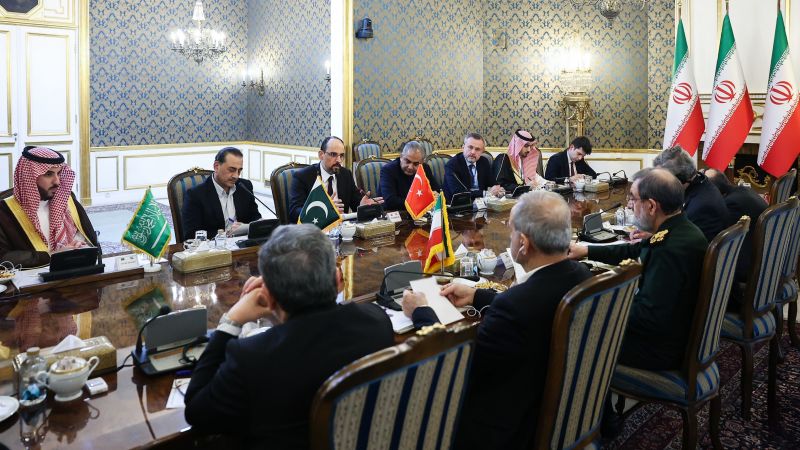

Saudi Arabia and its allies dispatched top security officials to Iran for talks on Monday, fearing a new U.S.-Israeli offensive that could plunge the Middle East into greater instability.
Pakistani military chief Asim Munir and Turkish intelligence chief Ibrahim Kalin joined Saudi Defense Minister Prince Khalid bin Salman in Tehran for meetings with senior Iranian officials, including national security chief Mohsen Rezaei and President Masoud Pezeshkian.
The Saudi Foreign Ministry said the visit by Prince Khalid and representatives of the Mecca Common Defense Agreement countries was part of ongoing efforts to defuse tensions between parties to the current crisis, encourage dialogue and diplomatic solutions, and support the mediation efforts of Qatar and Pakistan.
The ministry said the kingdom was seeking “positive and practical engagement” from the parties involved. He stressed the importance of opening channels of negotiation to prevent a return to military escalation in the region and pave the way for an agreement that would end the crisis and establish security and peace.
The Tehran meeting came at a tense time in the Middle East, as speculation grows that President Donald Trump may order new strikes against Iran after next week’s midterm elections. It is also the first high-level contact between Iran and Saudi Arabia since Yemen’s Iran-backed Houthis stepped up attacks on Saudi targets last month.
A statement released by Iranian state media said the four countries agreed to continue dialogue and strengthen cooperation to support security and peace in the region.
“We have always emphasized that regional security can only be ensured by relying on the will and security considerations of regional countries,” Iranian Foreign Ministry spokesman Esmaeil Baghaei told reporters before the meeting.
Saudi Arabia, Turkey and Pakistan represent the Mecca Alliance, a newly formed coalition of three of the region’s largest powers. The deal, under which an attack on one is considered an attack on all, has focused attention on the need to unite nuclear-armed Pakistan, Turkey’s military might and Saudi Arabia’s financial resources.
Pakistan has been a key intermediary between Washington and Tehran since the war began in February.
“The importance of the meeting lies mainly in its timing and the officials involved,” Hamidreza Azizi, senior Iran analyst at the International Crisis Group (ICG) think tank, told CNN. “This comes at a time when the risk of a new round of wars between Iran and the United States is increasing, and all three members of the Mecca Pact have direct security interests at stake.”
The visit by Khalid bin Salman – a Saudi royal and brother of Crown Prince Mohammed bin Salman, the kingdom’s de facto ruler – surprised observers. Iran and Saudi Arabia represent competing religious ideologies and have been locked in a regional rivalry for decades, culminating in outright confrontation earlier this year after the United States and Israel launched a war against the Islamic Republic.
Iran has hit Washington’s regional allies, including Saudi Arabia, after Israeli airstrikes killed Iran’s supreme leader, Ayatollah Ali Khamenei, and many of its military and top nuclear scientists in February, at the start of the U.S.-Israeli war with Iran. Iran’s allies and proxies, including those in Iraq and Yemen, have also struck Saudi oil installations and civilian infrastructure, putting unprecedented pressure on the kingdom.
Middle Eastern countries fear a new U.S. offensive against Iran could invite further Iranian retaliation after eight months of instability in the Middle East.
Sufficient US forces are now deployed in the region to carry out potential attacks, two US officials told CNN. The scope of new U.S. military operations would likely go beyond efforts to simply “mow the lawn” or maintain the status quo by striking Iranian radars, launchers and other assets that can be quickly replenished – as has been the case since Trump ended full combat operations earlier this year, the sources added.
After months of retaliating with Iranian missile and drone strikes against its U.S.-allied neighbors, Tehran has reduced the intensity of its attacks, instead focusing its strategy on creating economic uncertainty by trying to block the only waterway used by ships carrying a fifth of the world’s oil and gas daily.
Tehran has called on countries in the region to withdraw their American bases and stop depending on Washington for their defense. Most of Iran’s regional neighbors have militaries armed by the United States, but have slowly begun to diversify their arsenals and formalize new military alliances, amid concerns about Washington’s commitment to defending its allies.
The Mecca Alliance is part of a “broader effort” to develop a “more independent regional security architecture,” Danny Citrinowicz, former head of the Iranian branch of Israeli military intelligence, wrote on X.
“The decision to engage directly with Tehran is equally significant,” Citrinowicz added. “This reflects not only recognition of the Iranian regime, but also the understanding that Iran remains a central regional actor whose influence cannot simply be ignored. »
Iranian officials have welcomed the initiative, and some, including former Foreign Minister Mohammad Javad Zarif, see it as an opportunity to move toward a broader security framework in the region and away from dependence on the United States. Yet these developments do not yet signal an immediate diplomatic breakthrough, said Crisis Group’s Azizi.
“Tehran wants credible guarantees that any agreement would prevent another military attack, and it is difficult to see how Saudi Arabia, Turkey or Pakistan could provide such guarantees or exert sufficient influence over Trump to obtain them,” he said.
“Unless these countries bring something new that could change Tehran or Washington’s calculations, the meeting is unlikely to result in significant progress,” Azizi added. “For now, this looks more like a last-minute attempt to prevent a resumption of war than the start of a new diplomatic process.”
Gn headline