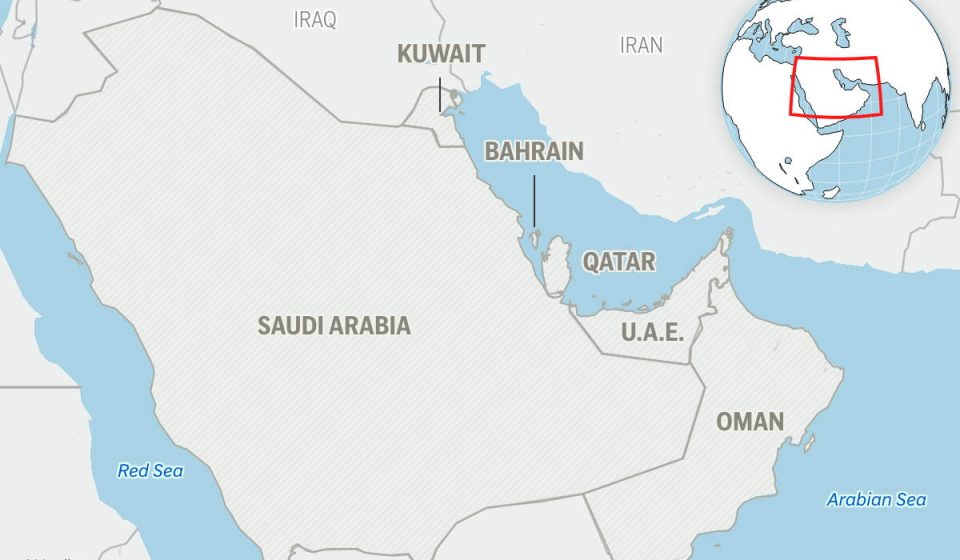
CAIRO (AP) — Iran fired drones Tuesday against a US radar installation in Bahrain, its third attack in recent days against US military targets in the small island kingdom of Bahrain. Persian Gulf after a lull of about two months.
After issuing a warning about the imminent launches, Bahrain said its air defense systems had successfully intercepted the “treacherous Iranian air attacks.”
The U.S. military said there was no damage to U.S. equipment or injuries to U.S. personnel.
The attacks could signal a shift in Iranian strategy after months in which Iran waited for an attack and then retaliated to target the bases’ operational capacity, Tehran-based security analyst Mostafa Najafi told The Associated Press.
Like the United States wonders whether to resume widespread military attacks against Iran or to intensify its blockade to undermine the strength of the Iranian economyIranian leaders will also now ask themselves whether to “break the blockade “Escalation is less expensive than accepting its continuation,” Hamidreza Azizi, senior Iran analyst at the International Crisis Group think tank, wrote in an analysis published on X.
“In other words, the risk of a resumption of war no longer depends solely on (US President Donald) Trump’s decision to attack Iran again,” he said. “It also depends on Tehran’s conclusion that the costs of a policy of continued restraint have become greater than the risks of escalation. »
The United States expands its naval presence in the Middle East
Tuesday’s attack came after the US military’s Central Command said USS Theodore Roosevelt Carrier Strike Group had arrived in the region. The move adds a third aircraft carrier and thousands more troops to the U.S. presence as Trump maintains his mandate. options are open for his next move in the war that began almost nine months ago.
Combined U.S. naval assets in the Persian Gulf, Arabian Sea, Red Sea and Mediterranean now exceed the force deployed when the United States and Israel carried out joint strikes against Iran to launch the war on February 28 – the presence provides greater offensive firepower and missile interception capability, according to a new analysis by the Israel Institute for National Security Studies.
The Roosevelt joins the aircraft carriers USS George HW Bush and USS George Washington, as well as smaller U.S. Navy ships, which are in the region to maintain a blockade of Iranian shipping. U.S. Central Command would not say whether it planned to keep the three carrier strike groups in the region or replace the Washington, which had been redeployed from the Asia-Pacific region to relieve the U.S. military. USS Abraham Lincoln amid concerns over its long deployment.
The Washington itself has been deployed for about six months.
Iran says it is responding to US attacks
The Iranian attack on Bahrain on Tuesday came after targeted a US early warning radar in the country on Friday and fired on a radar system at a US helicopter base on Sunday. Despite claims of success, there appears to have been little or no damage.
The attacks followed U.S. strikes on Iranian communications towers and ongoing drone surveillance operations, and Iran said they were carried out in retaliation.
“The continued aggression against the country’s airspace, as well as the use of regional military bases and installations for hostile acts against Iran, will not go unanswered,” Iran’s Revolutionary Guard Corps said in a statement.
The UAE Ministry of Foreign Affairs issued a statement condemning the Iranian attack, saying it constitutes a blatant violation of Bahrain’s sovereignty and a threat to its security and stability.
Negotiations to end the war have stalled, despite Qatar’s intensified mediation efforts.
Iran may lose patience as conflict drags on
The attacks on U.S. facilities in Bahrain are a sign that Tehran is growing impatient with this waiting game as its economic woes deepen, said Sascha Bruchmann, a Bahrain-based defense analyst at the International Institute for Strategic Studies.
“Firing on ships causes fear, but is not effective enough to change the strategic equation,” Bruchmann told the AP. “Tehran knows it has to do something, but I wouldn’t overestimate what we saw against Bahrain this week. It hasn’t happened yet.”
Iranian officials have called the current situation “neither war nor peace” and have promised to end it.
Tehran has said it is open to a negotiated agreement, but has also indicated that it is ready to intensify the conflict in the face of strengthening sanctions and the blockade which are strangling the Iranian economy.
Mahdi Mohammadi, an adviser to Iran’s influential parliamentary leader, posted on social media Monday that leaders view U.S. economic pressure as an attempt to create a domestic “security crisis.” He said the strikes against Bahrain were aimed “at preventing the gradual expansion of enemy operations and imposing costs on its military infrastructure.”
Iran and its proxies threaten two critical shipping lanes
Iran also continued to attack ships seeking to transit through the Strait of Hormuzwhich leads from the Persian Gulf to the open sea.
Before the war, ships freely navigated this key waterway, carrying around a fifth of the world’s traded oil and gas. Since then, Iran has tightly controlled the strait and only a fraction of peacetime maritime traffic has been able to pass through it, despite U.S. efforts to provide escorts.
On Tuesday, the British Maritime Trade Organization said an oil tanker was believed to have been attacked twice north of Oman and that the second strike caused a fire on board.
Iran’s Fars news agency also reported that two ships were hit by mines in the strait, causing them to catch fire. It was not immediately clear whether this was the incident reported by the British Army’s UKMTO.
In Yemen, Iran-backed Houthi rebels have now consolidated their control over the Bab el-Mandeb Strait, another critical maritime route that connects the Gulf of Aden to the Red Sea, after a group allied with the Saudi-backed Yemeni government withdrew over the weekend, a setback for the anti-Houthi coalition.
These government-allied forces are now strengthening their defenses in areas leading to the southern city of Aden, which serves as the internationally recognized government’s interim capital, two Yemeni military officials said.
Their efforts are focused on deploying more troops and equipment in and around the Tur al-Baha district of the southern province of Lahij, said the officials, who spoke on condition of anonymity because they were not authorized to brief the media.
___
Increase reported from Bangkok. Associated Press writers Sam Metz in Jerusalem and Ahmed al-Haj in Aden, Yemen, contributed to this report.
Gn usa