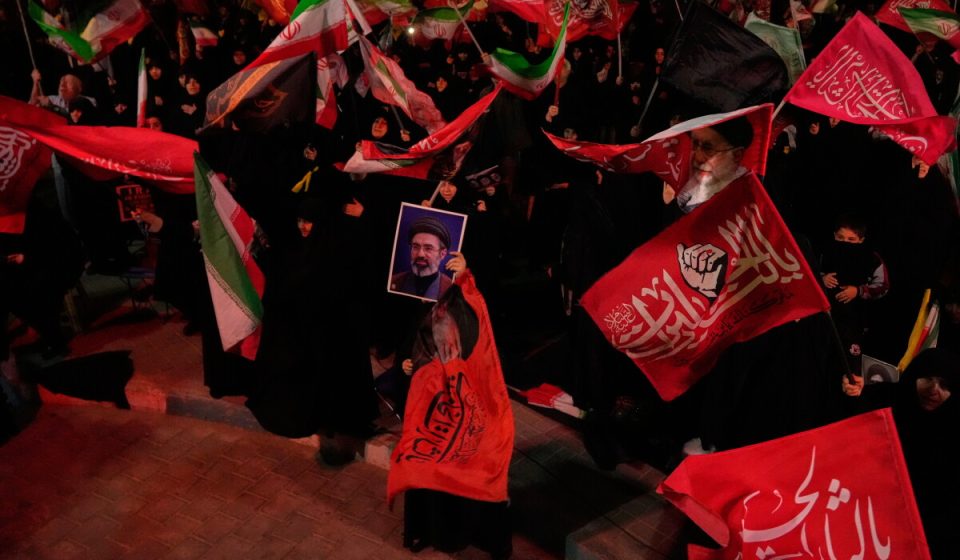
Iran’s supreme leader has threatened to respond immediately to a possible attack – without “geographical limits” – as diplomatic efforts continue to avoid a return to Iran. total war.
At the same time, Iran’s foreign minister said a proposal had been developed to fully reopen the Strait of Hormuz in just two days. And Iran’s security chief says the American tone has “completely changed” for the better.
Here is the latest news from the Middle East on Saturday. Read our full coverage here.
Khamenei says ‘any type’ of threat must be responded to immediately
Iran’s Supreme Leader Ayatollah Mojtaba Khamenei said “any type and level of threat” from the United States or Israel should be responded to immediately, without geographic limits, the official IRNA news agency reported.
State media said Khamenei, who has not been seen publicly since the war began with U.S. and Israeli strikes on Feb. 28, made the comments during a meeting with military leaders. He also called for an updated list of potential U.S. and Israeli targets.
Khamenei became supreme leader after the first strikes killed his father. He has met with a series of senior officials in recent weeks, according to state media.
Iran’s top diplomat says proposal could reopen strait in 2 days
Foreign Minister Abbas Araghchi said a new proposal had been reached with mediators that would reduce the deadline for fully reopening the Strait of Hormuz to two days. He said Iranian diplomats were in Qatar for discussions.
Araghchi offered last month to reopen the waterway within a week if the United States agreed to lift the blockade of Iranian ports, release frozen Iranian assets and lift sanctions on Iranian oil sales, among other conditions. This was rejected.
In an interview with Qatari television channel Al Jazeera, Araghchi said Iran had no plans to meet with U.S. officials, but called recent U.S. efforts toward “broader dialogue” a positive step.
Araghchi said a decision on whether the negotiations will be direct or indirect would be made “once Washington accepts Iran’s terms.”
Iran’s security chief says US tone has changed
The head of Iran’s Supreme National Security Council said “the tone has completely changed” from the United States and called it a “very good sign.”
Major General Mohsen Rezaei told state television that he had not responded to US Vice President JD Vance’s letter and gave no details about it.
Rezaei highlighted an important change in one of the conditions imposed by Iran: ships sailing through the reopened Strait of Hormuz would have to take a route agreed between Iran and Oman. And “anyone passing through this waterway will do so under Iranian leadership.”
He said Iran was awaiting the latest US response. Furthermore, Rezaei warned on X that any attack would bring “devastating blows to the aggressor using new weapons.”
Rezaei, who state media reported met with Iran’s supreme leader last week, also said there had been no decision to change Iran’s nuclear doctrine, but noted that some Iranians questioned whether that would have to change if Iran was attacked again.
Washington seeks to prevent Iran from acquiring nuclear weapons. Tehran insisted its nuclear program was peaceful and wanted to discuss the issue later.
UN says staff member died while held by Houthis in Yemen
UN human rights chief Volker Türk has urged Yemen’s Iran-backed Houthi rebels to investigate the death in custody of a staff member of the Office of the United Nations High Commissioner for Human Rights.
Mohammad al-Shami, a Yemeni national, was arrested in June 2024. Türk said al-Shami’s family was only recently informed of his death more than a month ago and was not given a cause of death.
Türk said he remained concerned about the fate of other UN staff still detained, including seven colleagues from his office.
The Houthis have claimed without evidence that detained U.N. personnel and those working with other international groups and foreign embassies in rebel-controlled areas were spies. The UN has denied this accusation.
Israelis mobilize for Arab-Jewish coalition for new government
Thousands of people gathered in Tel Aviv to support the formation of an Arab-Jewish coalition in Israel’s new government after Tuesday’s elections. Arab-led parties put in a historic performance, winning 19 seats out of the 120 seats in the Knesset parliament.
“An Arab-Jewish government is not only what we want, it is a necessity in this country,” said one of the participants, Shahd Bishara. Arab citizens make up 20% of the Israeli population but have long faced discrimination.
Right-wing activists also appeared waving flags with photos of Prime Minister Benjamin Netanyahu, whose dependence on his far-right allies to stay in power has angered many Israelis.
Syria says high-level meeting expected after Jordan tensions
Syrian Foreign Minister Asaad al-Shibani said a high-level meeting was planned next month to discuss border security arrangements with Jordan, after Jordanian strikes in Syria last week increased tensions.
Jordan said the strikes killed 20 militants from the Islamic State extremist group, but acknowledged civilians were also killed. Syrian authorities reported seven people killed, most of them women and children.
Separately, al-Shibani said Syria was in discussions to evaluate joining the Mecca Pact, the Saudi-led defense alliance that includes Turkey and Pakistan.
___
This report will be updated throughout the day as new developments emerge.
Gn world