
Can’t pay? I won’t pay!title translated from Dario Fo’s 1974 play, is one of the great works of post-war Italian literature. Exploring the struggles between moderates and radicals within the country’s Communist Party, Fo draws its audience into the intoxicating and violent atmosphere of the Years of Lead. In Italy, of course, that world is dead and buried, but Fo’s story could just as easily apply to the modern French left. It, too, is riven by factionalism – although, unlike Italy in the 1970s, French radicals now seem to be winning.
But more than its history, it is Fo’s title which seems most relevant for contemporary France. Because it is very possible that the country will stop, at some point, paying its debts. If debtors cannot pay, they will not. But a debtor who can theoretically pay could nevertheless choose not to do so. As one of the richest countries on the planet, France has no excuses on this matter. But when politics interfere, all bets are off, with worrying consequences far beyond bank balance sheets.
The economics here are not difficult to understand. Exceed a certain debt threshold, and France risks finding itself in a debt trap. Borrow too much – and the public debt already stands at €3.6 trillion, or 119% of GDP – and creditors will get so nervous they will start selling. With more sellers than buyers, interest rates rise. This, in turn, increases the cost of servicing future debt. Countries tend not to notice this process at first – but then, from Sri Lanka to Argentina, it just happens.
When nations fall into a debt trap, there are four potential escape routes. Perhaps the most difficult option is to simply default on their debt. There are then two forms of belt-tightening: either imposing austerity by raising taxes and cutting spending, or selling state-owned land or companies. Finally, central banks can finance their governments and print more money, which in practice means buying public debt. The latter strategy helps drive down interest rates, much like what happened recently in Japan.
The policy determines which combination of these four options will be chosen. The French electorate has not voted for candidates who prioritize balanced budgets for some time, which is considered very uncool in the country’s political culture. Indeed, the two candidates that polls now predict are most likely to advance to the second round of the next presidential election also turn out to be the least financially responsible: Marine Le Pen, leader of the right-wing National Rally, and Jean-Luc Mélenchon, leader of La France Insoumise, which translates to “Unruly France.”
In the case of Mélenchon’s party, one might ask: insensitive to what exactly? Bond markets? Mélenchon is in favor of canceling French debt held by the European Central Bank. To achieve this, he suggests an old financial trick: keep all the money that France has borrowed, never pay it back, and never pay interest either.
Mélenchon’s “perpetual zero coupon” trick – as this system is officially known – is a technical way of saying that he wants to default on his country’s debt. The idea is that this would give him the opportunity to take on more debt to finance his campaign spending promises. Yet Mélenchon has no way of securing agreement from the rest of the EU, particularly Germany. If he were to be elected and actually implemented his plan, France would likely leave the Eurozone and even the EU itself.
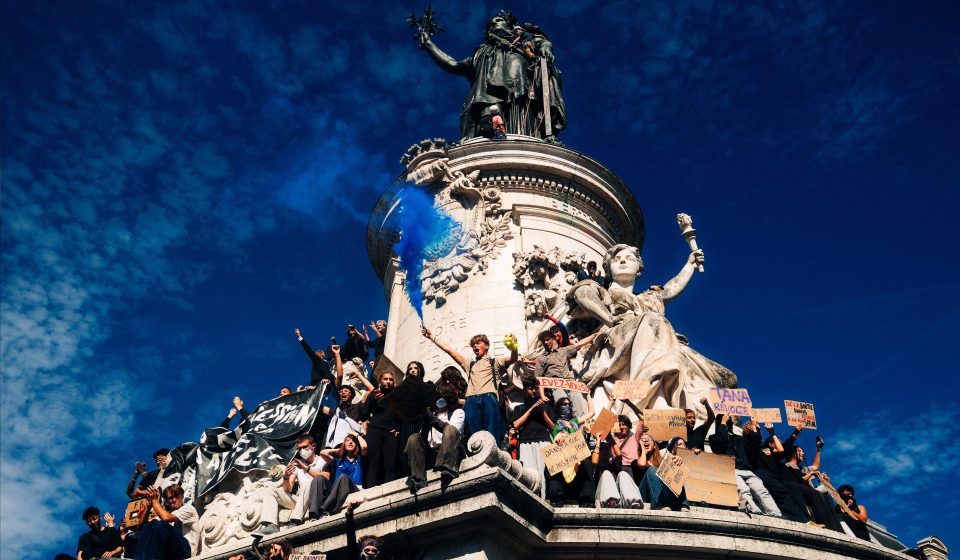
To be fair, the poll numbers will probably change between now and the first round of the presidential election next April – but it’s not clear how. An air of insurrection has descended on France, and this could well play into Mélenchon’s hands. After all, the protest of high school students, tired of their overcrowded and dilapidated classes, has now spread from Paris to the rest of France. Last week, 250,000 students took to the streets, leading to the closure of some 500 schools.
The protests were also marked by outbreaks of spontaneous violence, with demonstrators throwing projectiles at police and setting cars and buildings on fire. By the end of the week, police had arrested nearly 7,000 people, most of them young people, a third of whom will face prosecution. Not that this is simply an insurrection of the poor: even students from elite schools, like the Lycée Henri-IV in Paris, have joined their fellow teenagers, frustrated by the collapse of schools and the rise of state violence. Mélenchon exploits this feverish atmosphere like no other politician.
Marine Le Pen represents the other end of the political spectrum: the France of the angry rural middle classes. She has long topped the polls and her conviction in a trial for misuse of European funds has had no impact on her popularity. Just as the law did not work against Donald Trump, it also did not work in France, even though rumors are circulating that the yellow vestThe students, who paralyzed the country in 2018, could still join the students.
Unlike Mélenchon, to be honest, Le Pen does not want to default on the French debt. But if she implements the tax and spending plan she outlined last week, she could find herself in a similar situation. One of the biggest sources of new revenue would come from a unilateral two-thirds cut in French contributions to the EU budget, a historic policy. Before it was called the National Rally, Le Pen’s party was called the National Front – and under its leader, Marine’s father Jean-Marie, leaving the EU was a core policy.
Marine also supported France’s withdrawal from the EU until 2019. She no longer speaks explicitly about “Frexit”, but her policies are just as incompatible with EU membership as Mélenchon’s. The EU would cease to function if France were to default on its contributions – just as it would collapse by defaulting on the French debt, with Germany and the Netherlands remaining the only countries financing the operation.
Of course, with six months until the first round of voting, it is still possible that a centrist politician emerges as a viable candidate. But to win, such a person would still have to default in one form or another. Perhaps bondholders would still get what they were promised – but retirees, students or farmers would have to be sacrificed to maintain France’s fiscal situation.
What I find hard to imagine, however, is a scenario in which a radical centrist like Macron could emerge as a surprise winner and return the country to the path of liberal centrist reforms. Macron, after all, was elected in 2017: and his political experiment failed both politically and economically. As France nears the end of its decade in power, French cities are burning and financial markets are wondering whether France will default on its debt. This was not how Macron’s centrist revolution was supposed to end.
“What I find hard to imagine, however, is a scenario in which a radical centrist like Macron could emerge as a surprise winner. »
France falls into the category of countries too big to fail – and too big to be saved. If he refuses austerity for political reasons, he will also refuse the sale of assets. They will not auction off the Mona Lisa or the Bayeux Tapestry. This leaves us with exactly two paths out of the crisis: a combination of a default and a central bank bailout.
Certainly, the European Central Bank (ECB) could simply buy back French debt. This would lead to lower interest rates on French bonds, but would not solve the country’s underlying debt problem. Indeed, the ECB could raise its support to such extreme levels that the eurozone itself would end up with higher debt and inflation, while other countries would queue up for support. Italy’s public finances are much better managed than those of France, for example, but Italy also has higher debt levels relative to the size of the economy.
The ECB could therefore find itself in a position where it would be damned if it helps France – and damned if it doesn’t. This is the fundamental problem of the Eurozone: once the major countries diverge politically and economically, the end is near. The only thing that can help you is a political union that imposes convergence. The Eurozone crisis was the last moment when such a union could have been established. But instead of solving the bloc’s underlying financial problems, European leaders have done the bare minimum necessary to prevent the crisis from spiraling out of control, for example by providing cheap loans to already over-indebted countries.
We used to say at the time that Brussels was making do for later. Well, we’re at the end of the road now, with a dumpster full of cans piling up around us. Certainly, with the rise of far-right parties across Europe, union is too late now, although high inflation means the ECB has much less room to maneuver than a decade ago. No one can predict how things will develop from here: but some form of financial crisis is likely.
This brings us back to Fo’s play: and the fundamental difference between Italy then and France today. Can’t pay? I won’t pay! It was a conflict within the Italian Communist Party, which at the time had abandoned its radicalism, accepted austerity and moved closer to the political center. Fo himself was a hard-liner. As he once said of capitalists: “The only way to make this crowd think is to put them in the swamp and pull the chain!” » This is also the language of Mélenchon, except that unlike Fo, his dramaturgy is not limited to the theater.
Gn bussni