
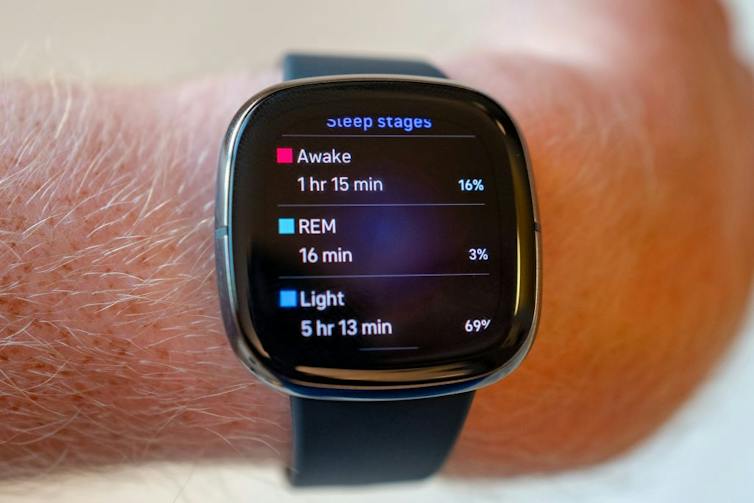

On a typical night, I go to bed wearing a tracking watch on one wrist and another type of tracker on the other wrist. Then I compare their sleep results while I drink my morning coffee.
I lead the Center for Modern Digital Health at Carnegie Mellon University in Pittsburgh, where my team and I study how to use wearable devices to improve health and performance. My lab’s research has relied on consumer devices for years. I wear them for both science and fun, and I also wonder how much of what they tell me is true.
Apple’s new Watch, announced September 9, 2026, greets its users each morning with a single “readiness” number, built in part from how it thinks they slept. Apple claims the redesigned sensors offer the most accurate heart rate tracking of any wearable device, but independent labs have yet to confirm this.
Given the growing popularity of sleep trackers, I think it’s worth asking whether a sensor placed on your wrist or finger can really tell you how your brain slept last night.
Here’s what recent studies show when consumer wearable devices are tested against polysomnography, the gold standard.
Does he know when I was sleeping?
Polysomnography, which combines EEG, or electroencephalogram, with other sensors, records brain waves, eye movements and muscle tone while a person sleeps.
On the simplest question – asleep or awake – today’s devices come close. A 2025 meta-analysis of 24 studies and nearly 800 participants found that wearable devices generally overestimate total sleep time by about 17 minutes compared to polysomnography. Over an eight-hour night, that’s an error of less than 4%, or about two presses of the snooze button.
Gado/Smith collection via Getty Images
This gap comes from a blind spot that all wearable devices share: silent wakefulness. When you lie awake, motionless in the dark, your tracker often mistakes it for sleep. If you sleep well, it rarely matters, because you don’t spend a lot of time awake. But if you suffer from insomnia, those long periods add up and your wearable device is probably overestimating how much sleep you’re getting.
Does he know what my brain was doing?
I’ll start with the obvious: that laptop on your arm or finger doesn’t measure your brain. It measures your heart rate, the variability of your heart rate from beat to beat, your movements and the temperature of your skin. The bet wearable makers are making is that the different sleep stages we go through at night leave fingerprints on each one — REM sleep, for example, has a distinctive cardiovascular profile — and the wearable’s algorithm reads those sleep fingerprints and makes an educated guess about which stage you’re in.
How good is this guess? A 2025 study of six wrist devices worn by 62 adults found only modest agreement with polysomnography on sleep stages, as well as significant differences in time awake after falling asleep and sleep efficiency. The authors concluded that the best-performing watches could track “prolonged and significant changes in sleep architecture.”
Translation: Your deep sleep number is a noisy nighttime estimate, best used to identify significant changes in your sleep over time.
Which trackers work correctly
One of the discoveries in my lab comes from using these devices for what they are good for. In a 2023 study in Proceedings of the National Academy of Sciences, we used Fitbits to track the sleep of more than 600 freshmen at three universities, including Carnegie Mellon University. We found that a student sleeping six hours or less per night at the start of the semester had a lower end-of-term average than the previous semester – an effect that persisted even after accounting for academic load and daytime naps.
Nighttime sleep duration is the number that these devices track well, and it’s one that my students can actually do something about, mainly by going to bed earlier.
In a randomized trial conducted in 2023, 113 adults with insomnia symptoms spent five weeks in one of two groups. One group received feedback on their sleep measured by a wearable sensor, as well as advice on how to interpret it. The other received standard sleep hygiene education: general advice on habits like keeping a regular bedtime, cutting back on caffeine and screens, and keeping the bedroom dark and quiet.
The feedback group ended up reporting milder insomnia symptoms than the sleep hygiene group, but the measured amount of sleep they got was unchanged. They didn’t sleep longer, fall asleep faster, or wake up less. The researchers expected the data to correct a common pattern in insomnia: People often report sleeping less than the sensors record. Feedback did not reduce this gap any more than sleep hygiene sessions. What changed was how disturbed people felt about their sleep: the comment group found themselves less disturbed, even though the sleep itself remained the same.
This distinction between measured sleep and felt sleep is one that sleep scientists here in Pittsburgh have been crafting for decades. Researchers at the University of Pittsburgh developed the Pittsburgh Sleep Quality Index in 1989, a questionnaire that asks people to rate their sleep rather than measuring it with wearable devices. It remains one of the most widely used sleep measures in the world.
The trial results suggest that for many people, the most important effect of a wearable device is the score measured by the Pittsburgh Sleep Quality Index: subjective feelings of sleep quality.
A trial carried out in 2026 among 229 elderly people in Japan goes in the same direction. Everyone received regular reports from a sleep monitor placed under their bedding. Participants who received the reports alone saw no improvement in their insomnia scores, but those who also received monthly telephone counseling about their sleep habits and daytime activities did, at least during the first three months. As in the first study, what improved was how people rated their sleep.
Alina Barilo/iStock via Getty Images Plus
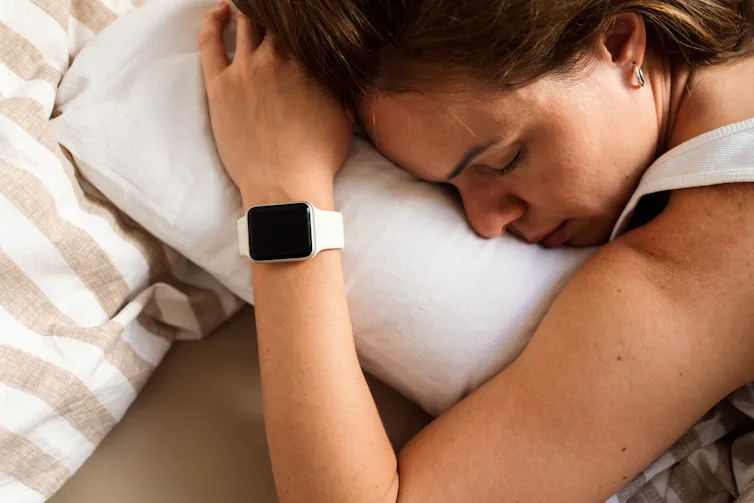
A cell phone can tell you how long you slept; It can’t make you sleep more. This part is up to you or someone helping you.
And for some people, tracking itself becomes the problem. Sleep clinicians have a name for patients who lie awake worrying about their sleep score: orthosomnia, a term coined in 2017 and still widely used. If reliably checking your score is ruining your morning, the device isn’t working for you.
How I read my own numbers
I read sleep stages and readiness scores the same way I read weather forecasts: a useful trend but a poor guide for a single night. And I keep in mind that by the time a study comes out, the device being tested has often been replaced.
Read more of our stories about Pittsburgh and Pennsylvania.
Gn Health