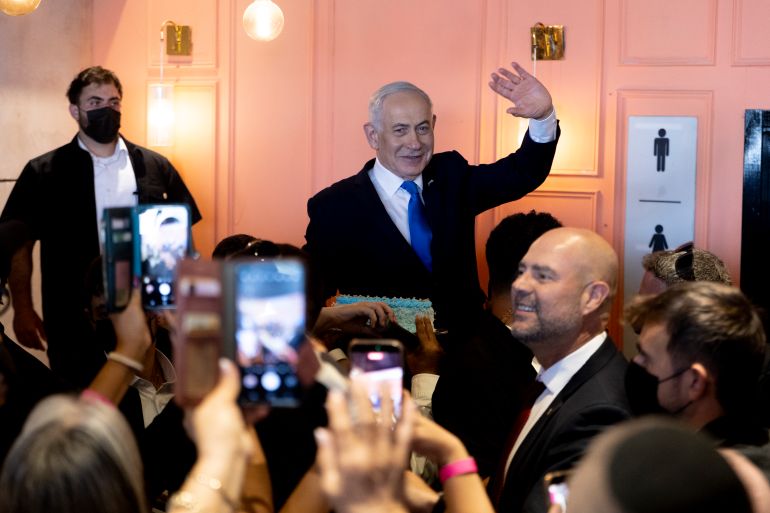

Israel goes to the polls on October 27 for elections that could end Prime Minister Benjamin Netanyahu’s long hold on power.
The vote for all 120 Knesset seats is the first since the Hamas-led attacks on October 7, 2023, the start of Israel’s genocidal war on Gaza and a broader conflict that has seen Israel carry out attacks in several countries in the region.
Recommended Stories
list of 3 itemsend of list
Opinion polls suggest his right-wing bloc is in a tight race against a Jewish-led opposition alliance. But defeating Netanyahu at the polls does not necessarily mean removing him from power.
Israel’s proportional representation system means that parties must negotiate alliances to achieve a governing majority in the Knesset. No party has ever obtained an absolute majority of at least 61 seats.
According to a recent poll, the opposition bloc is expected to win 52 seats, compared to 50 for Netanyahu’s religious and nationalist alliance. Palestinian-led parties could therefore determine who governs.
Here are eight possible outcomes:
Netanyahu forms another government
Despite trailing slightly in opinion polls, Netanyahu could remain prime minister if his Likud party garners enough parliamentary support from its existing allies or new coalition partners.
Its traditional partners include the Jewish Power party of far-right National Security Minister Itamar Ben-Gvir and the Religious Zionism party of Finance Minister Bezalel Smotrich.
The ultra-Orthodox parties Shas and United Torah Judaism – which have already joined his coalition several times but also withdrew, most recently in 2025 – could also play an important role.
A majority government led by the opposition
In late September, four opposition parties signed a non-aggression pact, agreeing to work together to try to unseat Netanyahu.
The rival movements – the Yashar Party, the Democrats, the Yisrael Beytenu Party and the Ensemble alliance – said they were united in their goal of “preserving and strengthening Israel as a Jewish and democratic state.”
The bloc has not announced who would lead a future governing coalition, but former army chief Gadi Eisenkot, head of the Yashar party, is seen as its most likely candidate for prime minister.
Former Prime Minister Naftali Bennett, who leads the Together alliance with Yair Lapid, is another potential candidate.
A coalition involving Ra’am
The Joint List and Ra’am – the two Arab parties representing Israel’s Palestinian citizens, who make up around 20 percent of the population – are expected to win around 13 seats.
Raam, also known as the Joint List, made history in 2021 by joining Bennett’s coalition, becoming the first Arab-led party to participate in an Israeli government coalition.
Mansour Abbas, leader of Raam, indicated he was ready to repeat this arrangement if the opposition-led alliance needed additional seats.
He said his priorities included tackling the wave of violent crime that has overwhelmed Palestinian communities, as well as combating discriminatory government policies, including on housing.
However, most opposition leaders, including Eisenkot, have ruled out such an alliance.
A minority government
If a coalition fails to secure 61 seats, it could seek parliamentary support from other parties without including them in the government, such as Palestinian-led parties.
The Joint List, which includes the Hadash, Taal and Balad factions, said it could provide a so-called safety net for the anti-Netanyahu coalition by agreeing not to oppose it in a vote of confidence, even if the alliance does not join the government. In return, he said he would demand certain conditions, including access to a Palestinian state and the fight against organized crime.
However, such an arrangement would leave the governing coalition vulnerable to defections and conflicts over key policies.
A government of national unity
A national unity government, according to the Israeli parliament, is a “government based on a broad coalition, whose members also include representatives of rival parliamentary groups.”
This is usually formed during times of national emergency, such as war, natural disaster or economic crisis.
In May 2020, Netanyahu and Benny Gantz formed a unity government after three inconclusive elections. That deal collapsed within a year.
However, in 2023, following Hamas-led attacks on Israel, Gantz and members of his party joined Netanyahu’s coalition – seen as an emergency unity government – despite Gantz’s staunch opposition.

A rotating prime ministerial position
Two political leaders could agree to alternate as prime minister under a power-sharing deal.
Netanyahu and Gantz agreed to such a rotation in 2020, but their coalition collapsed before Gantz could take over.
Bennett and Lapid made the same arrangements for the prime minister’s office to change hands after the former came to power in June 2021. After Bennett’s coalition lost its parliamentary majority in June 2022, Lapid took over as interim prime minister in July of the same year.
A different Prime Minister from the same political camp
In Israel, the prime minister is elected by members of the Knesset after an election.
If negotiations over forming a government fail, the parties could agree to support another Knesset member from Netanyahu’s political camp or that of an opposition bloc, someone who would be more acceptable to future partners.
No deal – another election
If no leader can muster sufficient support in the Knesset, Israel could face a new period of political turmoil and head toward new elections.
The country held five elections between 2019 and 2022 as rival blocs repeatedly struggled to form stable governments.
In such a scenario, Netanyahu would remain acting prime minister until a new administration takes office.
Gn headline