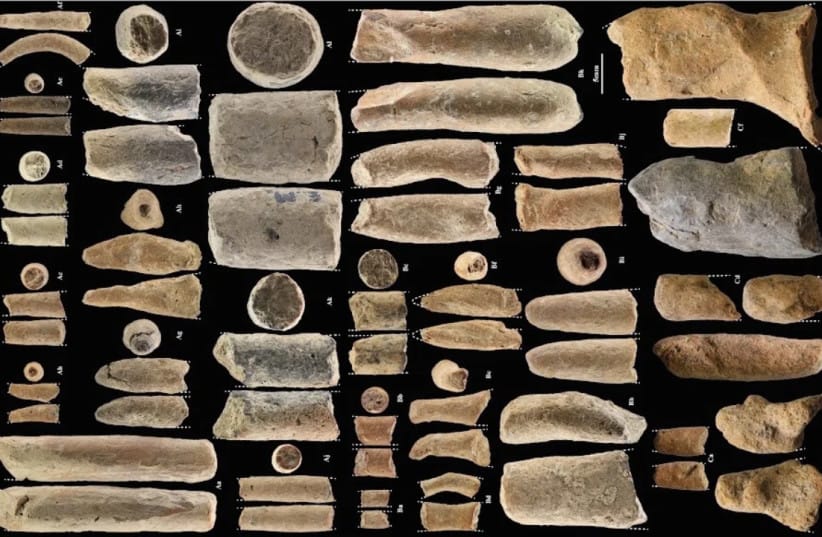
Natufian clay figurines discovered at archaeological sites across Israel have pushed back the timeline of the clay figurine-making tradition in Southwest Asia by 3,000 years, according to a new study.
Published by researchers at the Hebrew University of Jerusalem, the study analyzed 154 clay Natufian figurines discovered at Eynan-Mallaha in the Upper Jordan Valley, the Hayonim Terrace in the Galilee, and the el-Wad Terrace on Mount Carmel.
Fifteen of the figurines are recognizable, while the other 139 are cylindrical fragments that would have once been part of figures.
The Natufians, who lived in the Levant approximately 15,000 to 11,650 years ago, were the first people in Southwest Asia to establish permanent or semi-permanent settlements.
As part of the study, researchers carefully re-examined previously overlooked clay fragments found at the sites. Through careful analysis, they identified fingerprints, tool marks and traces of pigment revealing deliberate artistic work.

“These findings change the way we understand the beginnings of artistic expression in this region,” said Dr Laurent Davin, who led the study alongside Professor Leore Grosman and Professor Anna Belfer-Cohen of the Hebrew University of Jerusalem. “Thousands of years before the emergence of agriculture, people were already using clay to create figures, as part of their beliefs and knowledge of the natural world.”
Fingerprints of young people
Perhaps the study’s most notable finding concerns who made the figurines.
Using microscopic analysis to study fingerprints preserved in clay, researchers found that both adults and children helped shape and decorate the objects.
Some of the fingerprints found on the clay belonged to children probably younger than 10 years old, providing a rare insight into childhood and learning in prehistoric societies.
On a human-shaped figurine, the researchers identified two superimposed fingerprints: one left by a young adult or an adult woman, the other by a child who had not yet reached puberty.
According to researchers, children’s markings are not the result of chance.
Rather, the fingerprints suggest that children were likely invited to help shape and even color the figurines, which could have been a way of passing on skills and cultural knowledge between generations.
“What is particularly fascinating is the evidence that children were involved in the making of these objects,” Davin said, “suggesting that creativity and cultural knowledge were shared across generations.”

Animals, beginnings of the tale
Of the 15 identifiable figurines, the majority (11) represent birds. The rest include a mammal, a gazelle and two human forms.
Some birds are depicted in simple forms, while others have carefully marked wings, tails and feathers. Several appear to be waterfowl and others may be birds of prey.
Some birds are also depicted with their heads tilted downward and turned to the left, a posture that researchers believe may represent the ducks’ courtship displays during the breeding season.
If so, it is possible that the figurines served more than just decoration and may have been used to convey knowledge about animal behavior and seasonal changes, and may have played a role in storytelling and tradition.
Researchers also found traces of red coloring on several figurines, including traces of engobe, a technique which consists of applying a thin layer of colored clay. One figurine, dated 15,000 years ago, provides what the study identifies as the earliest known evidence of this coloring technique.
The study was led by Dr. Laurent Davin, Professor Leore Grosman and Professor Anna Belfer-Cohen of the Hebrew University, in collaboration with Professor Mina Weinstein-Evron, Professor Reuven Yeshurun, Professor Daniel Kaufman of the University of Haifa, Dr. Marion Sindel and Dr. Hamoudi Khalaily of the Israel Antiquities Authority and the French Research Center in Jerusalem, and Dr. François R. Valla of the CNRS and the French Research Center in Jerusalem. Jerusalem.
Gn Health