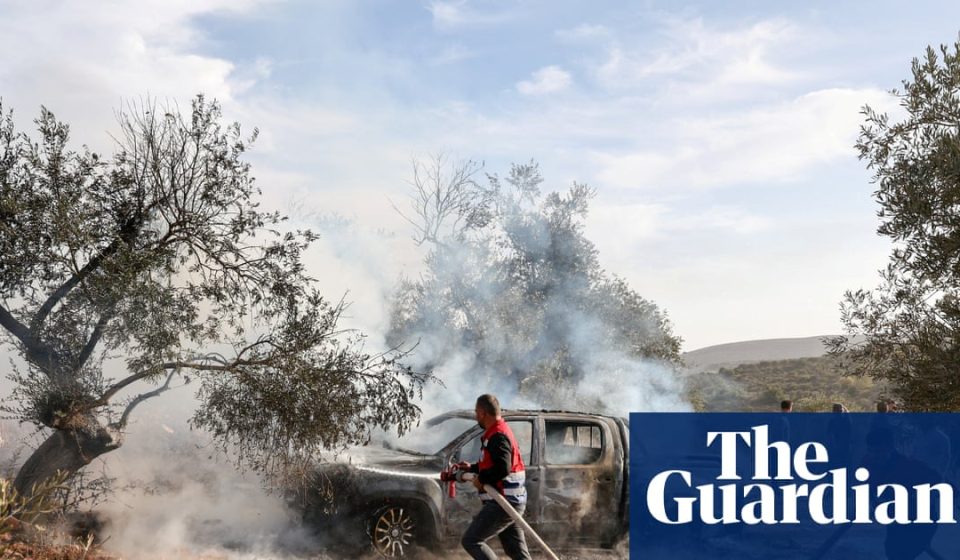

Israeli settlers attacked Palestinians across the occupied West Bank as part of a coordinated movement to disrupt the annual olive harvest, burning cars and trees and injuring Palestinians and a Washington Post photographer.
Masked settlers wielding clubs and other weapons attacked people trying to harvest their olives in West Bank towns on Friday. At least six people were injured in the town of Abu Falah, near Ramallah, the Palestinian Red Crescent said.
At least 80 settlers, some carrying guns or clubs, gathered to prevent Palestinians from harvesting their olives in Abu Falah, using slingshots to throw stones at farmers in view of Israeli military vehicles. As some Palestinians collected stones to defend themselves, the Israeli army fired tear gas in their direction.
The Israel Foreign Press Association said in a statement: “This is the latest in a long series of violent attacks by Israeli settlers against journalists and other civilians in the occupied West Bank. Yet our repeated calls for action to combat this lawlessness have been ignored by Israeli authorities.”
Among the injured was Washington Post photographer Heidi Levine, who was beaten by settlers in an attack that lasted more than 10 minutes, according to witnesses. The settlers stole his passport, phone, wallet and equipment.
“I was attacked, pushed to the ground. Luckily I had my bulletproof vest and my helmet on, otherwise I probably wouldn’t even be here, because they kept kicking and kicking me,” Levine said from a hospital bed in Ramallah. She said the attack ended when her Palestinian colleagues intervened to save her.
In a statement, the Washington Post said Levine wore visible markings clearly identifying him as a journalist.
There has been a surge in settler violence against Palestinians over the past month. Settlers have carried out at least 170 attacks since September 27, the start of the annual olive harvest, according to Yesh Din, an Israeli rights group.
Every year, settlers attack Palestinians trying to harvest their olives, but this year’s harvest saw a surge in violence in the run-up to Israeli elections in late October.
At least four Palestinians have been killed and more than 100 injured over the past month, Palestinian authorities said. Thousands of trees were damaged.
Israel imposed new rules on the olive harvest this year, banning Palestinians from harvesting their trees located in Area C – an area under the control of the Israeli military, which includes most of the agricultural land in the West Bank.
The new orders prohibit Palestinians from accessing approximately 8,800 hectares (21,800 acres) of agricultural land – a 30% increase from the previous year – without approval from the Israeli military. On the other hand, the army this year gave Israeli citizens access to more land.
Rights group Peace Now says the military has reduced the amount of land forbidden to Israeli citizens from entering from about 1,070 hectares in 2025 to 680 hectares in 2026, in an effort to prevent settler violence.
The olive harvest is an economic lifeline for Palestinians and has grown in importance since Israel revoked the work permits of many Palestinians in the West Bank following the Hamas-led attack on October 7, 2023.
Photos and videos showed large areas of farmland with uprooted olive trees in Kufur Malek, outside Ramallah, where Israeli bulldozers had razed trees.
Settlers are rarely held accountable for their violence, even when it is well documented. Rights groups say settlers benefit from protection from the Israeli army, which only intervenes if Palestinians try to defend themselves.
Israeli Prime Minister Benjamin Netanyahu has at times condemned the violence, which he says is attributable to around 100 settlers, but he has taken few steps to stop the settler violence.
Settlements quickly expanded across the West Bank under his right-wing government, leading to international condemnation. The UN and most countries believe the settlements violate international law.
Friday’s attack in Abu Falah followed a similar attack hours earlier near the West Bank village of Turmus Ayya, where settlers set fire to three cars after attacking Palestinians harvesting olives.
Videos shared by Israeli rights group B’tselem showed hundreds of bags of olives “violently” stolen by Israeli settlers from Palestinians and taken to Israeli olive presses.
Sarit Michaeli, an independent activist, said settlers were stealing Palestinians’ olive crops on a scale “never seen before in my 22 years of working on this issue.”
A spokesperson for the US Embassy in Jerusalem said he was aware of reports of the attack and declined to comment further due to privacy laws.
Gn world