
It is “probably implausible” that a strong economy could stabilize US debt when 5-6% growth is needed.

Congressional Budget Office Director Phillip Swagel said faster economic growth would likely fail to contain U.S. debt, even if GDP grew at more than double its current rate.
Gross debt now stands at $40 trillion and public debt represents 100% of GDP. Simply keeping this ratio stable, let alone reducing it, would require a massive and sustained boom. For now, the CBO projects that the debt-to-GDP ratio will climb to 120% by 2036.
At a Fed conference in Minneapolis on Thursday, Swagel said stronger economic growth would help generate more revenue for the federal government, but it wasn’t that simple.
Federal spending also spurs growth, which leads to higher wages, which in turn affects spending on Social Security benefits, he pointed out. A robust economy also tends to raise interest rates, which increases the interest costs of debt.
“So growth will help, but it’s probably not plausible that growth alone will stabilize our fiscal trajectory,” Swagel added. “So we end up with changes in revenue and changes in spending, and those are inherently political choices.”
Minneapolis Fed President Neel Kashkari asked whether AI could help boost economic growth, and he responded that the CBO had detected an increase in total factor productivity, which measures the efficiency of labor, capital and other inputs.
The CBO’s next set of economic forecasts, expected early next year, will incorporate its views on AI, Swagel said, adding that future growth will be stronger. Yet the budget deficit is so deep that even additional AI-fueled growth won’t be enough, he warned.
Kashkari then asked how much faster growth would be needed to stabilize the debt. Swagel cautioned against making calculations on the fly, but offered some back-of-the-envelope numbers.
Assuming interest rates of 4-5%, he estimated that nominal GDP growth should reach 7-8% and real GDP growth should reach 5-6%.
This is more than double the latest real GDP pace of 2.2% in the second quarter. Meanwhile, even Wall Street’s optimistic forecasts call for GDP growth of 2.5% for the full year.
The CBO chief’s rough numbers also far exceed what Treasury Secretary Scott Bessent said would be needed to overcome the debt.
“With 3 percent growth, we can get out of this situation,” he said last month at Southern Methodist University. “We will get to the other side of this Iran conflict, and the underlying economy is very, very strong, and I think it’s accelerating.”
Meanwhile, other estimates fall somewhere in between. According to the Penn Wharton budget model, growth would need to average 3.5 to 4 percent over a decade to maintain the debt-to-GDP ratio.
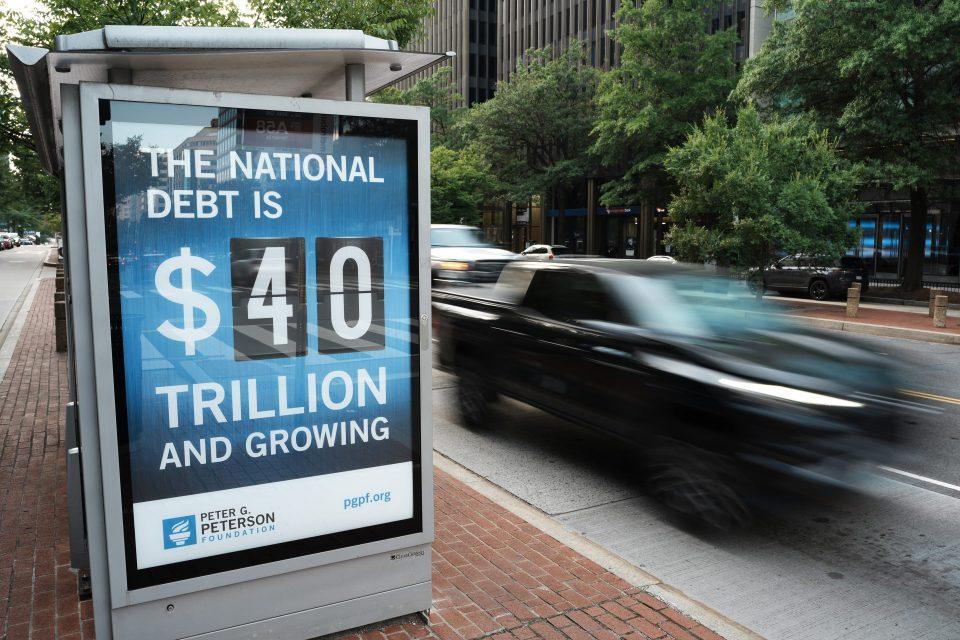
Jemal Countess/Getty Images for the Peter G. Peterson Foundation
Swagel also noted that an economic shock that caused interest rates to suddenly rise would trigger a vicious fiscal cycle.
“So there’s almost like a turbocharger,” he explained. “An interest rate shock fuels the deficit, fuels the debt and feeds through to interest rates. »
So far, the bond market is absorbing all the debt issued by the US Treasury to finance the budget deficit, but long-term yields have reached their highest levels in 24 years.
This is due in part to a strong economy, expectations of Fed rate hikes, high oil prices keeping inflation high, and a flood of AI hyperscaler debt competing for bond market demand.
But the enormous size of the US debt is also a factor. Swagel said the debt ratio is low right now, with a 1 percentage point increase in the debt ratio leading to a 0.015 percentage point increase in long-term interest rates.
“So it’s modest, but the fiscal trajectory is really very difficult,” he added. “It adds up, and of course there’s that turbocharger-type effect that I mentioned, where it trickles down to the deficits.”
Gn bussni